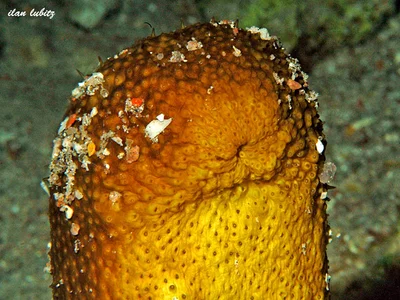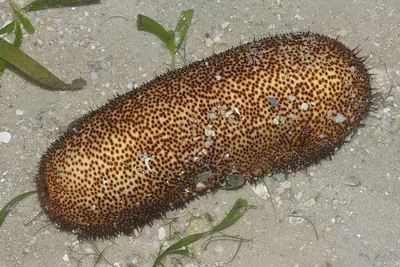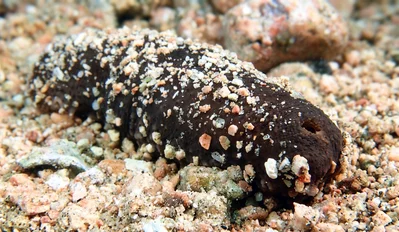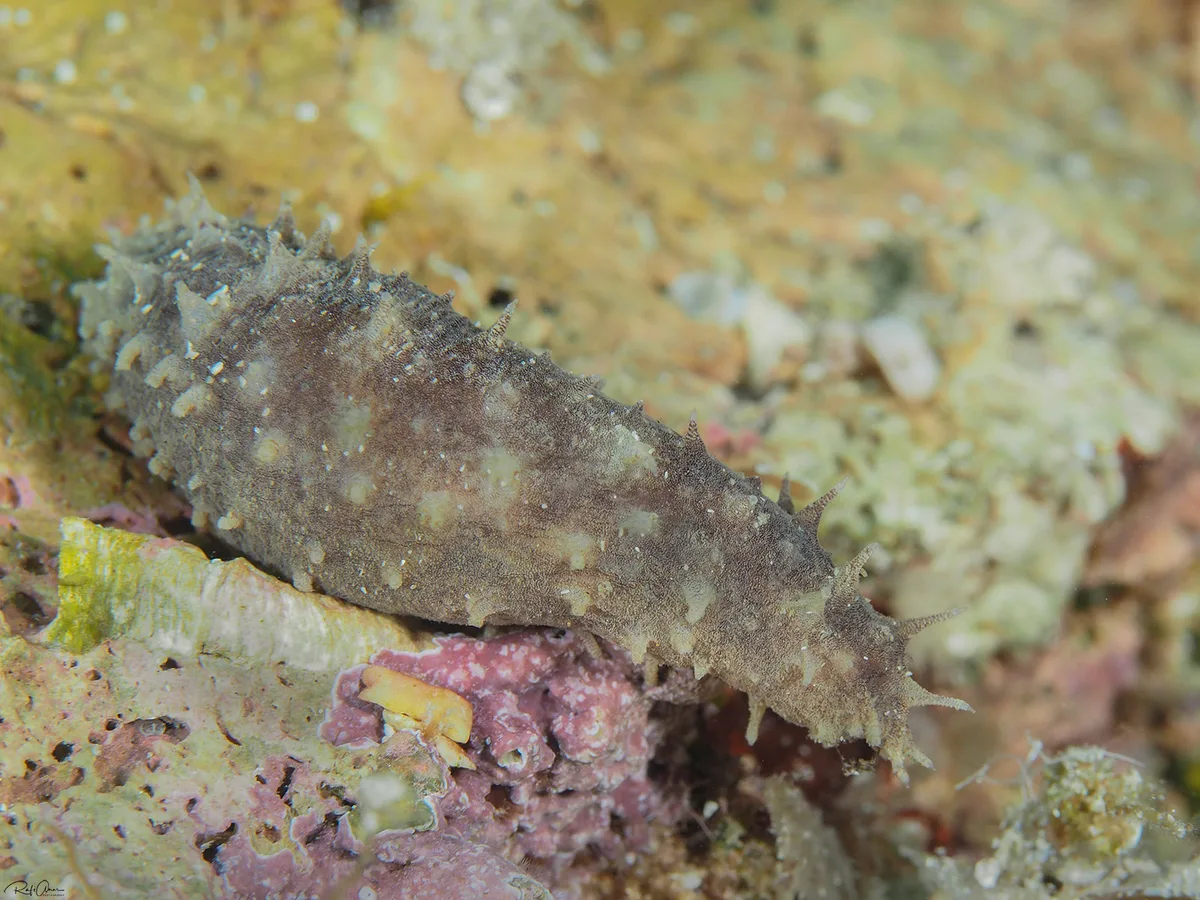
A rough-skinned sea cucumber to about 30 cm (12 in), mottled brown and cream, with an outline no other local species shares: the front narrows into a distinct neck behind the feeding tentacles, giving a bottle-shaped profile. The skin is warty and gritty to the touch, thanks to a dense layer of calcareous ossicles just beneath the surface.
It lives pressed into crevices and beneath rocks on rubble bottoms from the shallows down to about 25 m (80 ft), and is far more often seen as a head and neck protruding from a hole than as a whole animal. Feeding happens after dark, when the tentacles work the sediment around the entrance while the body stays anchored inside. Forsskål described it in 1775 from material collected on this coast, and the epithet - impatient - refers to how quickly it withdraws when touched. It is genuinely common on broken ground, but easily overlooked precisely because the part on show is small and the rest is out of sight.
- narrow neck behind the head, bottle-shaped outline
- rough warty skin, mottled brown and cream
- body usually hidden with only the head out
- length up to 30 cm
Why it's threatened
Threat classification from the IUCN Red List.