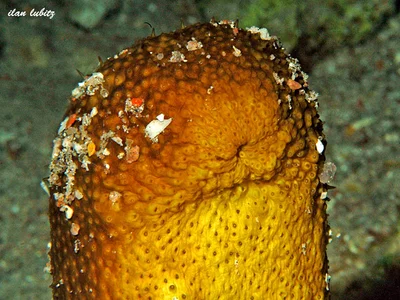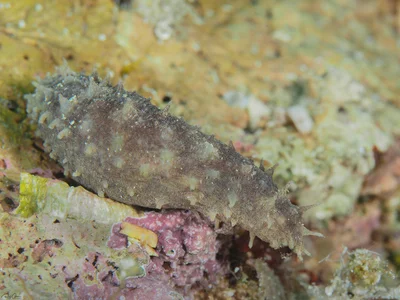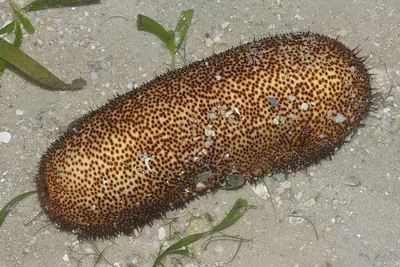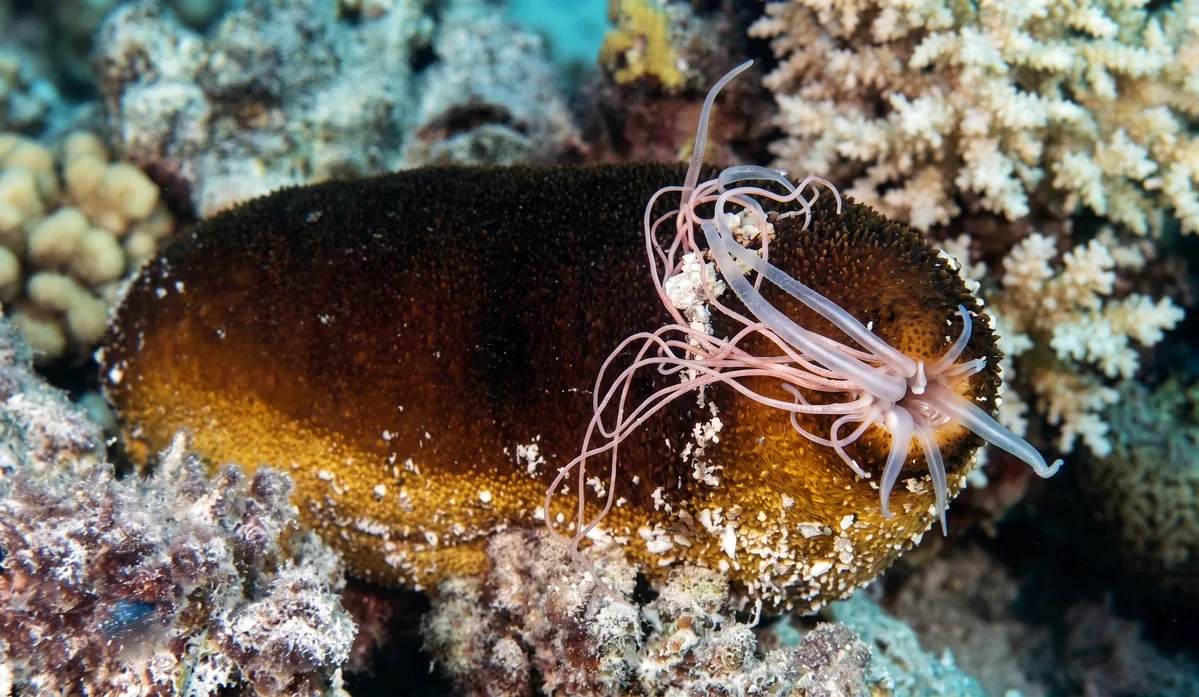
A soft, smooth-walled sea cucumber to roughly 24 cm (9 in), typically yellowish with a browner back, though the color varies enough that identification from a photograph alone is often tentative. There are no anal teeth and no prominent papillae; the outline is a simple, slightly tapered cylinder, and adhering sand frequently obscures the pattern.
It occupies sand and rubble at the foot of reef, from about 2 m to 25 m (7 to 80 ft), moving slowly across open bottom and feeding on the organic film in sediment. Like the rest of its genus it defends itself with Cuvierian tubules - sticky white threads ejected through the body wall that tangle whatever provoked them. The species was described in 1963 and honours Heinz Steinitz, whose work at the Gulf of Aqaba laid much of the groundwork for marine biology in this region; a good number of the animals named in the decades that followed came from collections he built. It appears to be restricted to this sea and its immediate surrounds.
- yellowish body, darker brown along the back
- smooth soft body wall
- sticky white threads released when disturbed
- length up to 24 cm
Why it's threatened
It is not known if there are any major threats to this species.
Threat classification from the IUCN Red List.