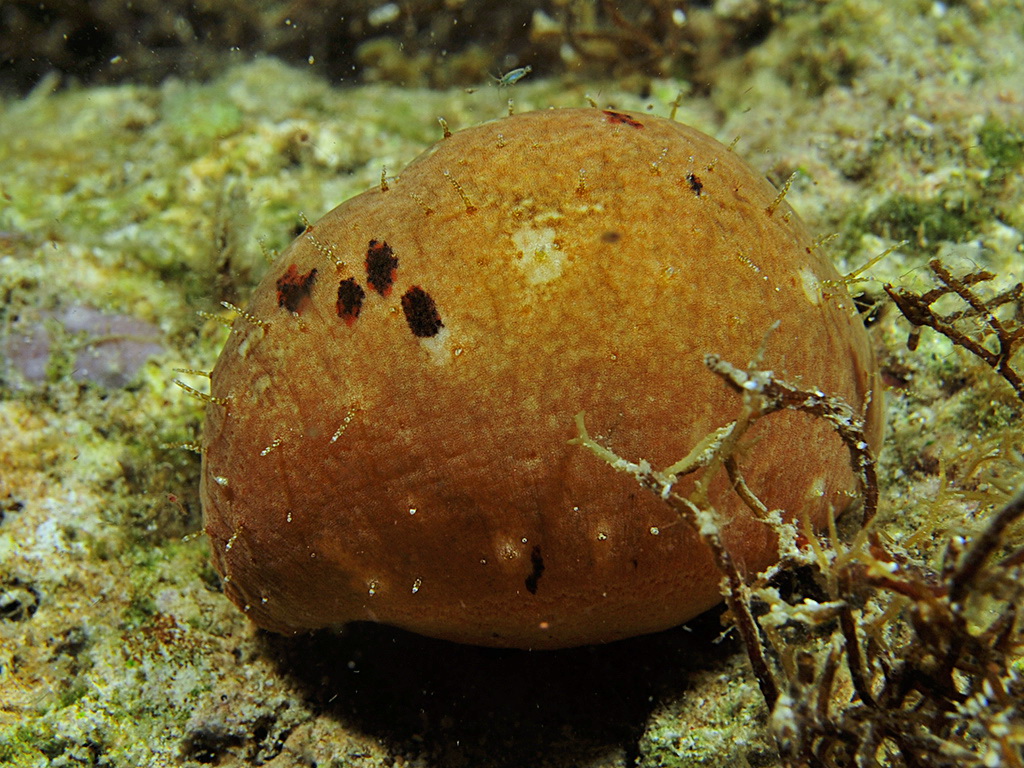
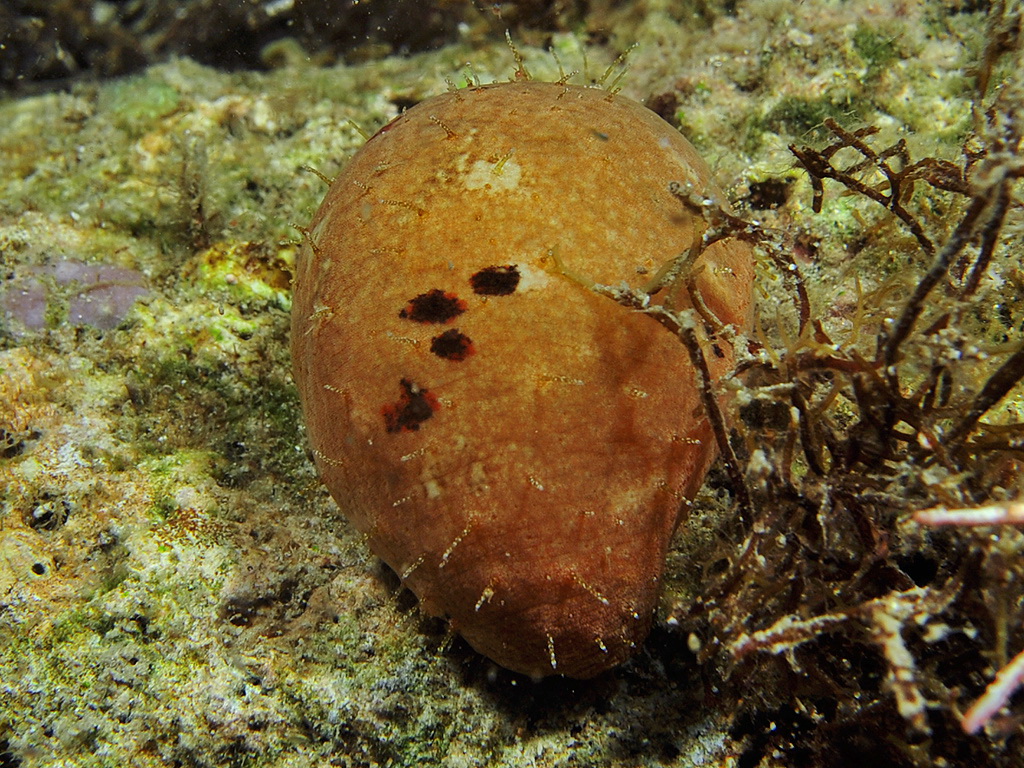
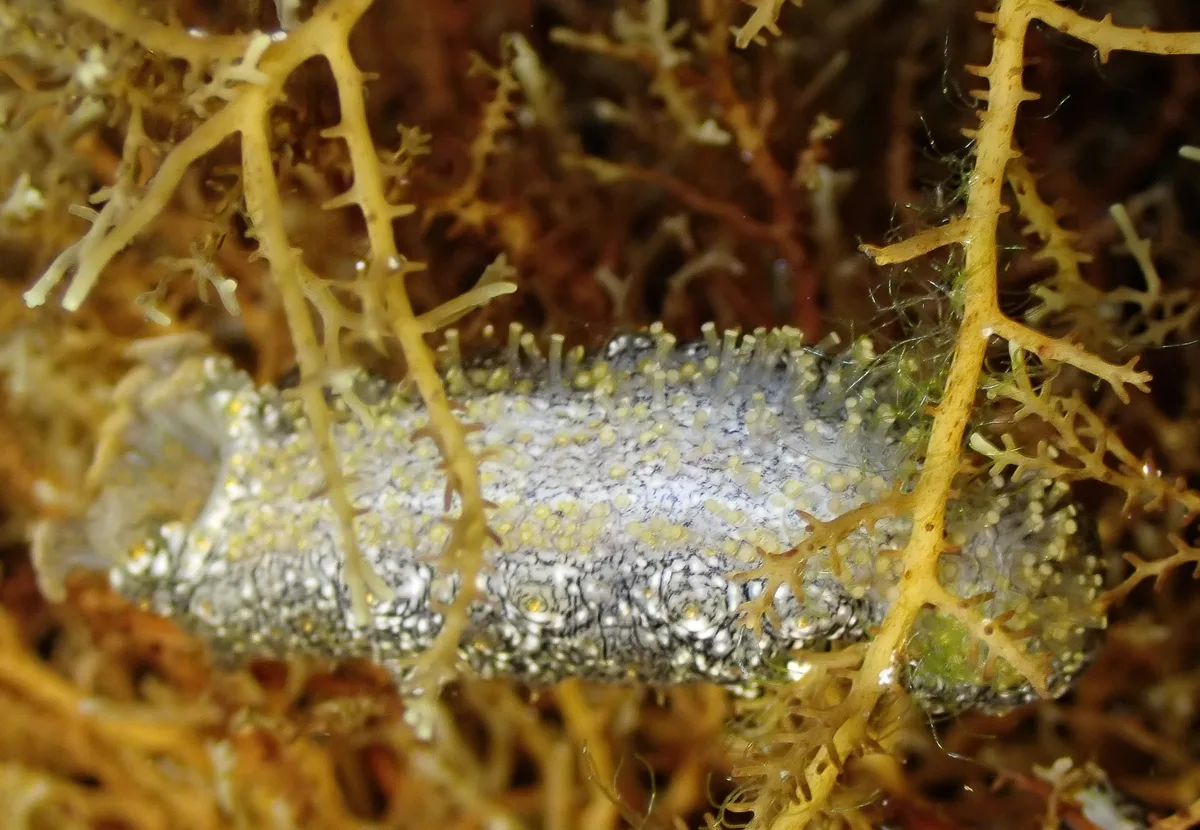
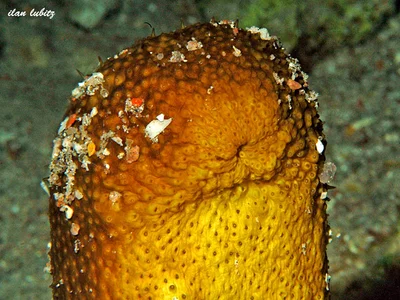
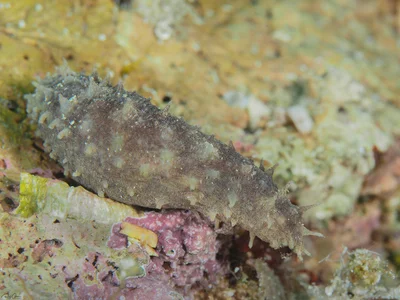
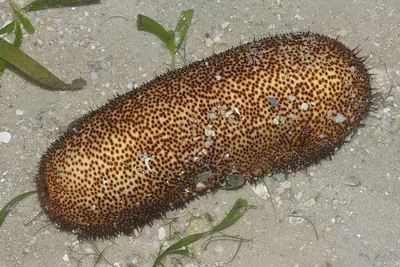
A heavy-bodied holothurian growing to roughly 35 cm (14 in), beige through rusty brown, with a thick wrinkled body wall that is nearly always dusted with adhering sand. Around twenty stubby tentacles ring the mouth, and five hard teeth guard the vent at the other end. Despite the English name it is not a deepwater animal at all - the name comes from the trade, not the habitat.
It favors sandy lagoon floors and the margins of seagrass, from wading depth down to about 30 m (100 ft), lying half-buried by day and feeding through the night. Sediment goes in at one end, is stripped of its organic film, and comes out the other as clean castings; this constant turnover aerates the top few centimetres of sand and slows the build-up of decaying matter. That same abundance made it a target: it is among the most heavily fished sea cucumbers across its range, and populations near settled coasts have thinned markedly. Divers here still meet it often enough on sheltered sand, usually as a motionless brown log that turns out, on a second look, to be steadily eating.
Commercial harvest of this species is reason for concern in some of its range. Conand (2004) identified that this species was under population stress as a result of fisheries to satisfy the international trade. Later, Bruckner (2005) categorized this species as of concern in some countries of its range. Toral-Granda et al. (2008) includes this species as a species with significance in the global sea cucumber market.
Commercially it is of medium value. This species is targeted throughout its range, and fishing pressure has dramatically increased in the past 25 to 50 years since the 1960s, and is expected to continue, even as stocks are depleted. Although not one of the most important species (medium value) for fishery purposes, it can be expected that this species may become more popular after the depletion or reduction of other species of higher commercial importance and value.
Threat classification from the IUCN Red List.
Comments
Please, sign in to leave a comment
Continue with a social account - yours will be created automatically.