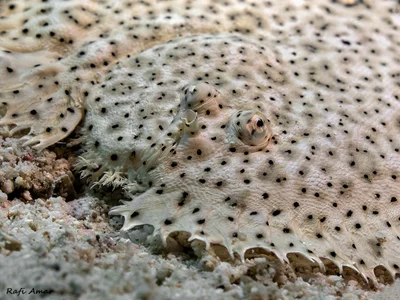
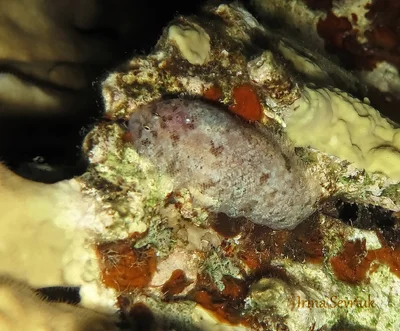
The Long-Nose Sole is a small flatfish of about 6 cm (2.4 in), the body a flattened oval with both eyes set close together on the right side of the head. A continuous fringe of dorsal and anal fins runs around the whole body, so it moves in a shallow undulating ripple rather than by beating a tail. The ground color is grayish, scattered with whitish spots and blotches that break up its outline against coarse sand and fine rubble. The name macronasus, Greek for "long nose", is not about the snout: it refers to the pair of long tubular nostrils on the eyed side, and those nostrils are the one feature that separates this species from the Steinitz Sole, which is otherwise near-identical on the sand. A photograph rarely settles it - the two were told apart on fin-ray counts and measurements.
It lives on open sand and silt directly against coral reef, on reef flats and lagoon bottoms, recorded between 1 and 20 m (3-66 ft) and known only from the 🌊 Red Sea. It lies motionless, partly buried or under a fine dusting of sediment, and a stationary fish is almost never picked out from the substrate; what gives it away is the short dart of a disturbed one across the open sand. It feeds on small benthic invertebrates taken from the surface layer. The species was described only in 2013, from material collected at Dahab.
The genus. Aseraggodes Kaup 1858 - a- (without) + seraggodes (possibly a misspelling of serangodes). ETYFish
The species. Aseraggodes macronasus Randall & Bogorodsky 2013 - macro- (long) + nasus (nose). ETYFish
- gray with scattered whitish spots
- both eyes on the right side
- unbroken fin fringe around the whole body
- long, tubular nostrils on the eyed side
Why it's threatened
Threats to this species are unknown.
Threat classification from the IUCN Red List.