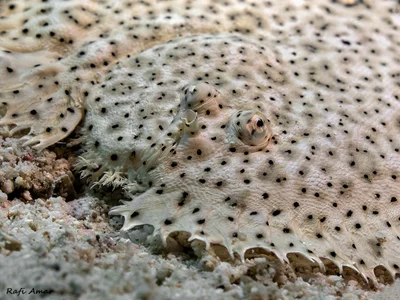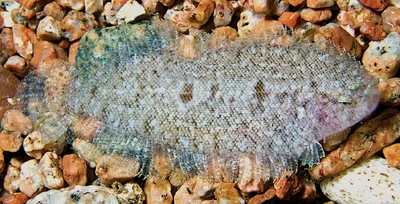
The Steinitz Sole is a flattened, oval fish of about 4 cm (1.6 in), gray-brown above with pale irregular spotting that breaks up its outline against sand. Both eyes sit on the right side of the head, and a continuous fin runs unbroken around the whole body, so the fish moves in a shallow ripple rather than by beating a tail. Separating it from the Long-Nose Sole, the other small Aseraggodes on the same sand, comes down to the nostrils: short here, drawn out into obvious tubes in that species. A photograph is usually not enough - the two were told apart on fin-ray counts and measurements, and divers who photograph one routinely need a specialist to settle which of the two they saw. The epithet steinitzi commemorates Heinz Steinitz, the Israeli marine biologist whose surveys shaped much of what is known of the region's fish fauna.
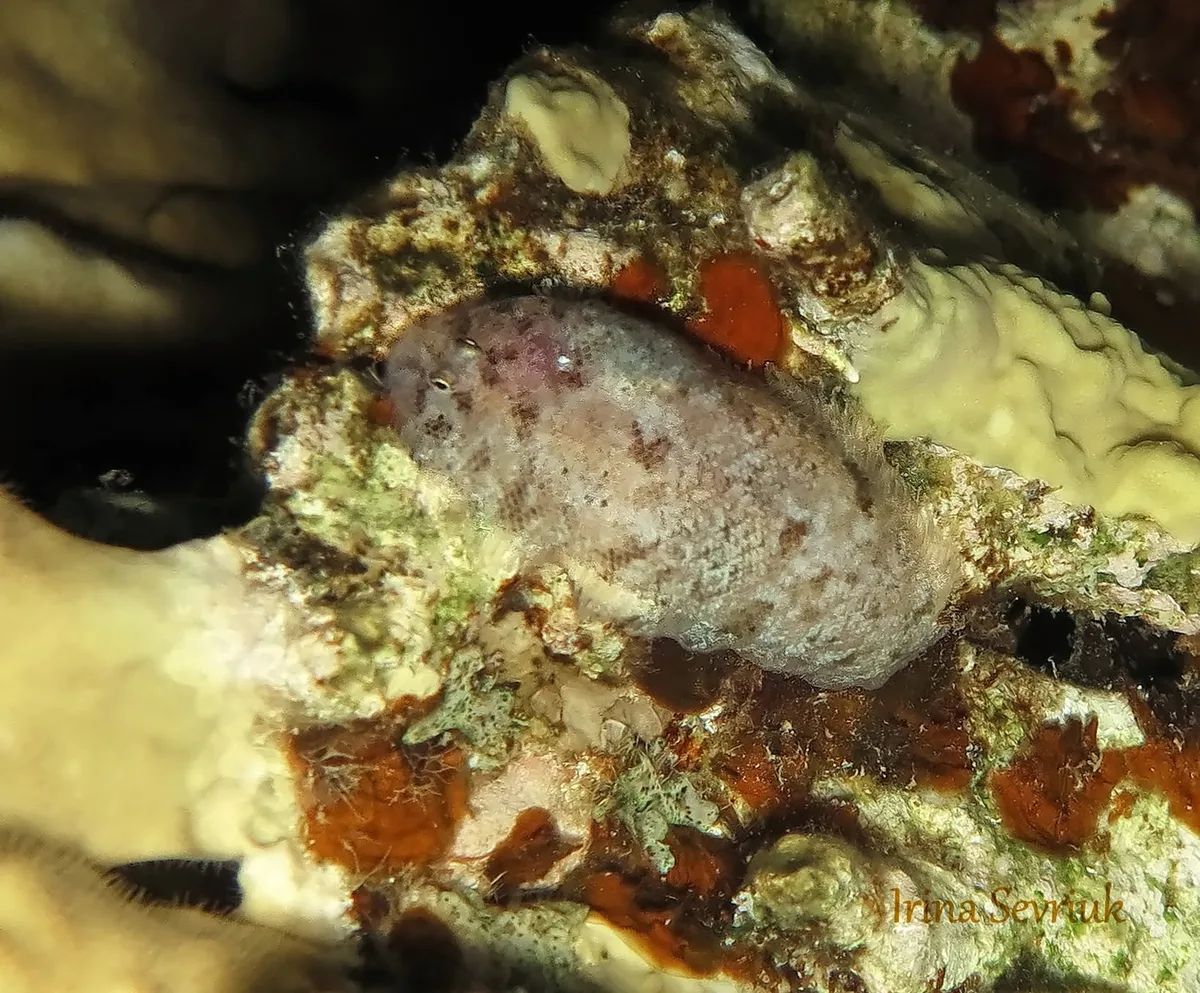
It lives on sand and silt at the foot of coral and rocky reefs, recorded between 10 and 25 m (33-82 ft), and is known only from the 🌊 Red Sea. It rests partly buried, a dusting of sediment over the body and little more than the eyes clear of the surface, which is why a stationary one is almost never spotted. Disturbed, it lifts off, darts a short distance and settles again within a meter or two - that movement is the usual way it is noticed at all. It feeds on tiny crustaceans and worms picked from the top layer of the sand.
The genus. Aseraggodes Kaup 1858 - a- (without) + seraggodes (possibly a misspelling of serangodes). ETYFish
The species. Aseraggodes steinitzi Joglekar 1971 - Honours Heinz Steinitz. ETYFish
- gray-brown with pale spotting
- very small, about 4 cm
- both eyes on the right side
- nostrils short, not tubular (unlike the Long-Nose Sole)
Why it's threatened
No major known threats.
Threat classification from the IUCN Red List.