World Sea Turtle Day - 150 Million Years of Survival, and Why Every Year Still Counts

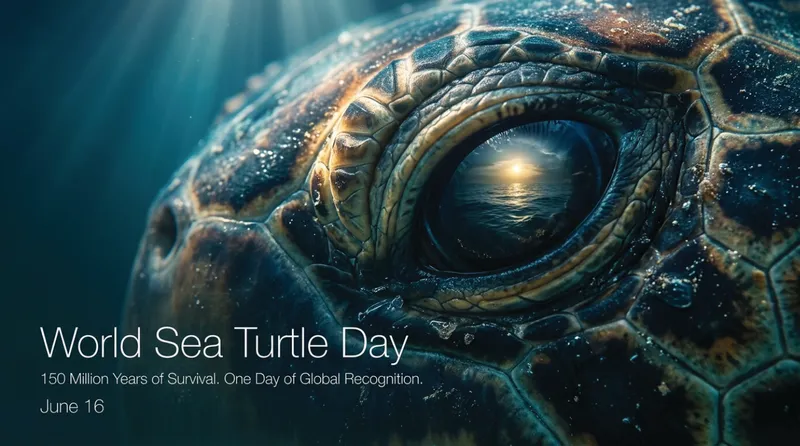
June 16th is World Sea Turtle Day - and if you stop to think about what that number actually means, it reframes everything. One hundred and fifty million years. Sea turtles were already ancient when the first flowering plants appeared on Earth. They shared the ocean with mosasaurs and plesiosaurs, survived the asteroid that ended the dinosaurs, and kept swimming through every ice age and mass extinction since. Today, on the Red Sea coast, we sometimes cross paths with these living time capsules on a single dive. That alone feels like a privilege. World Sea Turtle Day - celebrated on June 16th - asks us to honor that privilege with action.
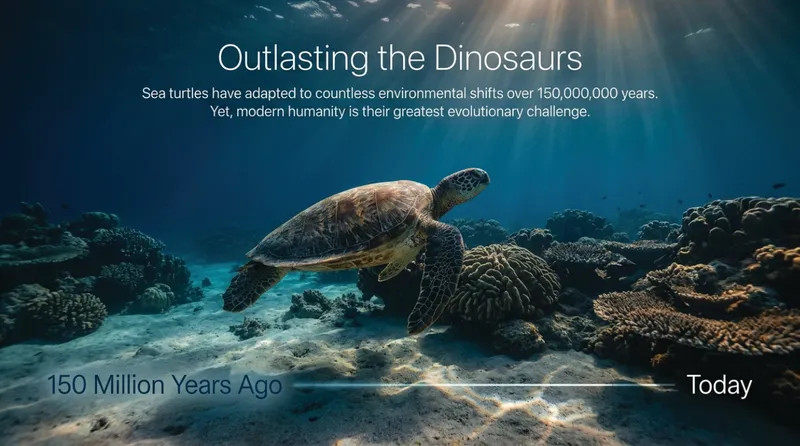
They Outlasted the Dinosaurs. But Can They Outlast Us?
Across 150 million years, sea turtles adapted to continental drift, shifting ocean chemistry, and climate swings far more dramatic than anything in recorded human history. Every environmental disruption thrown at them, they navigated and survived. That track record is one of the most extraordinary in the animal kingdom. And yet the challenge they face today is categorically different from anything in their evolutionary past - not a geological event or a volcanic winter, but the sustained, accelerating pressure of modern human civilization. Habitat loss, pollution, overharvesting, and climate disruption are converging faster than natural adaptation can respond. For the first time in 150 million years, sea turtles need outside help just to survive.
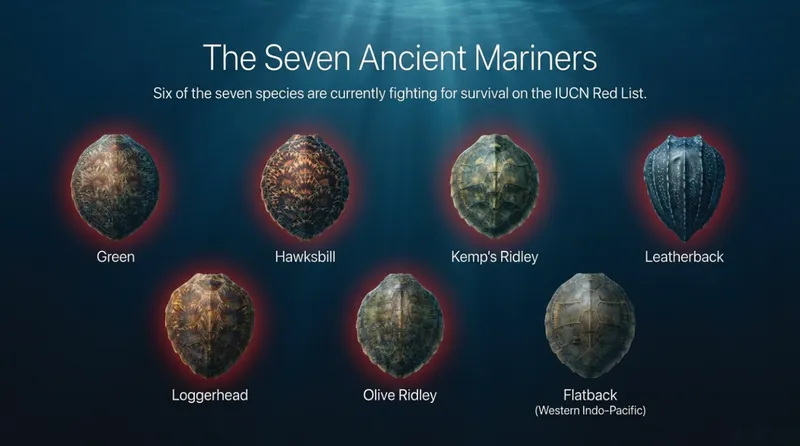
Seven Species. Six of Them Fighting for Their Lives.
There are exactly seven species of sea turtle on Earth, and six of them currently appear on the IUCN Red List of Threatened Species. The full family reads like a roll call of ocean history: the Green Turtle, grazer of seagrass beds and coral reefs; the Hawksbill, architect of reef health through its sponge-feeding habits; the critically endangered Kemp's Ridley, the rarest of all; the deep-diving giant Leatherback, the only shell-less species; the powerful Loggerhead, built for crushing hard prey; the synchronized mass-nester Olive Ridley; and the Flatback, found only in the waters of the Western Indo-Pacific. Each species fills a distinct ecological role. Losing any one of them would send ripples through marine ecosystems that science is only beginning to fully understand.
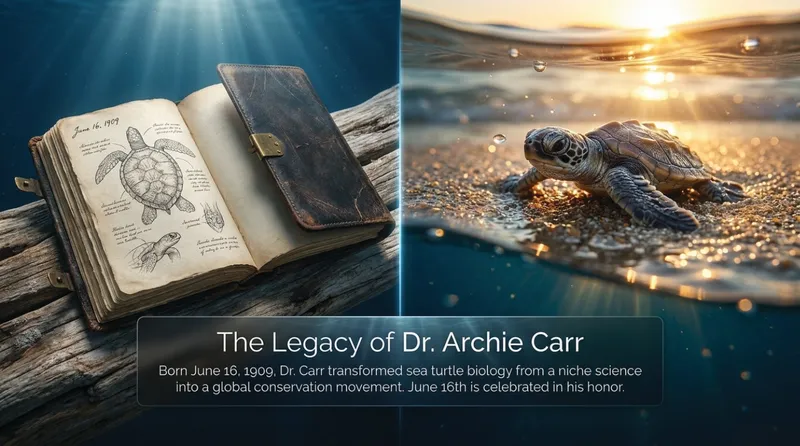
The Man Who Made Sea Turtle Science Matter: Dr. Archie Carr
World Sea Turtle Day falls on June 16th for a specific reason - it's the birthday of Dr. Archie Carr, born in 1909, who almost single-handedly transformed sea turtle biology from an obscure academic niche into the foundation of a global conservation movement. Before Carr, sea turtles were poorly understood, their migratory routes unknown, their nesting behavior largely undocumented. His decades of field research in the Caribbean, his writing, and his relentless advocacy built the scientific and public case for protecting these animals when almost no institutional support existed for doing so. The conservation tools and legal frameworks that protect sea turtles today trace a direct line back to his work. Celebrating June 16th is not just about the turtles - it's about recognizing that one person's commitment to science and advocacy can change the trajectory of an entire species.
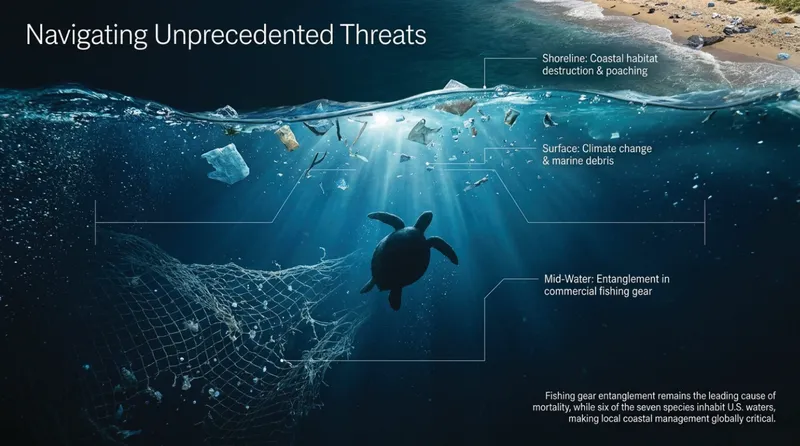
A Gauntlet from Shore to Sea Floor
To understand the scale of the threat facing sea turtles, it helps to think about their entire environment - not just one layer of it. On the shoreline, coastal development destroys nesting beaches and poaching continues to remove eggs and adults from populations that can barely replace themselves. At the surface, floating marine debris - especially plastic - is ingested at every life stage, and climate change is warming the sands that determine the sex of unborn hatchlings. In mid-water, entanglement in commercial fishing gear remains the single leading cause of sea turtle mortality worldwide - an accidental killing on a massive, industrialized scale. Six of the seven species inhabit U.S. waters alone, which illustrates just how globally distributed this problem is and why local coastal management in every country with a coastline carries genuine conservation weight.
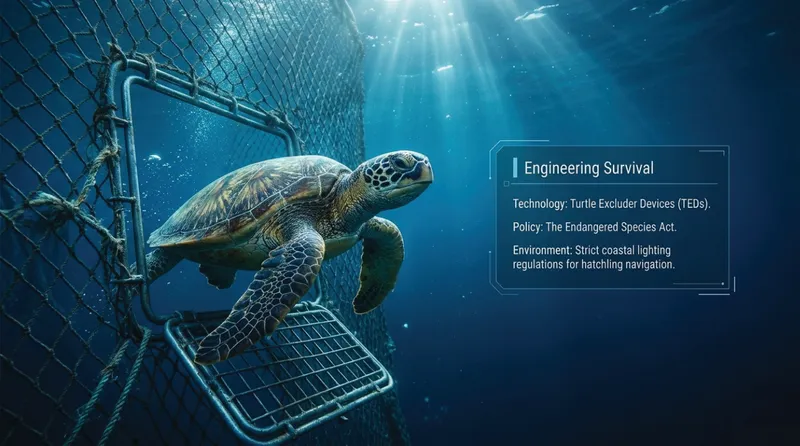
Engineering a Way Out: The Tools That Are Actually Working
Conservation science hasn't stood still. Alongside legal protections and marine protected areas, specific technologies have made a measurable difference in sea turtle survival. Turtle Excluder Devices (TEDs) - escape hatches built into fishing trawl nets - have saved countless turtles from drowning as bycatch and are now mandated in many national fisheries. Legislation like the Endangered Species Act in the United States provided the framework that made coordinated protection and recovery programs legally enforceable, not just aspirational. And coastal lighting regulations - requiring beachfront buildings to use turtle-friendly amber lighting - address a surprisingly impactful threat: hatchlings navigate toward the sea using the natural brightness of the horizon, and artificial light from development causes them to crawl inland to their deaths. These solutions work. The challenge is deploying them consistently and globally.
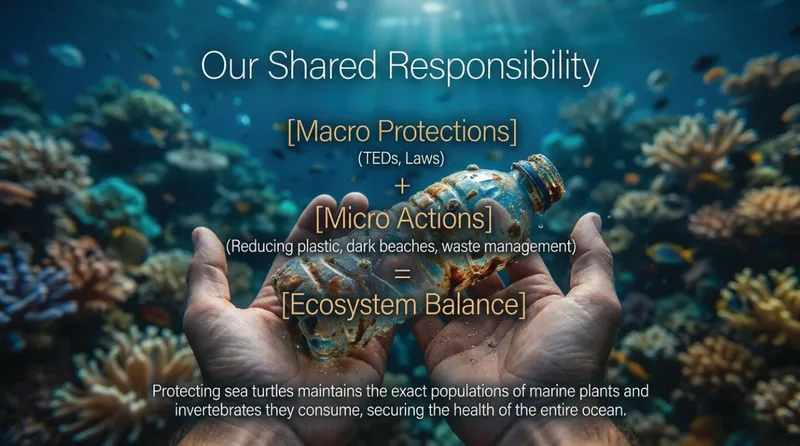
The Equation Is Simpler Than It Looks
Protecting sea turtles ultimately comes down to a two-part equation. Macro protections - international treaties, national legislation, Turtle Excluder Devices, protected nesting beaches - create the structural conditions for recovery. Micro actions - reducing single-use plastic, supporting dark-beach initiatives, responsible waste management, choosing seafood from turtle-safe fisheries - address the diffuse, everyday pressures that policy alone can't fully reach. Together, they add up to something larger than the sum of their parts: ecosystem balance. Sea turtles aren't just charismatic megafauna worth saving for sentimental reasons. They are active regulators of seagrass density, coral reef health, and the population dynamics of the marine invertebrates they feed on. Protecting them protects the ocean system that every coastal community and every marine species depends on.
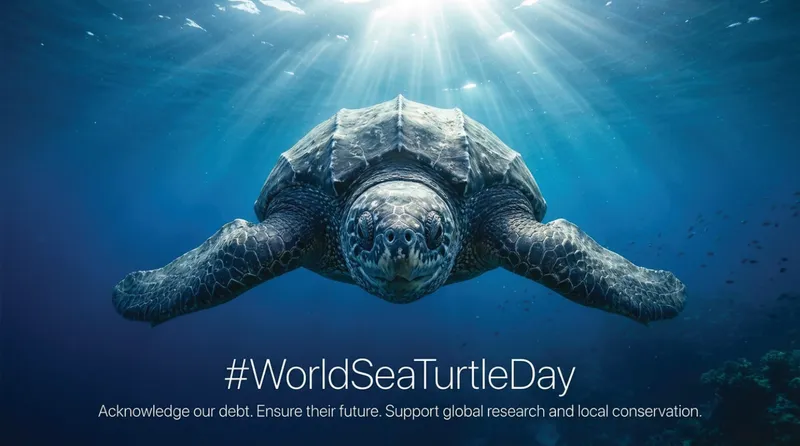
Acknowledge the Debt. Secure the Future.
One hundred and fifty million years of survival - and the species that poses the greatest threat to their continued existence has been around for a fraction of a percent of that time. That's a debt worth acknowledging. On this World Sea Turtle Day, the ask is straightforward: support global sea turtle research, back local conservation programs wherever you live and dive, and keep the conversation alive beyond a single day on the calendar. If you've ever locked eyes with a sea turtle underwater - that ancient, unhurried gaze that seems to look straight through you - you already understand what's worth protecting. The rest is just deciding to act on it.
Share your sea turtle encounters and tag us - and use #WorldSeaTurtleDay to join the global conversation. 🐢
PADI Divemaster and underwater storyteller with over 7 years of hands-on Red Sea diving experience, documenting marine life, mapping dive sites, and promoting responsible ocean conservation.