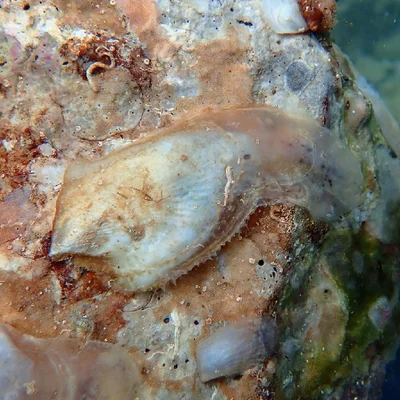
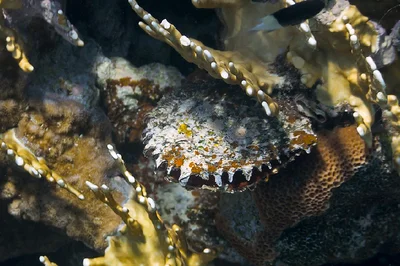
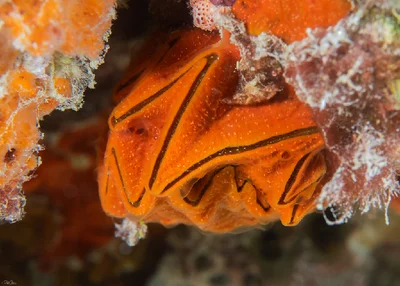
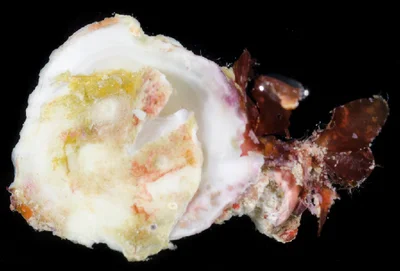
An oyster whose shell is thrown into deep, regular folds running from the hinge to the margin, like a concertina - plicatula means small fold. Where the folds reach the edge the two valves meet in a strongly toothed, wavy line, coarser and more regular than the fine crimping of most true oysters. The shell is cemented flat against its substrate, so the outline is irregular and the profile low; color is gray to purplish brown outside, white within. Width reaches about 10 cm (4 in).
It settles on coral rock, boulders and rubble on shallow reef flats and in lagoons, usually below the tide line but rarely deeper than 20 m (65 ft), and filters plankton and organic particles from the water. Encrusting growth covers most individuals, and the folded margin is often the only part of the shell that gives the animal away. Animals frequently grow in small groups, one cemented partly over another, and the resulting crust can cover a boulder face. The species was long placed in Lopha, and older shell guides still list it under that name, which is worth knowing when checking older 🌊 Red Sea species lists.
- shell folded into deep, regular concertina-like plaits
- valves meet in a strongly toothed, wavy line
- cemented flat against rock, outline irregular
Why it's threatened
Threat classification from the IUCN Red List.