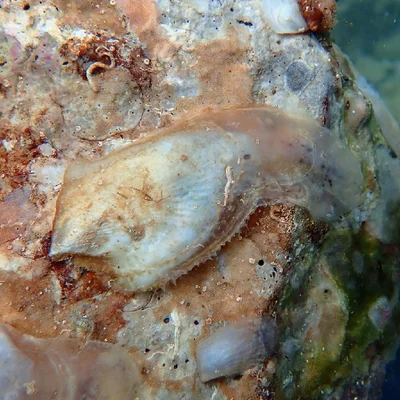
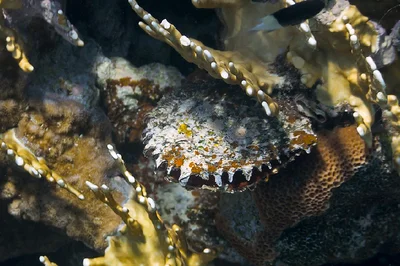
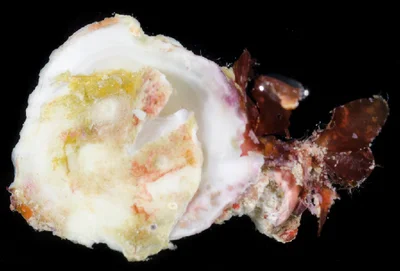
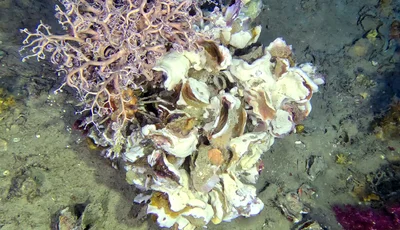
A thin-shelled oyster whose valves close along a deep zigzag of interlocking triangular teeth - the feature behind both the common name and cristagalli, Latin for cock's crest. The shell is roughly triangular and folded into a few large radial plaits, so the outline is coarsely toothed rather than smooth. Color runs from purple-brown through dull red to gray, though living animals are usually masked by encrusting sponge, algae and bryozoans, and the zigzag gape is often the only part left visible. Width reaches about 10 cm (4 in).
Individuals cement the left valve to coral rock, dead coral heads and the bases of gorgonians, favoring vertical faces and overhangs where sediment cannot settle on them. Groups of several animals often grow side by side on the same patch of rock. Like all oysters it feeds by filtering plankton and organic particles from the water, and the valves close the moment a shadow or a surge passes. It is one of the more frequently seen oysters on 🌊 Red Sea reefs, from just below the surface down to about 30 m (100 ft), and its empty valves - still recognisable by the toothed margin - turn up regularly in reef rubble.
- valves meet in a deep zigzag of interlocking teeth
- shell folded into a few large radial plaits
- purple-brown to dull red, usually overgrown