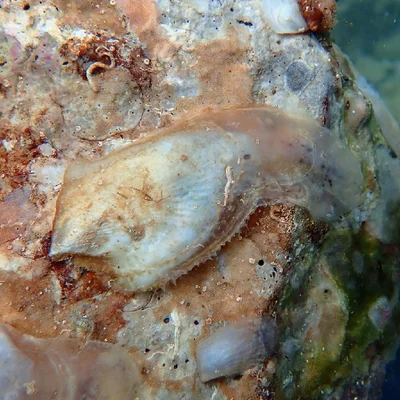
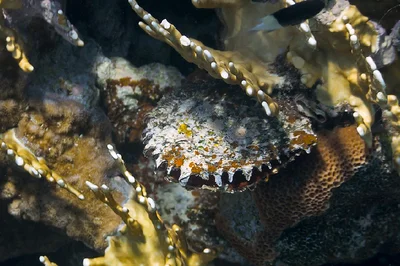
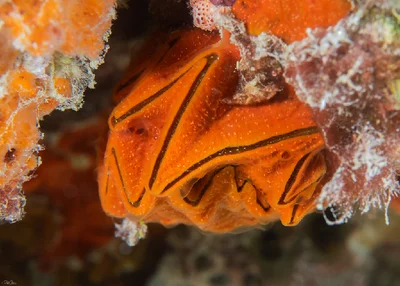
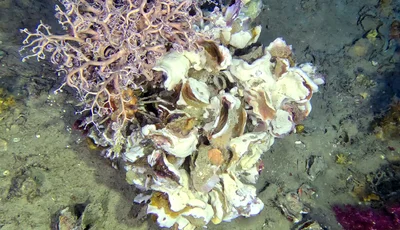
A small honeycomb oyster with a round, flat shell that gave it the name numisma, Latin for coin. Structurally it is a miniature of the giant honeycomb oyster - the same chalky, cavity-filled shell wall - but the outline is nearly circular, the profile low, and the radial ribbing much finer, with a shallowly crimped rather than deeply toothed margin. Diameter reaches about 6 cm (2.4 in). Color is off-white to pale brown, usually hidden under a film of algae or encrusting sponge.
It cements to shaded rock: the roofs and side walls of overhangs, the entrances of caves, and undercut faces on reef walls, generally between 5 and 40 m (16 and 130 ft). The preference for low light means it is often overlooked, and a torch held into an overhang finds far more of them than an unlit swim past. Feeding is by filtration, and the small, evenly gaping shell is easier to identify by its circular outline than by color or sculpture, both of which are usually obscured. Several animals commonly occupy the same shaded patch, and where the giant honeycomb oyster shares the wall the two are told apart on size and profile alone: this one stays flat and coin-sized, the other grows deep and massive.
- small, round and flat - coin-shaped outline
- chalky honeycombed shell like a miniature Hyotissa hyotis
- usually on shaded rock under overhangs