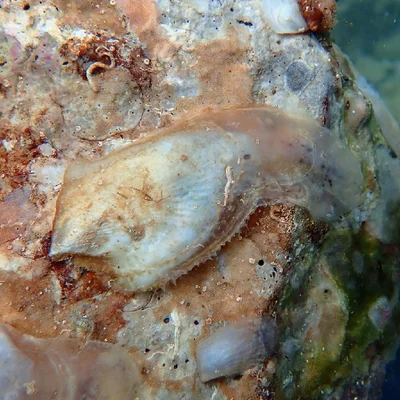
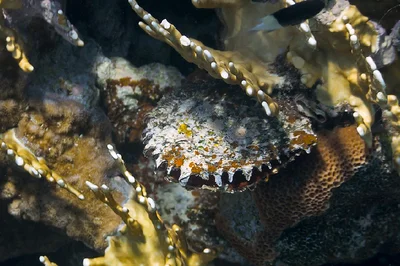
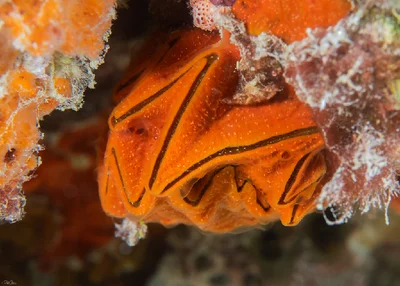
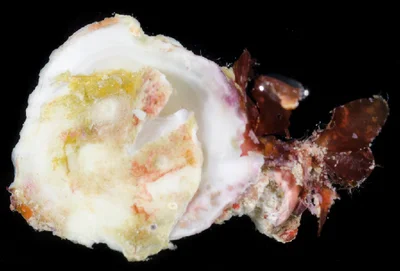
A bivalve with an outline unlike anything else on the reef: the hinge is drawn out sideways into two arms while the body grows down as a long narrow blade, so the whole shell forms a T - the shape behind both the common name and the genus Malleus, Latin for hammer. The arms are shorter and blunter than in the larger hammer oysters of the wider Indo-Pacific. Color is dull brown to gray, the interior partly nacreous near the hinge. Height reaches about 10 cm (4 in).
Animals live wedged upright in rubble, sand pockets and seagrass among the reef, with the narrow lower part buried and anchored by byssal threads and only the hammer head at sediment level, usually crusted with algae and sponge. That posture, plus the drab color, makes them easy to walk a fin past. Depth runs from about 1 to 20 m (3 to 65 ft). It feeds by filtration like the other oysters. The species was described by Peter Forsskål from 🌊 Red Sea material collected on the Danish expedition of 1761 to 1767, and published after his death in 🇾🇪 Yemen.
- T-shaped or hammer-shaped outline
- long narrow body with the hinge drawn out sideways
- shell dull brown or gray, wedged upright in rubble