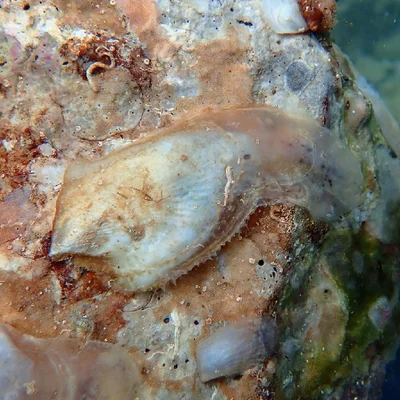
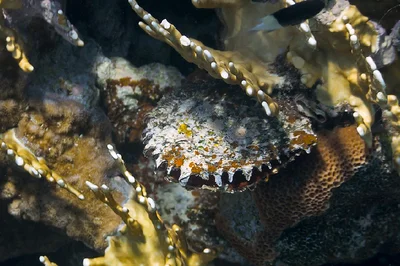
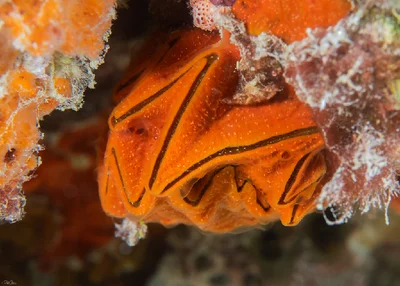
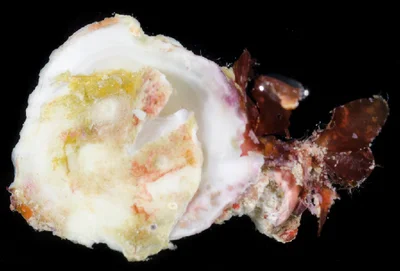
The largest oyster found on coral reefs, reaching about 30 cm (12 in) and weighing several kilograms. The shell wall is thick and chalky, and a broken edge shows the structure the name refers to: the calcite is riddled with tiny gas- and fluid-filled cavities, giving it a honeycombed, foam-like texture. Outside, coarse radial ribs end in broad rounded teeth where the valves meet, so the closed gape runs in a heavy wavy line. Live animals are almost always overgrown by sponge, coralline algae and ascidians, and the mantle edge showing in the gape is dark brown to purple-black.
Individuals cement themselves into reef walls, drop-offs and the flanks of coral heads, often set so deeply into the surrounding growth that only the gape is visible - which is how most are found. Depth runs from about 3 m down to 50 m (165 ft), with the larger animals deeper. It filters plankton and organic particles and can close with enough force to hold shut against a prying blade. Growth is slow and individuals are long-lived, so the biggest shells on a 🌊 Red Sea reef represent decades in the same spot.
- very large and heavy - the biggest oyster on the reef
- shell wall chalky and honeycombed with tiny cavities
- coarse radial ribs ending in broad rounded teeth