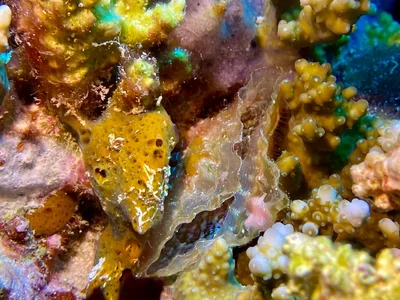
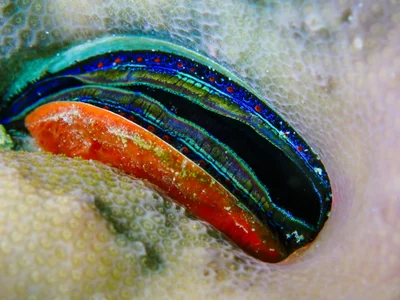
A thick-shelled bivalve cemented by its right valve into the reef and armed with rows of spines, though on live animals these are usually broken, worn or buried under sponge and coralline algae. What gives it away instead is the gape: a bright orange, red or purple mantle edge, fringed with tentacles and carrying a ring of tiny simple eyes that detect passing shadows and snap the valves shut. Width reaches about 10 cm (4 in). The valves interlock on a ball-and-socket hinge, so a closed animal cannot be twisted open.
Despite the English name these are not true oysters at all but relatives of the scallops, which the hinge and the eyed mantle both show. Individuals cement into reef walls, coral heads and undercuts between about 3 and 40 m (10 and 130 ft), set so deeply into the surrounding growth that the animal is normally invisible until it closes. Feeding is by filtration. Juveniles start out byssally attached and only cement down once they settle for good, and the spines they grow afterwards act as scaffolding for the sponge and algae that end up hiding them. The species is also listed as Spondylus marisrubri, the name under which most 🌊 Red Sea shell literature describes it, and shells of the genus were traded and worked into ornaments around the ancient world long before either name existed.
- cemented shell armed with rows of spines
- bright orange, red or purple mantle edge in the gape
- ring of small blue or red eyes along the mantle