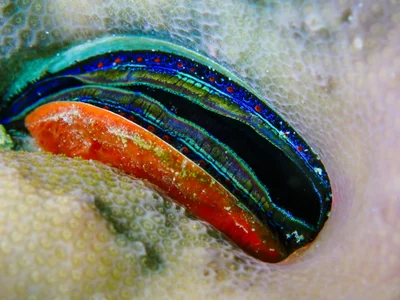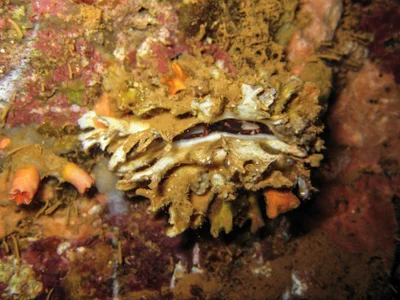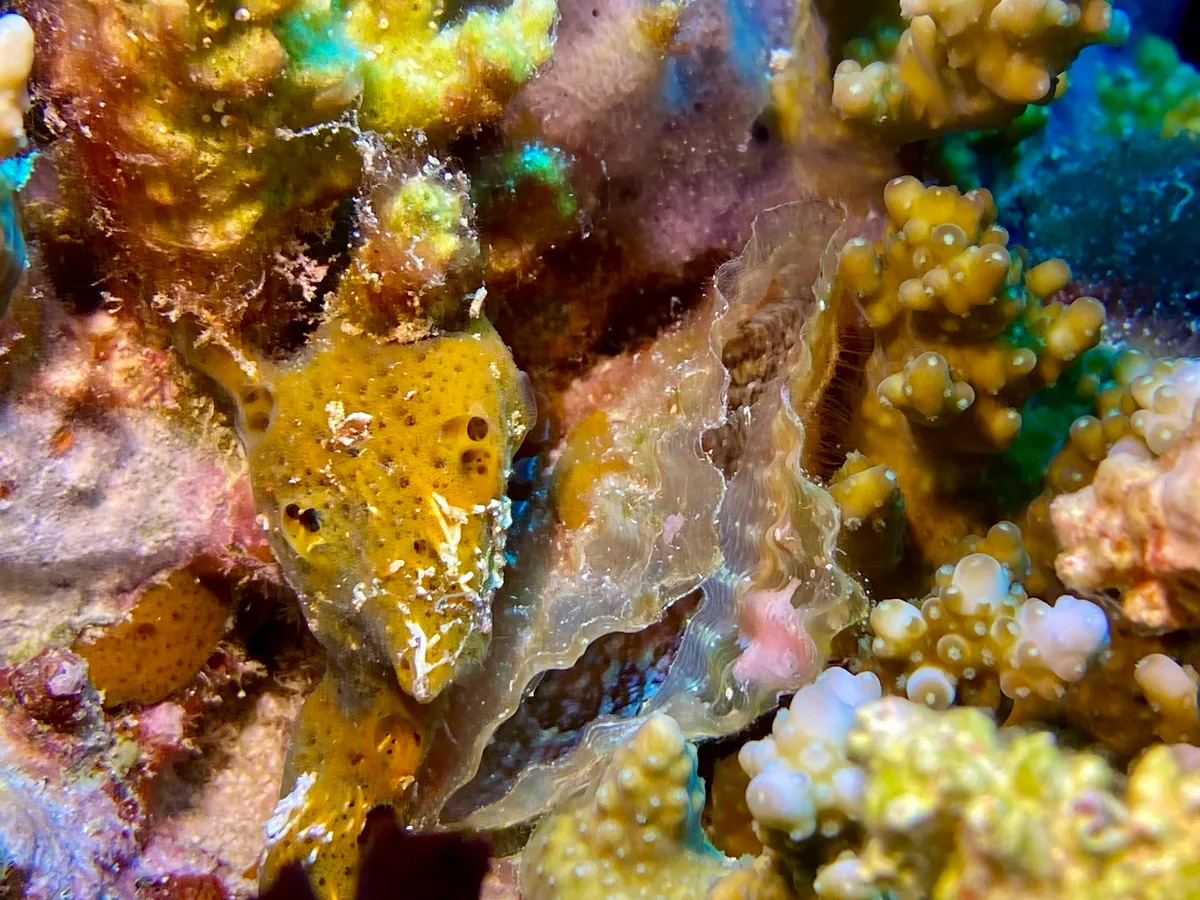
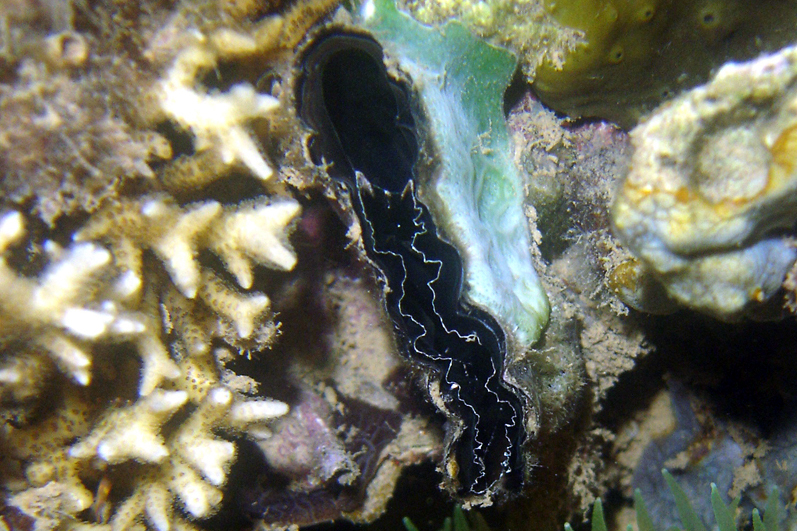
A pen shell that gave up on sand. This one grows out of a crevice in coral or rock, and because the shell forms around whatever space is available, no two look alike: the outline is irregular and bag-like, thin, translucent, with a wavy gaping edge, up to 20 cm (8 in) long.
Growing to fit is a real strategy rather than an accident. Wedged in a hole, the animal needs no anchor line and no burrow, and it is far harder for a fish to reach than one standing exposed in a meadow. The cost is that it can never move, and that its shape is dictated by a crack it settled in as a larva.
What shows underwater is the gape, a wavy dark line with the mantle just inside it, usually surrounded by growth. It closes slowly and reopens slowly, and if the crevice is tight the two valves may not meet at all - the shell simply grew to the shape of its cell.
- shell growing out of a crevice rather than out of sand
- irregular, bag-like outline that follows the shape of the hole
- thin translucent shell, often with a wavy gaping edge
- shell to 20 cm