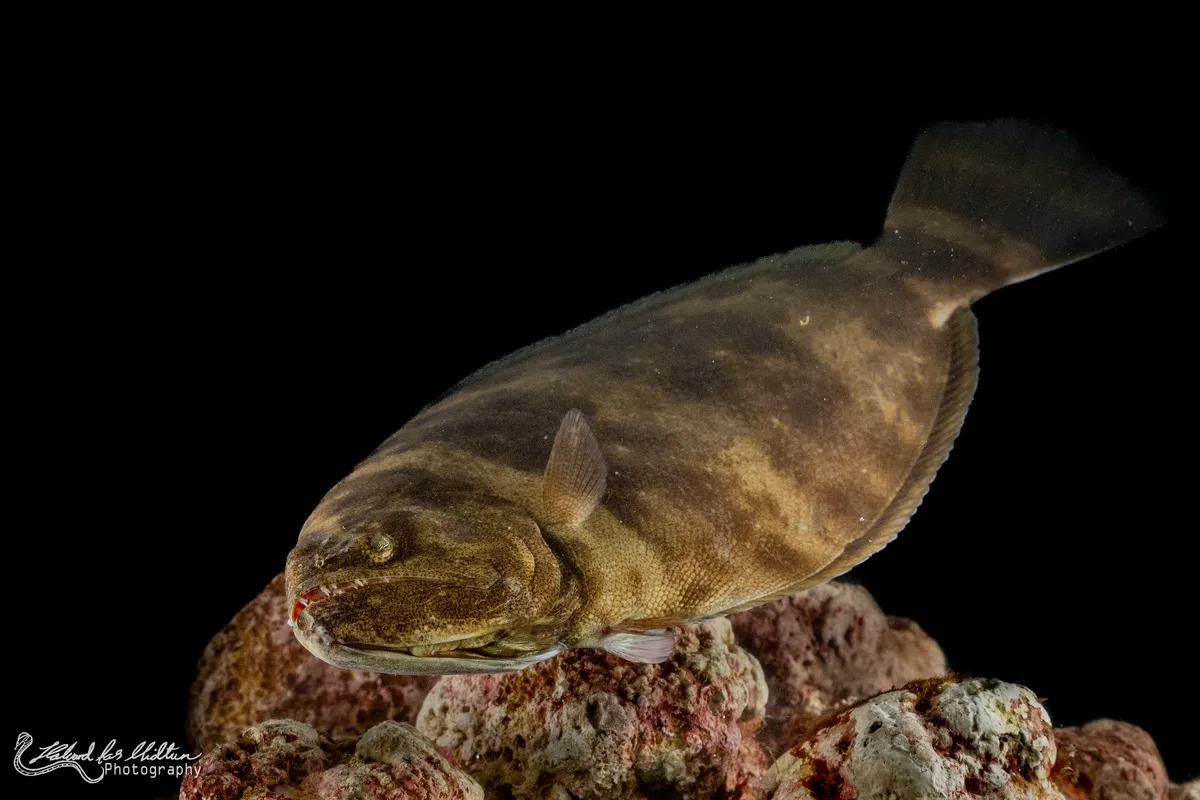
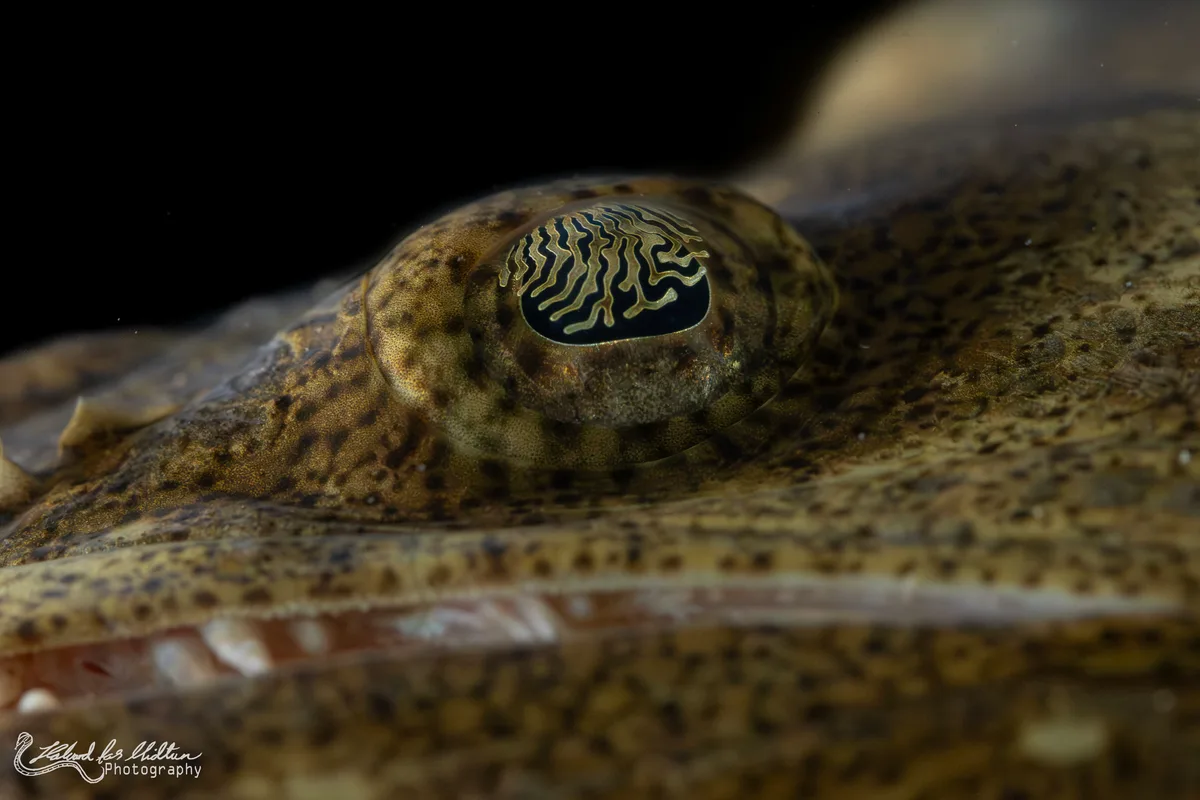
The Indian Halibut, Psettodes erumei, is the largest flatfish commonly encountered in the 🌊 Red Sea. It grows to 64 cm (25 in) in length and can weigh up to 9 kg (20 lb), though individuals encountered by divers typically range from 18 to 50 cm (7-20 in). Unlike most flatfish, its body is thick rather than wafer-thin, reflecting a less complete evolutionary transition. A key distinguishing feature is the presence of stiff, spiny rays at the front of its dorsal fin, a characteristic absent in other flatfish families. Another unique trait is the incomplete migration of its eye during development; the migrating eye stops at the edge of the head, rather than settling next to the other eye, resulting in individuals that can be either left-eyed or right-eyed. The eyed side typically displays a plain, brownish or grayish coloration with faint, irregular pale stripes running along the back. Its large mouth extends to below the posterior margin of the lower eye, equipped with sharp, conical teeth.
This species inhabits sandy or muddy substrates on coastal slopes and reef bases, from depths of 1 m down to 100 m. During daylight hours, it typically lies partially buried, camouflaged against the seafloor. It is primarily a nocturnal predator, emerging from its sandy hiding places to hunt fish and cephalopods in the water column. Its robust body, large jaw, and powerful swimming ability are adaptations for active pursuit of prey at night. While not regularly encountered by casual divers due to its nocturnal habits and preference for burial, its distinctive thick body and ambidextrous eye placement make it readily identifiable when seen.
The species. Psettodes erumei (Bloch & Schneider 1801) - from Erumie naku. ETYFish
- thick, heavy body - not wafer-flat like other flatfishes
- stiff spiny rays in front of the dorsal fin
- large jaw extending well past the eye
- eyes may be on either side of the head
Why it's threatened
Threat classification from the IUCN Red List.