Unveiling the Octopus: Anatomy of a Soft-Bodied Evolutionary Masterpiece

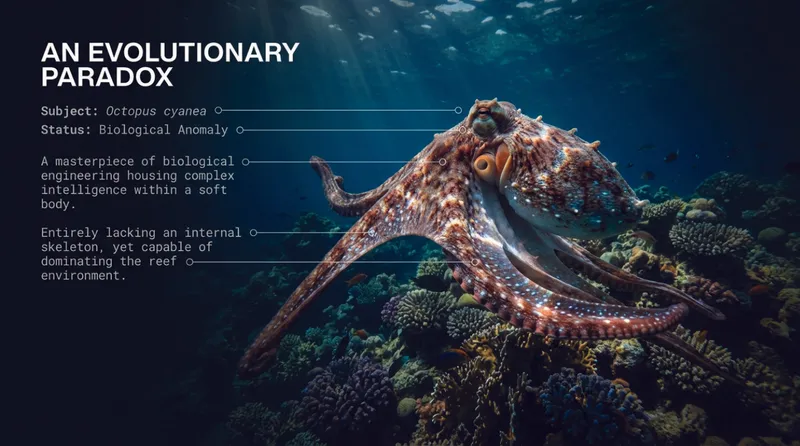
Whether observing a common Octopus vulgaris or a day octopus (Octopus cyanea) gliding over a Red Sea reef, you are witnessing an evolutionary paradox. These creatures house incredibly complex intelligence within a soft body entirely lacking an internal skeleton. By deconstructing their anatomy, we can truly appreciate this masterpiece of biological engineering.
Morphology and Movement
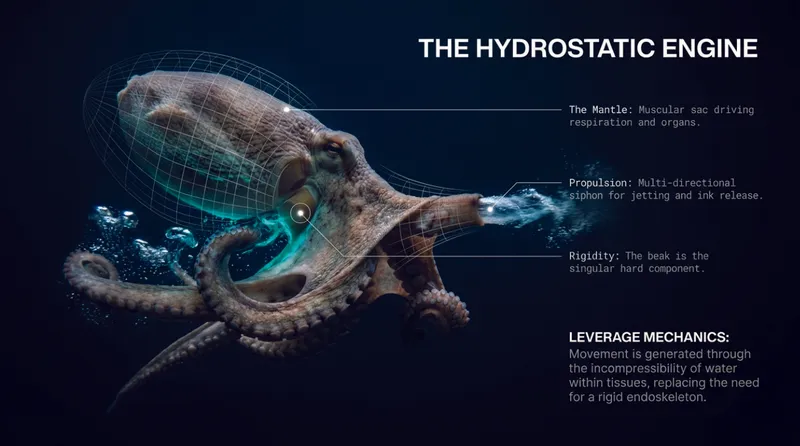
Lacking a rigid endoskeleton, the octopus relies entirely on a hydrostatic skeleton. Leverage is generated through the incompressibility of water within its tissues. The mantle - a muscular sac - houses the visceral organs and drives respiration, while a multi-directional siphon handles jet propulsion, waste expulsion, and ink release. To maximize flexibility, the only rigid component in the entire body is the beak.
The Adaptive Display Interface
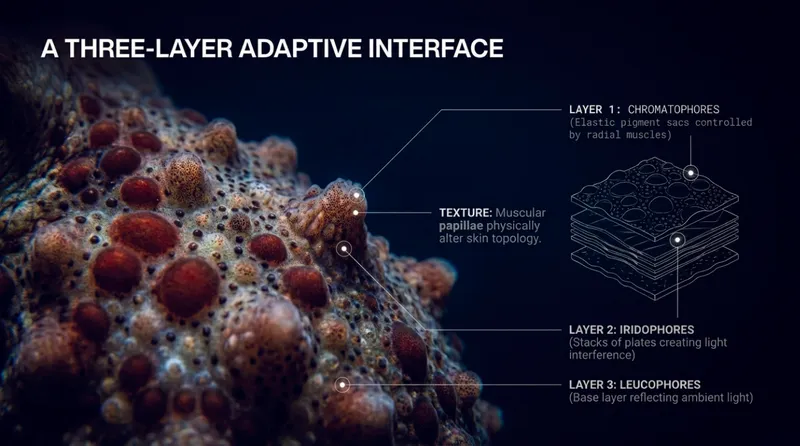
The octopus skin is a highly advanced display interface featuring three distinct layers. Chromatophores are elastic pigment sacs controlled by radial muscles to flash black, brown, red, orange, or yellow. Beneath them, iridophores use stacks of plates to create iridescent blues and greens via light interference. Finally, a base layer of leucophores reflects ambient light to flawlessly match the background. Muscular projections called papillae can even physically alter the skin's texture from smooth to spiky.
Modular Arms and Chemotactile Grippers
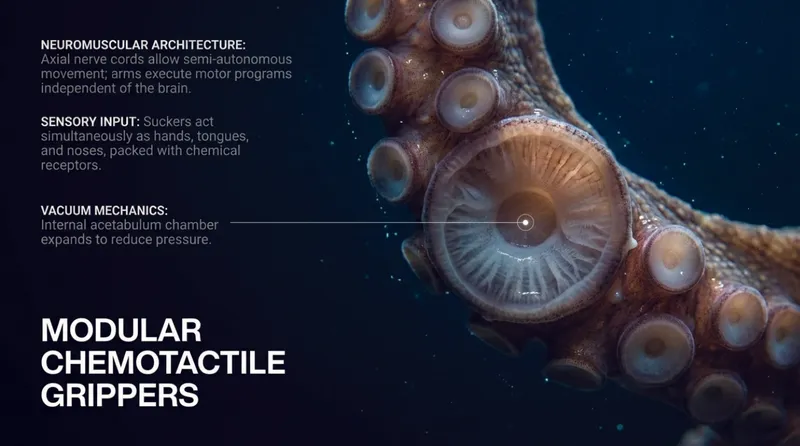
The eight arms possess a modular neuromuscular architecture. The axial nerve cord is divided into segments by septa, resembling a corrugated pipe. Because nerves exit through these septa to control specific muscle regions, the arms are capable of semi-autonomous movement.
The suckers operate as highly precise chemotactile grippers. Using vacuum mechanics, muscles expand the internal acetabulum chamber to reduce pressure, forming a powerful seal. More than just hands, each sucker is packed with chemical receptors, acting simultaneously as a tongue and a nose. The nervous system even maintains a continuous topographical map of the suckers for spatial awareness.
Vision Without Blind Spots
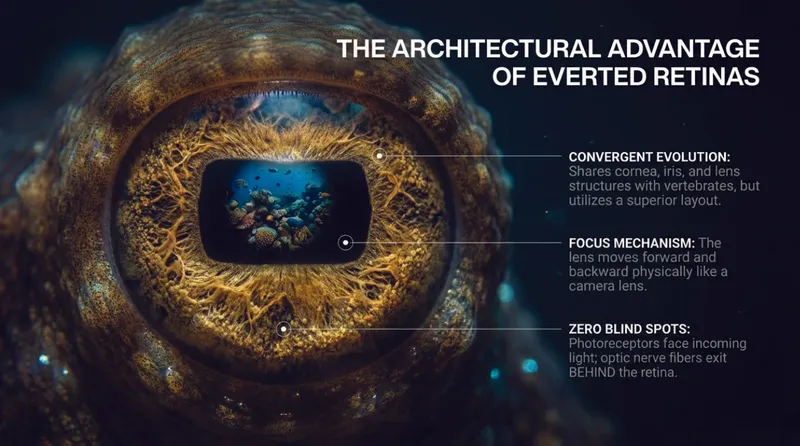
The cephalopod eye evolved independently but shares the cornea, iris, and lens structures with the vertebrate eye through convergent evolution. However, it focuses by moving the lens forward and backward - like a camera - rather than warping its shape. Crucially, the retina has an "everted" design where photoreceptors face the incoming light, and optic nerve fibers exit behind the retina. This architectural advantage means octopuses have zero blind spots.
A Distributed Intelligence Network
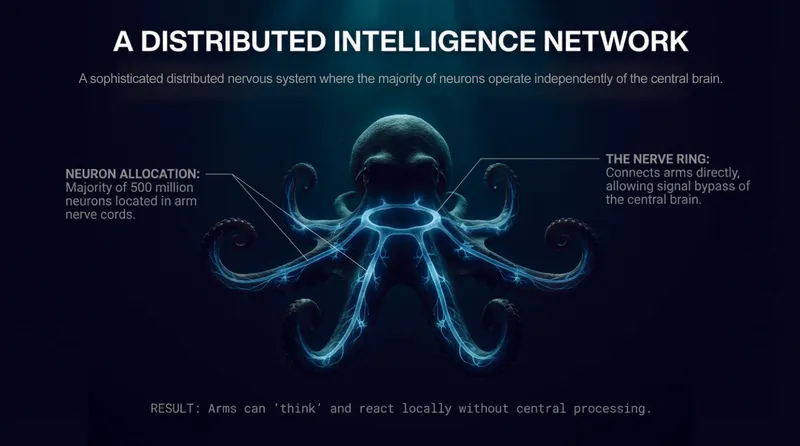
Of the octopus's 500 million neurons, the vast majority are located in the arm nerve cords rather than the central brain. These axial nerve cords can execute complex motor programs independently. A specialized nerve ring connects the arms directly to one another, allowing signals to completely bypass the central brain.
Central Command and Feeding
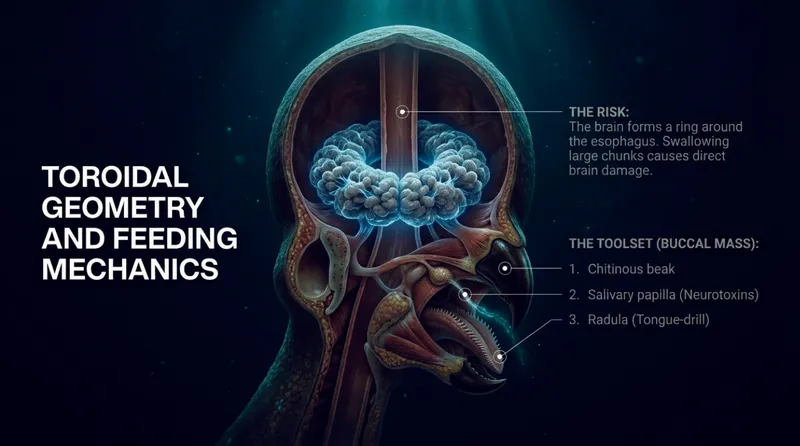
The central brain features a toroidal geometry, literally forming a ring around the esophagus. This introduces a severe physiological risk: swallowing large, unchewed food can cause direct brain damage.
Feeding is handled by the buccal mass. The chitinous beak is operated by massive muscles, while a salivary papilla drills into prey to inject predigestive neurotoxins. A tongue-drill covered in denticles, called the radula, then rasps away the flesh. Food is stored in a crop for rapid ingestion before moving to the stomach and caecum for digestion.
Blue Blood and Cardiac Arrest
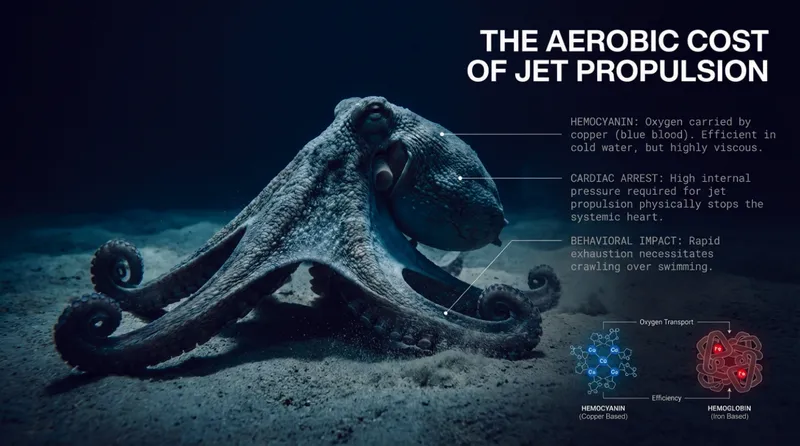
The octopus has a hemocyanin circulatory system. Because oxygen is carried by copper rather than iron, their blood is blue. This is highly efficient in cold, low-oxygen water, but it makes the blood very viscous. To manage this, two branchial hearts pump blood through the gills, and one systemic heart circulates it to the body.
While jet propulsion is a great escape mechanism, it carries a massive aerobic cost. The high internal pressure required to shoot water out of the siphon physically stops the systemic heart. Because this cardiac arrest leads to rapid exhaustion, octopuses strongly prefer crawling over swimming.
A Fleeting Legacy
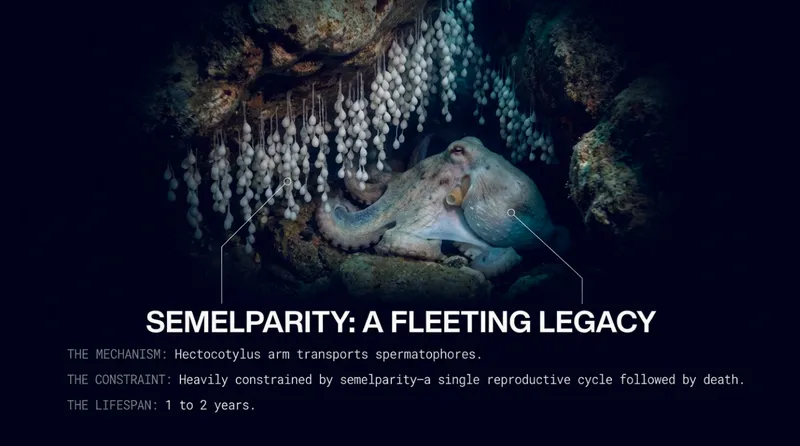
In males, the third right arm is modified into a reproductive organ called the hectocotylus. It uses a ciliated groove to transport spermatophores to the female.
The octopus is undoubtedly the ultimate invertebrate, combining distributed intelligence and adaptive camouflage. However, this unique lineage of complex intelligence is heavily constrained by semelparity. They have a very short lifespan of just 1 to 2 years and undergo only a single reproductive cycle before they die.
PADI Divemaster and underwater storyteller with over 7 years of hands-on Red Sea diving experience, documenting marine life, mapping dive sites, and promoting responsible ocean conservation.