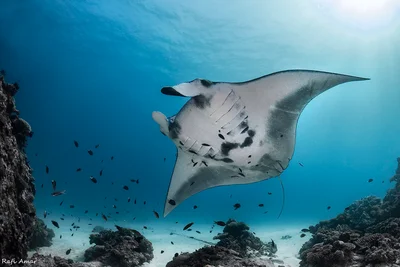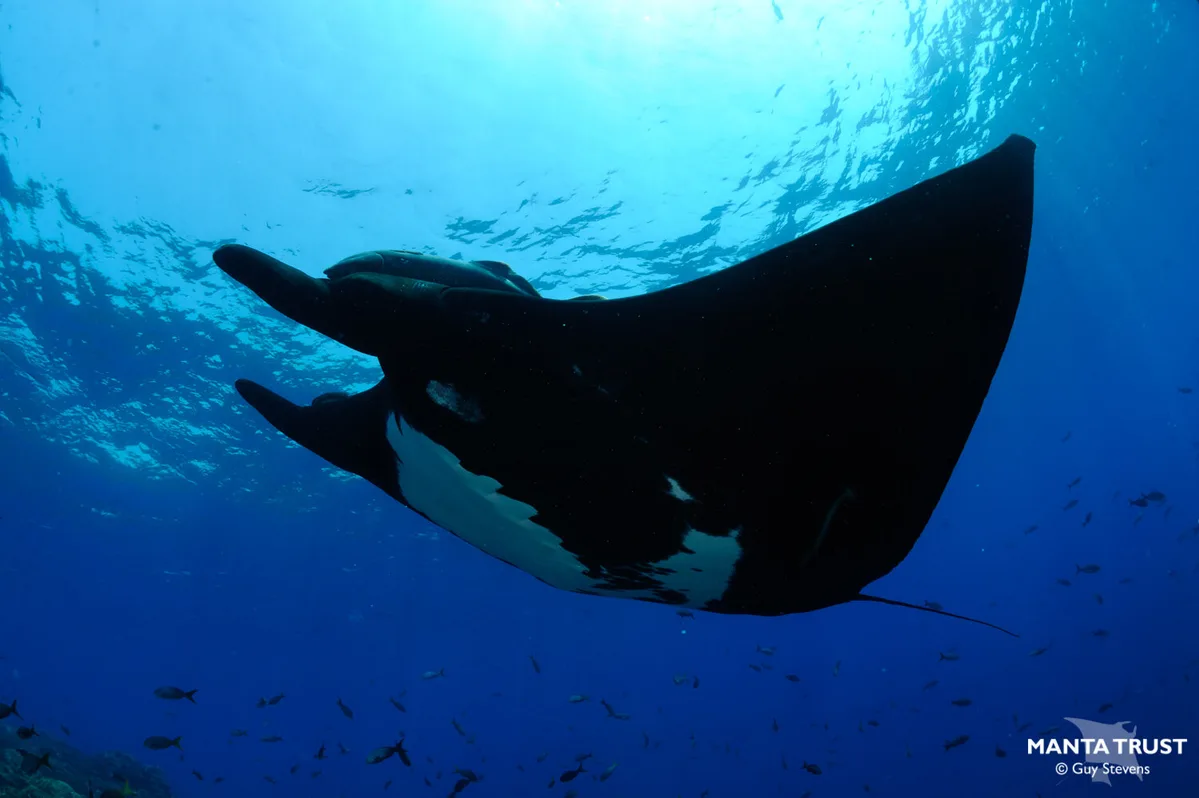
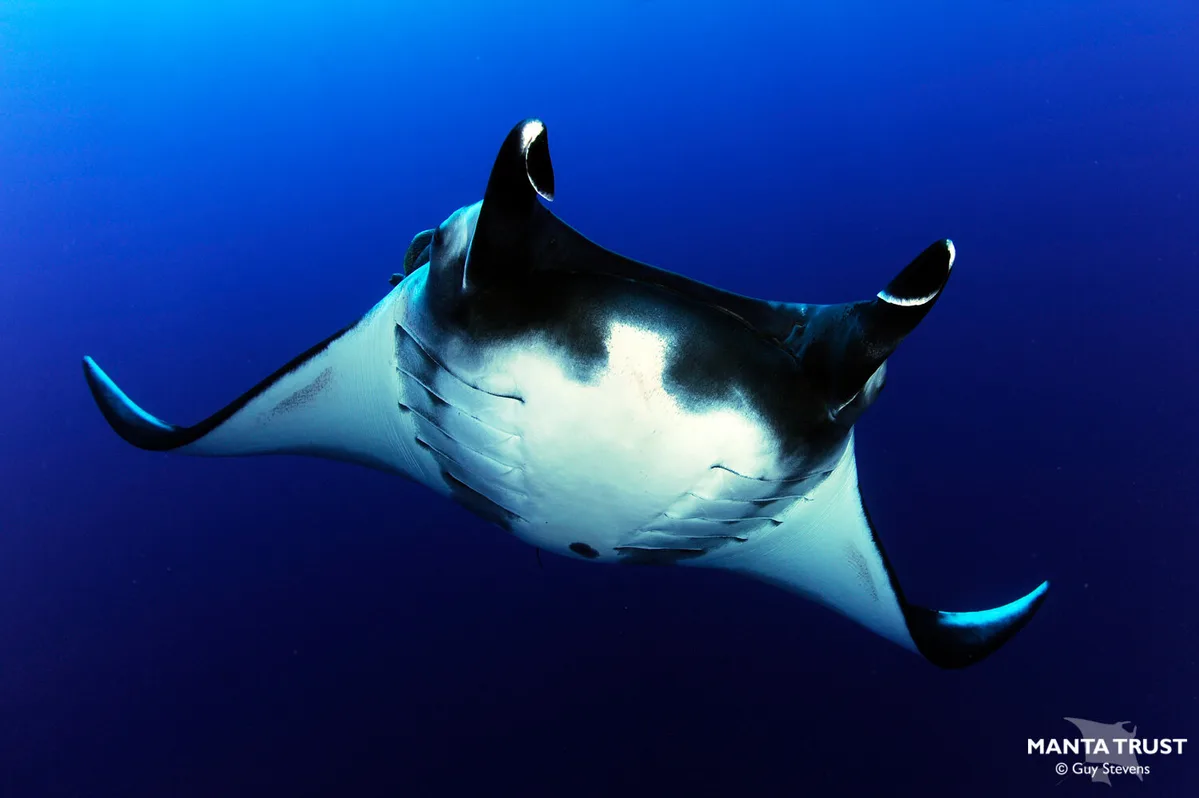
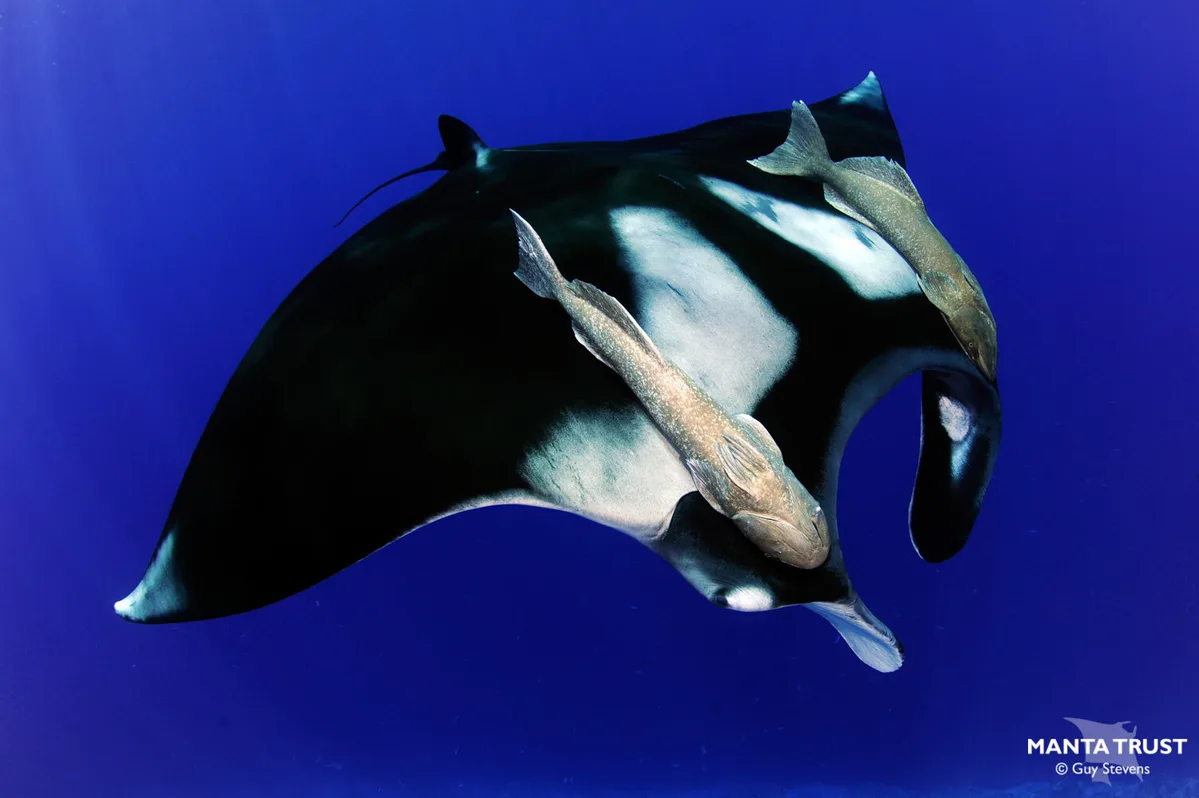

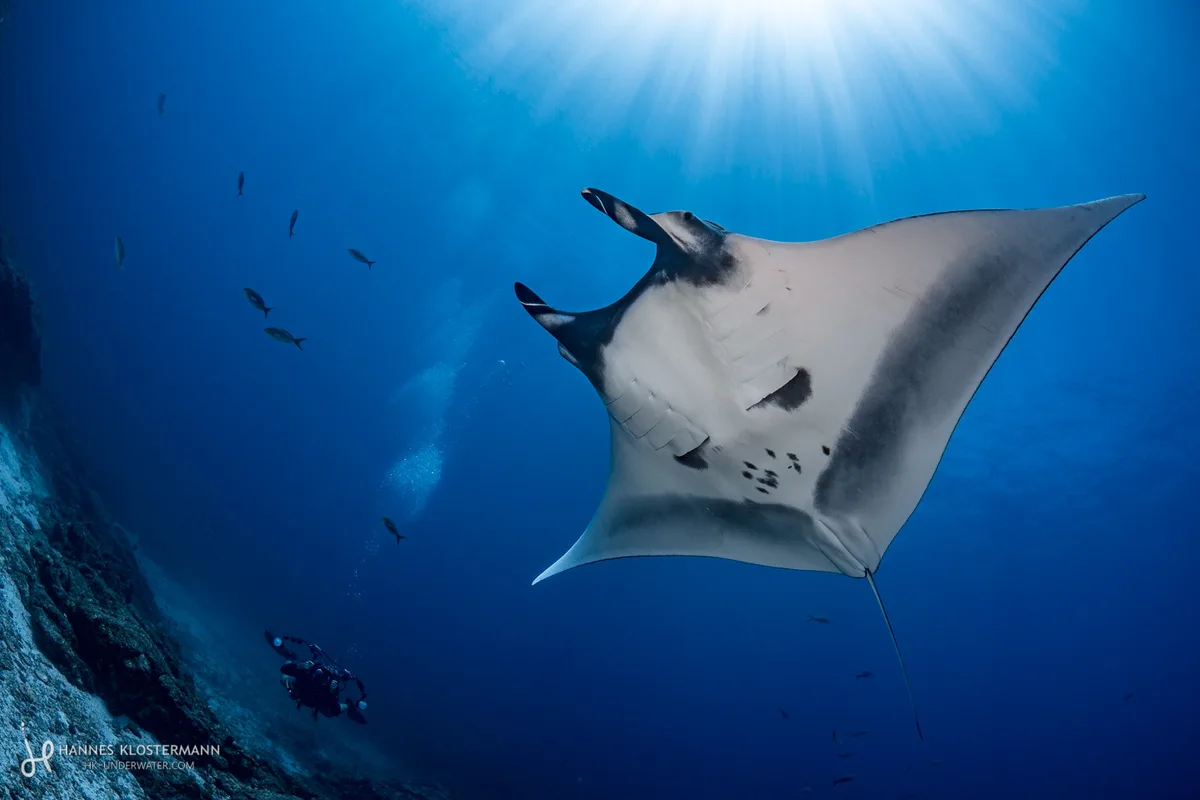
The largest ray in the world: a diamond of a body up to 7 m (23 ft) across and 1,500 kg, black above with a white shoulder pattern and a mouth carried at the front of the head rather than underneath. The two horns beside it are rolled-up fins.
Unrolled, those cephalic fins funnel water into the mouth, and the manta filters plankton through a mesh of gill plates that works like nothing else in the sea: the water spirals through and the particles are flicked back into the throat without ever touching the filter, which is why it does not clog. Engineers have copied the geometry for industrial filtration.
It has the largest brain of any fish by a wide margin, most of it the regions handling learning, coordination and social behavior. Mantas pass mirror tests in a way that suggests self-recognition, visit the same cleaning stations for decades and appear to recognize individual divers.
Every animal is identifiable. The pattern of dark spots on the pale belly is unique and fixed for life, and photographs of it feed global identification databases - which is how researchers know an individual seen off one coast can turn up 1,500 km away. The species is Endangered, killed for its gill plates.
The species. Mobula birostris (Walbaum 1792) - bi-. ETYFish
- enormous diamond-shaped disc, black above with a white shoulder pattern
- a pair of horn-like cephalic fins rolled up beside the mouth, unrolled while feeding
- mouth at the front of the head, not underneath as in a devil ray
- disc up to 7 m across