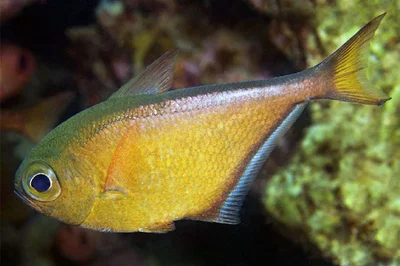
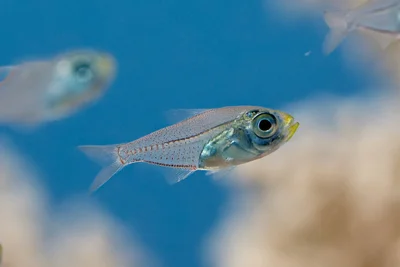
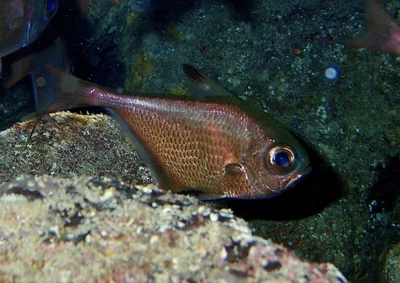
A deep-bodied sweeper built like the rest of its family: blunt and heavy at the front, narrowing sharply to a thin tail, with the body depth taking up roughly half the length. The eye is very large and set high on the head, and the anal fin runs as a low band along most of the underside. Length reaches about 14 cm (5.5 in). Color is silvery to coppery brown, often with a darker back, and shifts with the light - the same shoal photographed inside a cave and at its mouth can look like two species.
Days are spent in shade: caves, undercuts, the space beneath ledges, usually in loose aggregations that shuffle rather than swim. That large eye pays off after dark, when the fish disperse into open water above the reef to feed on zooplankton and return before dawn. Depth runs from the shallows down to about 20 m (65 ft). The species was described from 🇲🇺 Mauritius, and the name records it - Nesogallia was the Latin name of that island. Through the 🌊 Red Sea it is known only from the southern end of the basin, so a sweeper seen in the north is almost certainly one of the other three species: getting a look at the dorsal fin, which carries a black spot in the Yellowtail Sweeper, settles most of those encounters.
The species. Pempheris nesogallica Cuvier 1831 - -ica (belonging to nesos) + Gallia (France). ETYFish
- deep body, blunt front, tapering to a narrow tail
- very large eye set high on the head
- hangs under ledges and in caves by day