
SoapfishesGrammistini
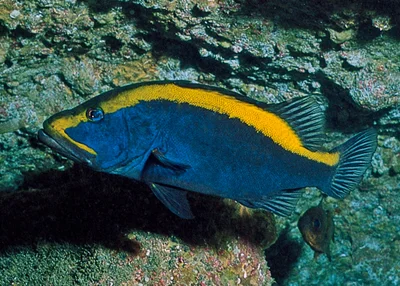
Almost every chemical defense on the reef has to be delivered. A spine has to be stepped on, a tentacle has to be touched, a cone snail has to fire. A soapfish carries its on the outside, finished, at all times. The mucus on its skin is loaded with a bitter toxin, and anything that takes the fish into its mouth lets go of it immediately, which the goldenstriped soapfish's page describes at the moment of contact.
The effect that has on the animal's behavior is the reason the group is worth a page. A fish this size on a reef full of things that eat fish ought to be nervous. Soapfishes are not. They hang in the mouths of caves and under ledges in plain view, unhurried, and let a diver come closer than almost anything else of comparable size will.
They are groupers by descent, which makes the trade explicit. A grouper's usual answer to being edible is to keep growing until the things that hunt it cannot fit it in. Soapfishes stayed small, moved into the shade and bought the same result out of a gland, and they hunt the way the rest of the family does, sitting still until something small enough passes and taking it with one pull of an enormous mouth, mostly after dark.
The chemistry has a practical edge. Handle one and you will smell it on your hands; confine one in a bucket or a bag and the toxin can kill every fish in the water with it, including the soapfish. There is no reason to pick one up.
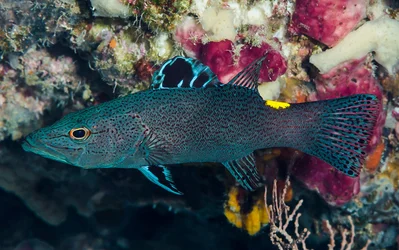
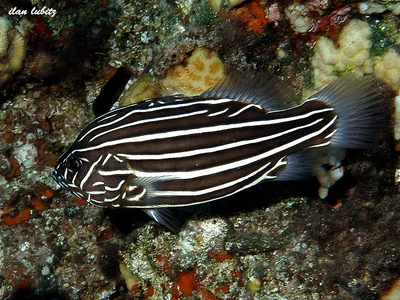
Four species are listed for this sea, all of them animals of the shade rather than of the open reef, and one of them adds gold lines to its flanks as it grows, so the number in its name is only right at one point in its life.
- elongated, robust body
- large mouth
- bold patterns of spots, stripes, or reticulations
- often hiding under ledges or in crevices
- secreting foamy, toxic mucus when stressed
4 species in Soapfishes

Other elongated groups
Similar silhouette underwater - worth a look if this was not your animal.


Last Update: August 23, 2026