
CornetfishesFistulariidae
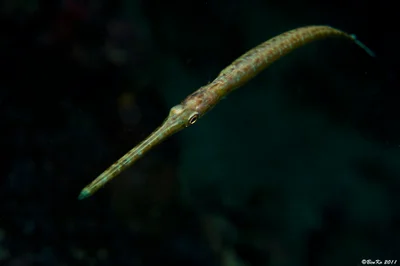
A cornetfish is a close relative of the seahorse. That reads like a joke and it is the current shape of the family tree: cornetfish, trumpetfish, shrimpfish, pipefish, ghost pipefish and seahorses all sit in one order, and what holds that unlikely company together is the front of the head. In every one of them the bones between the eye and the mouth are drawn forward into a tube with a small mouth at the tip, and feeding is a suck rather than a bite. The mouth opens, the tube fills, and the prey arrives with the water. Take a seahorse, straighten it out, and run the body behind that snout to a meter and a half.
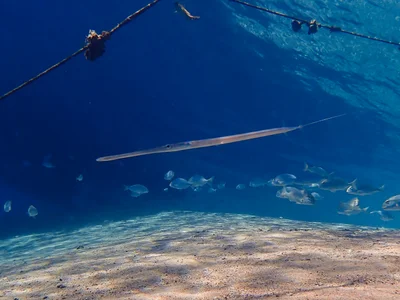
Everything else has been spent on length. The trunk of a full-grown cornetfish is barely thicker than a thumb, the dorsal and anal fins have migrated to the back and sit opposite one another, which is the arrangement of an animal that does not cruise so much as launch once, and there is no armor on it anywhere. It is a design with one move in it and no fallback. A cornetfish that decides you are a problem leaves in a straight line, faster than looks reasonable for something that thin, and small fish and shrimp go down whole.
The shape has also turned out to be portable. The smooth cornetfish went north through the Suez Canal (🇪🇬 Egypt) out of this sea, was recorded in the eastern Mediterranean around the turn of the century, and inside a decade had been caught at the western end of it, one of the fastest range expansions ever documented for a marine fish. The population it set out from is the one you are diving over.
Two species are listed here: one common over reef and sand from the shallows down, usually noticed only when it turns and stops being a line, and one deeper, redder and living on soft bottoms, which divers almost never see.
- extremely elongated, cylindrical body
- long, tubular snout with a small terminal mouth
- dorsal and anal fins positioned far back on the body
- forked caudal fin with a single, extremely long central filament
- often hovers motionless or drifts slowly, sometimes head-down
2 species in Cornetfishes
Other elongated groups
Similar silhouette underwater - worth a look if this was not your animal.


Last Update: August 23, 2026