
MojarraGerreidae
It takes a mouthful of the seabed and spits out everything that is not food. A mojarra drives its jaws into sand or soft mud, lifts a load of it up into the head, sorts it against the gill rakers and the throat teeth, and blows the sediment back out through the mouth and from under the gill covers. What stays behind is worms, small crustaceans and thin-shelled bivalves, animals that were buried and out of sight when the fish arrived.
The tube of a mouth that does the digging belongs to the species pages. The character that actually defines the family is the slot it goes back into: a bare groove running down the top of the head, into which the jaw folds as it retracts. Whether that groove is naked or crossed by a row of scales is one of the characters a taxonomist counts to tell mojarras apart, which gives you the measure of the problem.
The pits are the visible half. A feeding school leaves a sand flat pocked with small craters, and anything that turns the bottom over on a reef flat tends to collect an audience, with wrasses and other opportunists working in behind for whatever comes up and gets away. It is also a living with no cover in it: a fish out on open sand has nothing to hide behind, and the answers are a deeply forked tail, a tight school and room to use it.
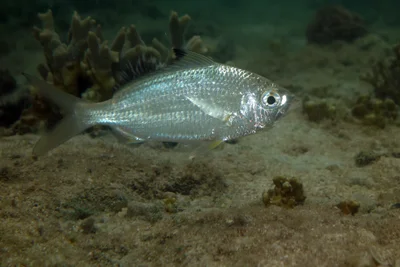
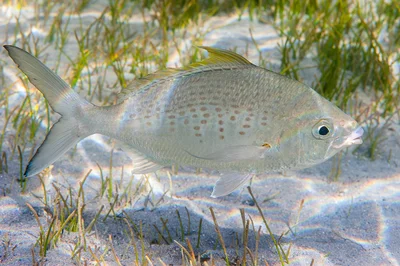
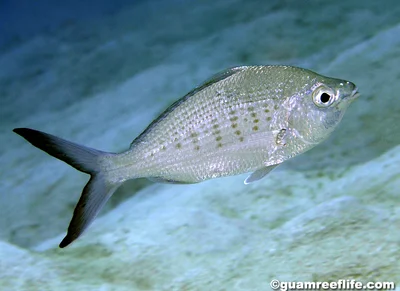
Three are listed here, and separating them underwater is close to hopeless - same silver, same outline, differences that come down to snout length and the marking on the dorsal fin. The species pages take on the silver itself, which is better engineering than it looks, and the awkward fact that this is a family of estuaries living in a sea with no rivers.
- oval, laterally compressed body
- silvery body colour
- deeply forked tail fin
- highly protusible mouth, extended downwards like a tube when feeding
- often in schools, sifting sand or mud over the bottom
3 species in Mojarra
Other oval-bodied groups
Similar silhouette underwater - worth a look if this was not your animal.


Last Update: August 23, 2026