The Silent Tide: Why Hundreds of Sharks are Washing Up on Welsh Shores

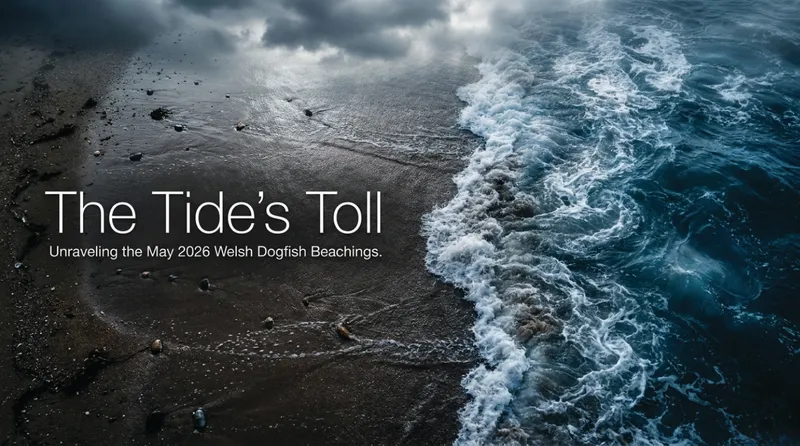
A morning walk along the Welsh coastline is typically a restorative ritual - the rhythmic, percussive pulse of the Atlantic, the sharp sting of salt air, and the vast, shifting sands of beaches like Cefn Sidan or Saundersfoot. But for several dog walkers recently, this tranquility was shattered by a grim, olfactory-led discovery. Strewn across the tide line was not the usual driftwood or kelp, but a tangled, silver-grey mass of hundreds of dead sharks and fish.
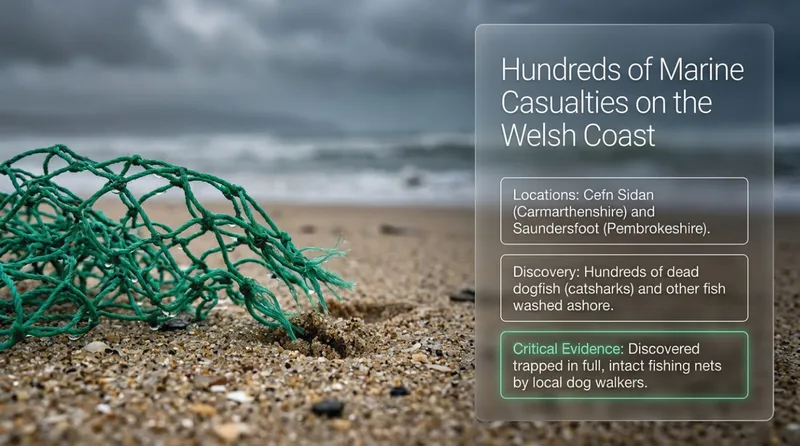
The sight of these small, slender sharks - scientifically known as Scyliorhinus canicula, but more commonly called dogfish or catsharks - cluttering the pristine Welsh shoreline raises a chilling question for those who frequent the coasts of Carmarthenshire and Pembrokeshire. Is this a bizarre natural mystery, or the visible debris of a man-made disaster occurring just beyond the horizon?
This Isn’t Just a Few Strays - It’s Industrial Scale
The scale of these recent events has moved far beyond the occasional isolated carcass that typically follows a storm. At Cefn Sidan in Carmarthenshire, witnesses discovered an entire fishing net bulging with dead catsharks. This followed a nearly identical scene just days earlier on Saundersfoot beach in neighboring Pembrokeshire, where hundreds of dead sharks and fish lay scattered like discarded litter across the sand.
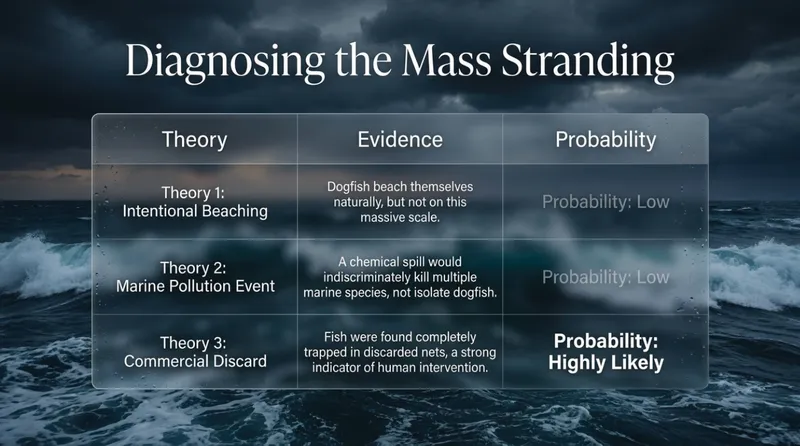
From a scientific perspective, seeing such a massive concentration of a single species is more alarming than a diverse wash-up. A variety of species might suggest a localized environmental failure or a toxic "red tide," but a mass of catsharks alone suggests a targeted, industrial event.
Cliff Benson, a veteran conservationist and founder of Sea Trust Wales, emphasized the sheer volume of these sightings to the Western Telegraph:
“We quite often see dogfish or catsharks seemingly intent on suicide and beaching themselves, though nobody seems to know why. However, this is on a different scale and looks like they might have been caught by some fishing boat that was hoping to catch more commercial species and thrown overboard dead.”
The "Commercial Bycatch" Theory
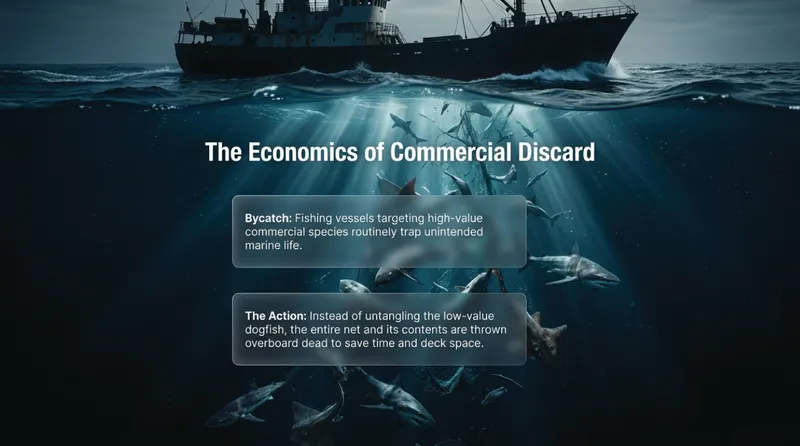
The leading theory among experts is that these sharks are the collateral damage of the commercial fishing industry. In this scenario, the catsharks are caught incidentally as "bycatch" while vessels target more lucrative, "commercial" species like bass or cod. Because catsharks have negligible market value, they are often treated as inconvenient waste.
The process reveals a tragic irony in marine management: life is hauled up in indiscriminate nets, and the "wrong" kind of catch is simply shoveled back into the sea. By the time they hit the water, these creatures are often already dead from the pressure of the net or prolonged exposure on the deck. However, Benson notes that this is not the only potential culprit:
“Another possibility is it's a case of some marine pollution event, but you would expect several species to fall victim, not just dogfish.”
By distinguishing between these two theories, researchers can better narrow down the cause; if only catsharks are dying, the "human error" of the fishing industry becomes the far more likely suspect.
The Lethal Legacy of "Ghost Nets"
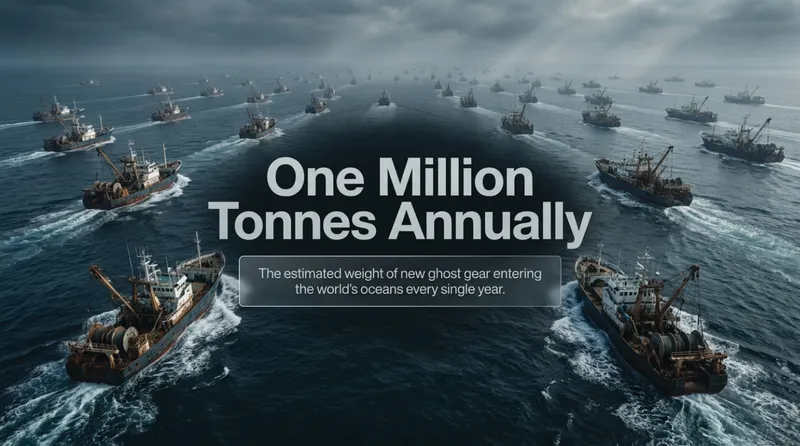
While the tragedy at Cefn Sidan may appear to be a local mishap, it is a microscopic view of a global plague known as ghost gear. It is vital to distinguish between active discard - where a vessel currently fishing throws back unwanted catch - and ghost nets. Ghost nets are fishing gears that have been abandoned, lost, or discarded. Unattended and autonomous, they travel with the currents, trapping and killing marine life indefinitely in a cycle of "ghost fishing."
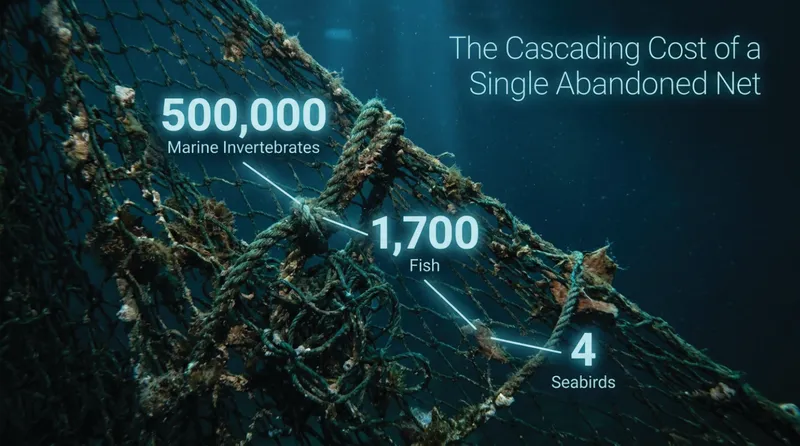
According to data from the World Wildlife Fund and the Ocean Conservancy, the impact of this "invisible" debris is staggering:
- 1 million tonnes: The estimated amount of ghost gear entering the oceans every year.
- 500,000: The number of marine invertebrates killed by a single abandoned net.
- 1,700 fish and 4 seabirds: The average additional toll per net.
The Ocean Conservancy identifies ghost gear as the single most harmful form of marine debris. While the net found at Cefn Sidan was likely an active discard, the broader issue of ghost gear ensures that even when the boats go home, the killing continues beneath the waves.
A Recurring Pattern, Not an Isolated Incident
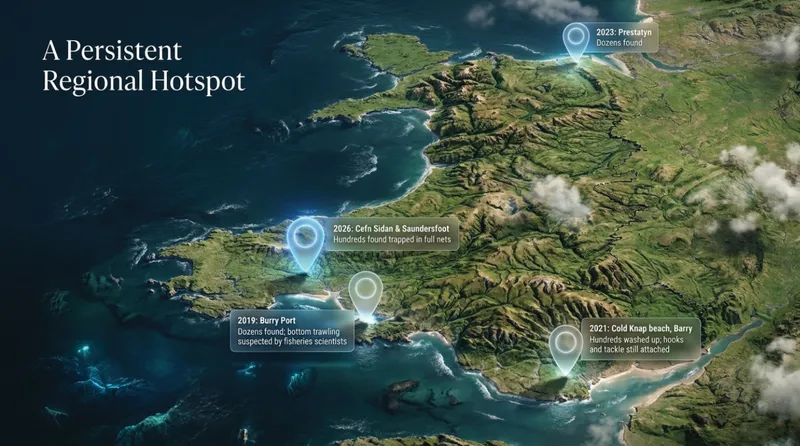
These recent findings are not an anomaly; they are part of a systemic, recurring pattern that has seen Welsh beaches transformed into shark graveyards multiple times over the last decade:
- 2019 (Burry Port): Dozens of dogfish washed up, with fisheries scientists attributing the event to the destructive practice of bottom trawling.
- 2021 (Cold Knap, Barry): Hundreds of sharks were found in a discovery that provided the "smoking gun" for human culpability: many specimens still had hooks and tackle embedded in their mouths.
- 2023 (Prestatyn): A few dozen dogfish were discovered on the shoreline, continuing the trend.
The 2021 incident at Cold Knap is particularly damning. While theories of pollution or natural death are often floated, the presence of metal tackle and hooks is a physical indictment of human interference that cannot be easily explained away.
The Mystery of "Shark Suicide"
While the evidence points toward industrial activity, science must also grapple with a strange, natural counter-narrative. Benson’s observation that catsharks appear “seemingly intent on suicide” points to a behavior that remains largely unmapped by marine biology. Why would a species evolved for the deep deliberately beach itself?
Using a loaded, anthropomorphic term like "suicide" highlights the frustration of researchers who still understand so little about these ancient elasmobranchs. This lack of knowledge makes the human-caused mortality even more tragic; we are decimating a species before we have even deciphered its most basic behaviors. While a single shark beaching itself might be a biological enigma, hundreds appearing in a net points firmly back to the surface.
A Question for the Shoreline
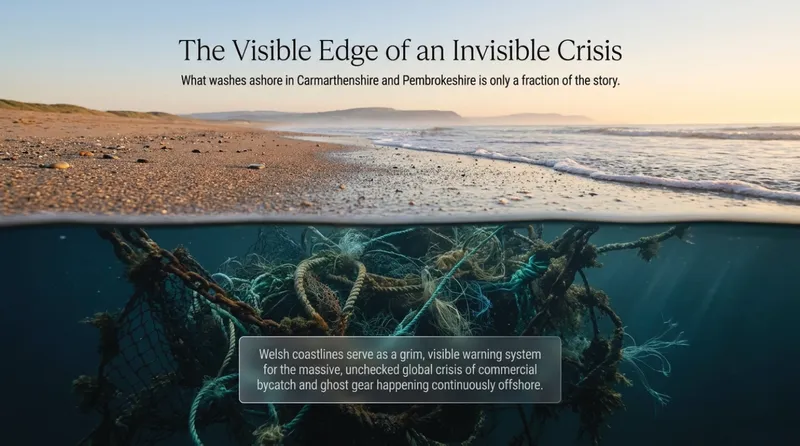
The grim scenes unfolding in Carmarthenshire and Pembrokeshire represent a mounting tension between the demands of the commercial fishing industry and the fragile health of our marine ecosystems. For too long, the ocean has acted as a vast, opaque shield, hiding the consequences of our industrial appetite.
Now, the "silent tide" is bringing those consequences directly to our feet. These "unseen" creatures of the deep - these catsharks that play vital roles in the marine food web - only seem to earn our attention when they begin to clutter our leisure spaces and spoil our morning walks. As the sea purges what we have discarded, we must ask ourselves: what is our collective responsibility for a world that we only choose to see when it is already dead?
PADI Divemaster and underwater storyteller with over 7 years of hands-on Red Sea diving experience, documenting marine life, mapping dive sites, and promoting responsible ocean conservation.