up to 2.7 m136 to 272 kg0-300 mCITES IILeast Concern
45
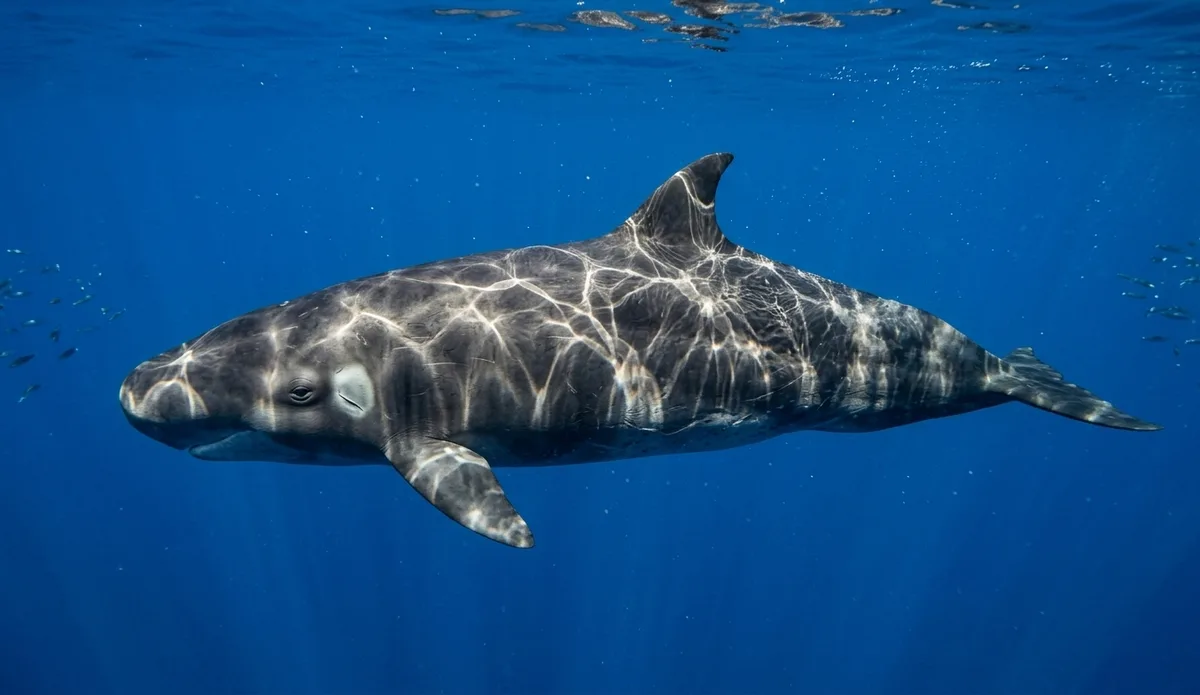
A blunt-headed whale barely 2.7 m (9 ft) long with a squared-off snout, a tall central fin and a pale crescent behind the eye that looks enough like a gill slit to have earned it the nickname false gill. The whole profile is oddly shark-like, which is not a coincidence anyone has explained.
It releases ink. A sac in the lower intestine holds over ten liters of reddish-brown fluid, and a startled animal voids it into the water and disappears behind the cloud - the same defense a squid uses, in a mammal, and the only case of it. In young animals the cloud is proportionally enormous.
It hunts squid in deep water, mostly at night, and spends the day lying motionless at the surface with the head low and the tail hanging - a habit that makes it easy to approach, easy to hit with a boat and easy to overlook entirely. Most of what is known about the species comes from strandings rather than sightings.
How common it is nobody knows. It is rarely seen anywhere, and the few records from this region are consistent with an animal that lives past the drop-off and surfaces without being noticed.
How to recognise it
small blunt-headed whale, shark-like in profile, with a pale crescent behind the eye
tall dorsal fin set at the middle of the back, unlike the Pygmy Sperm Whale's small one
lies motionless at the surface with the head down, and does not flee
Small numbers of Dwarf Sperm Whales have been taken deliberately in opportunistic hunting off Japan, Indonesia, Taiwan, the Lesser Antilles, and Sri Lanka (Jefferson et al. 1993). However, the scale of such removals is thought to be very small. These whales also die incidentally in drift gillnet fisheries in the northern Indian Ocean and in pelagic longline fisheries in the north-eastern Atlantic (Jefferson et al. 1993, Arbelo et al. 2013). In 2005, a large series of unusual stranding events over a period of about 3 weeks in and around Taiwan included 13 Dwarf Sperm Whales (Yang et al. 2008). It is unknown if military, seismic survey or other loud noise-producing human activities were implicated in these strandings. Exposure to domoic acid associated with harmful algal blooms was implicated in Dwarf Sperm Whale mortality in the south-eastern US (Fire et al. 2009). As with most other cetaceans, there is growing evidence that Kogia species have a propensity to swallow plastic debris (Stamper et al. 2006).
Threat classification from the IUCN Red List.
Comments
Please, sign in to leave a comment
Continue with a social account - yours will be created automatically.