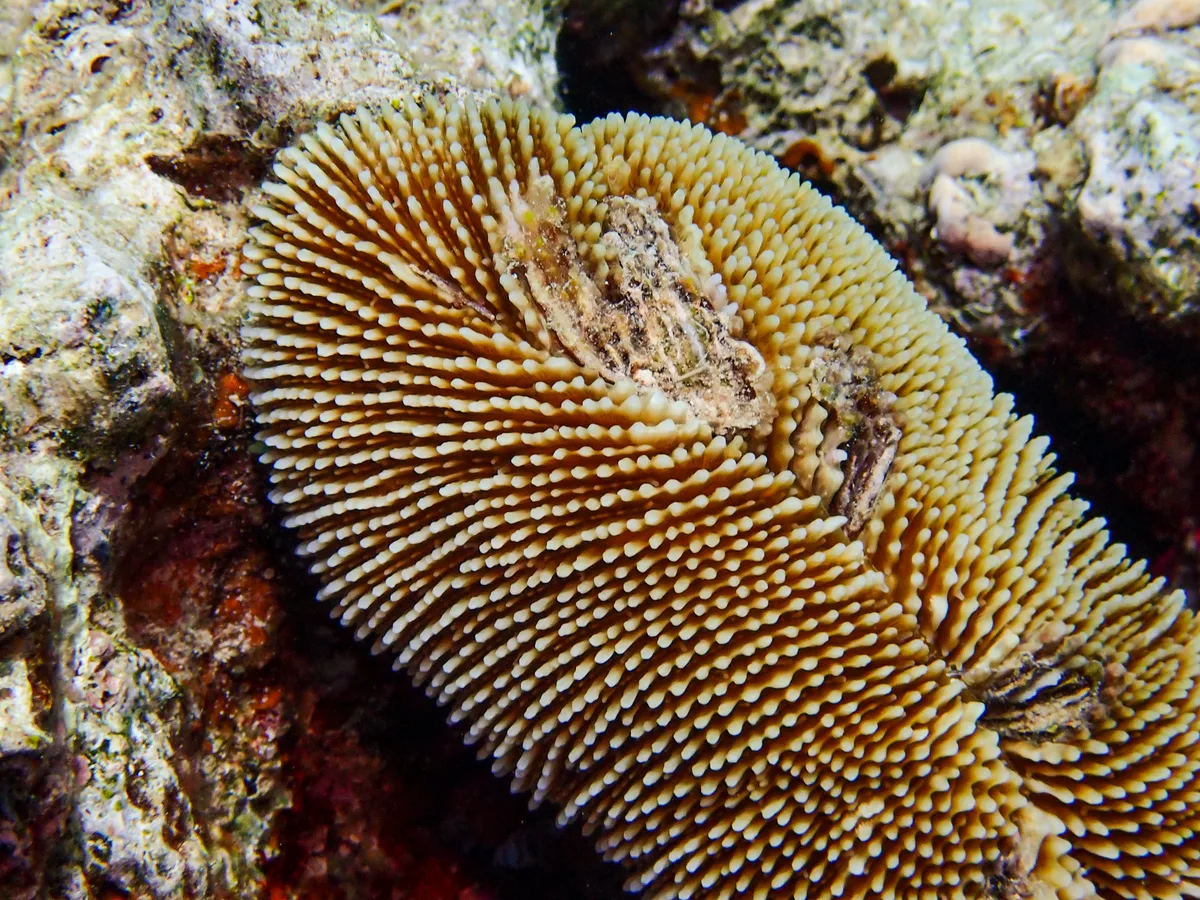
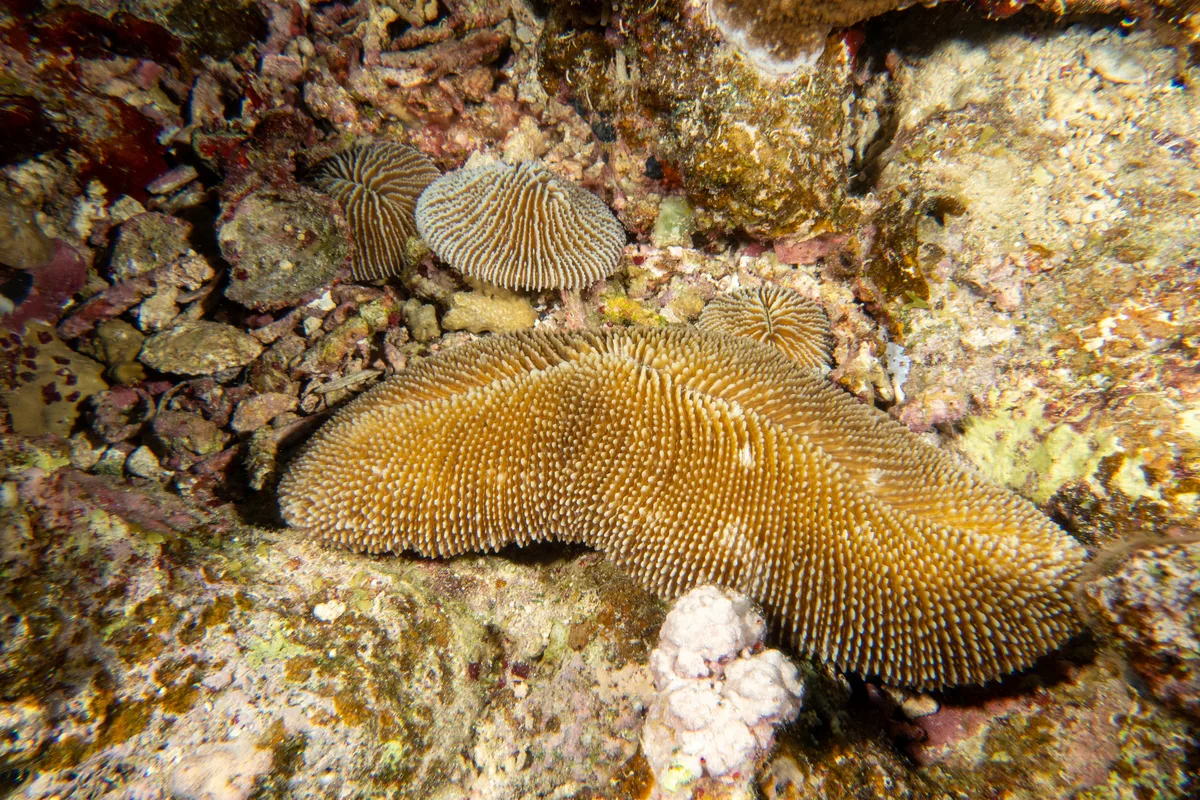
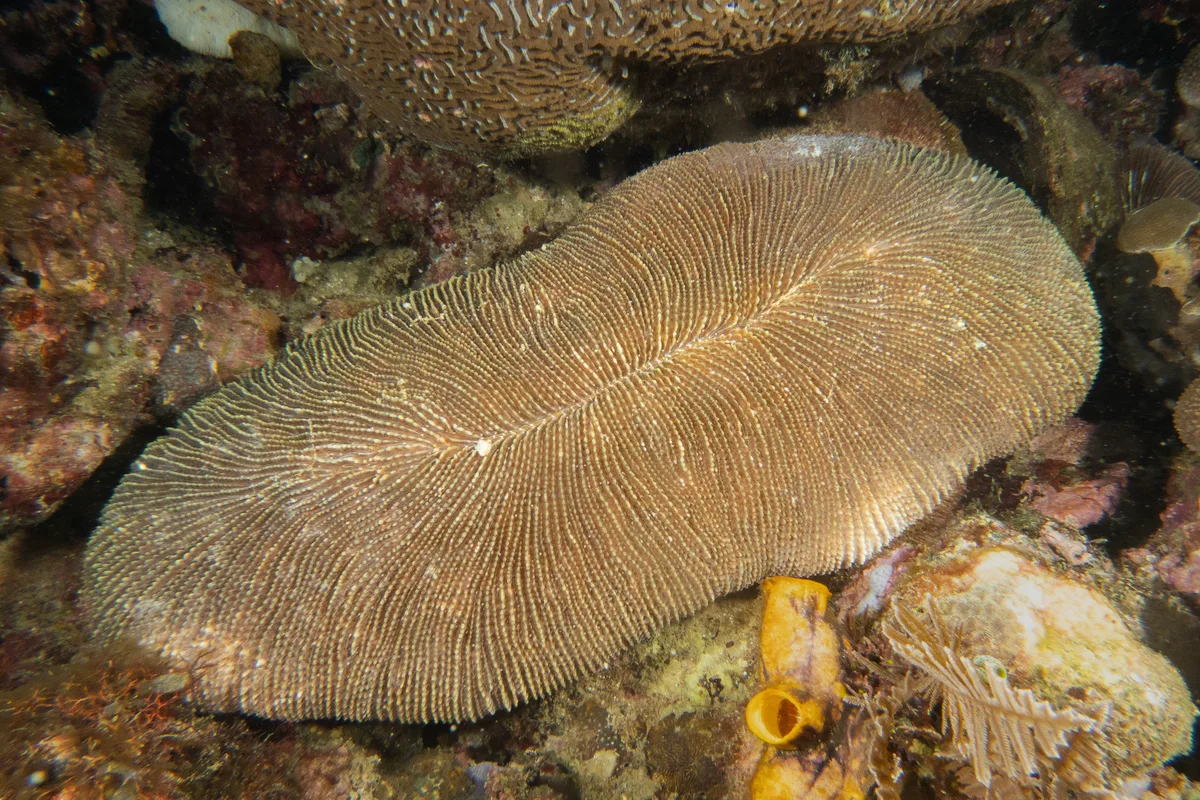
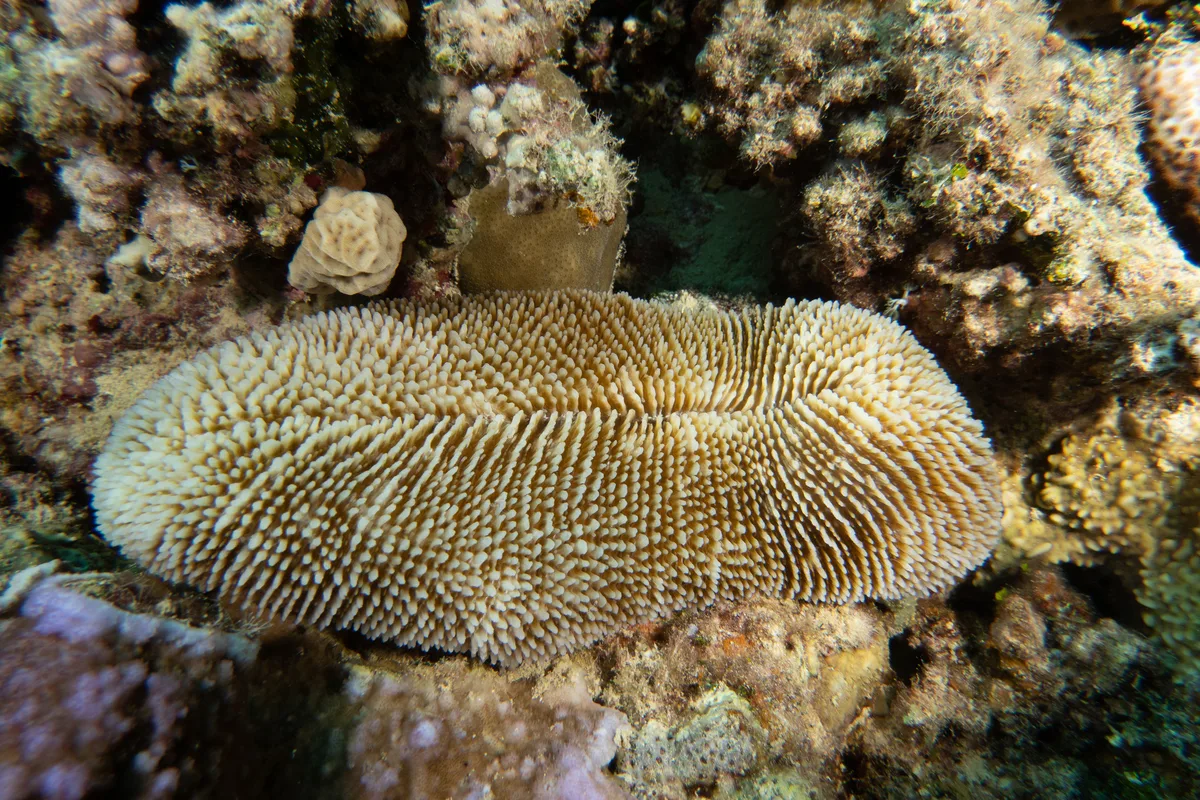
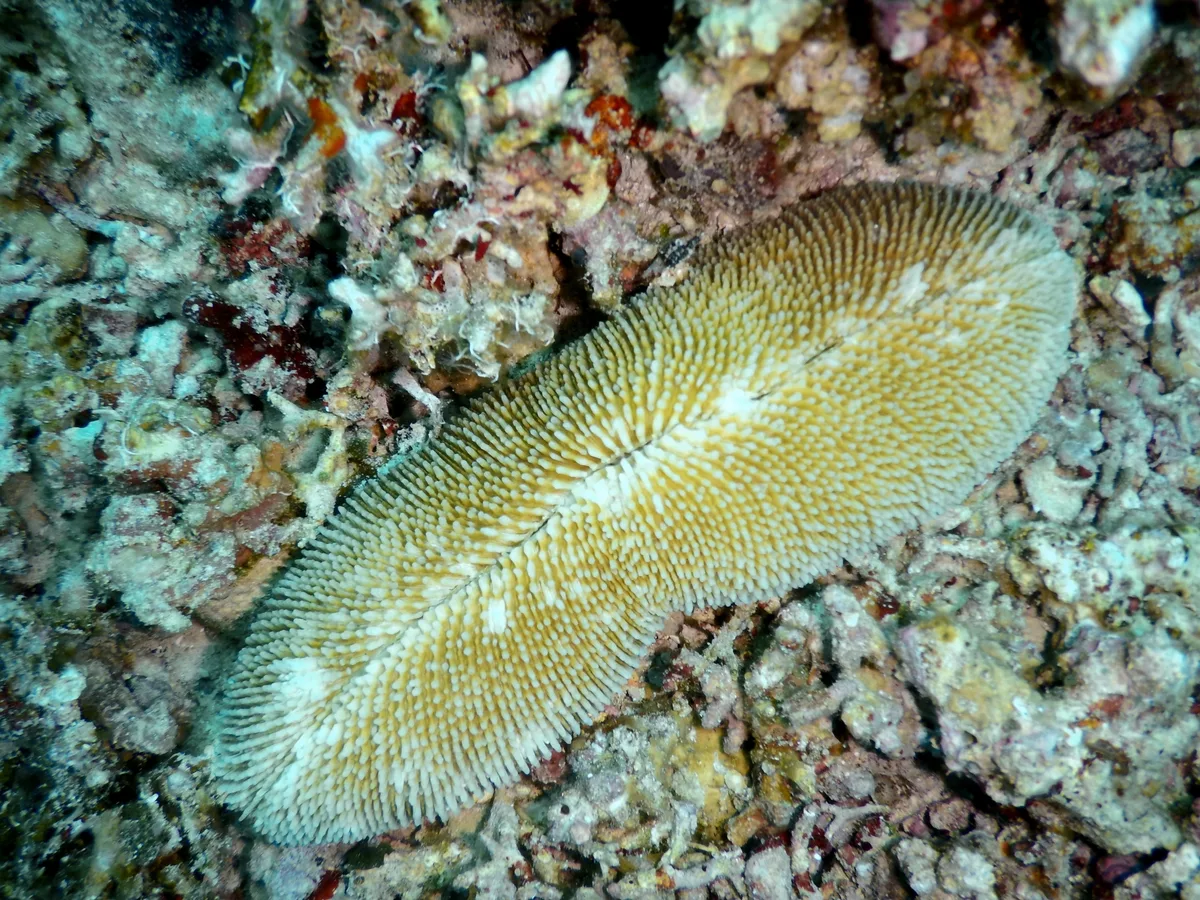
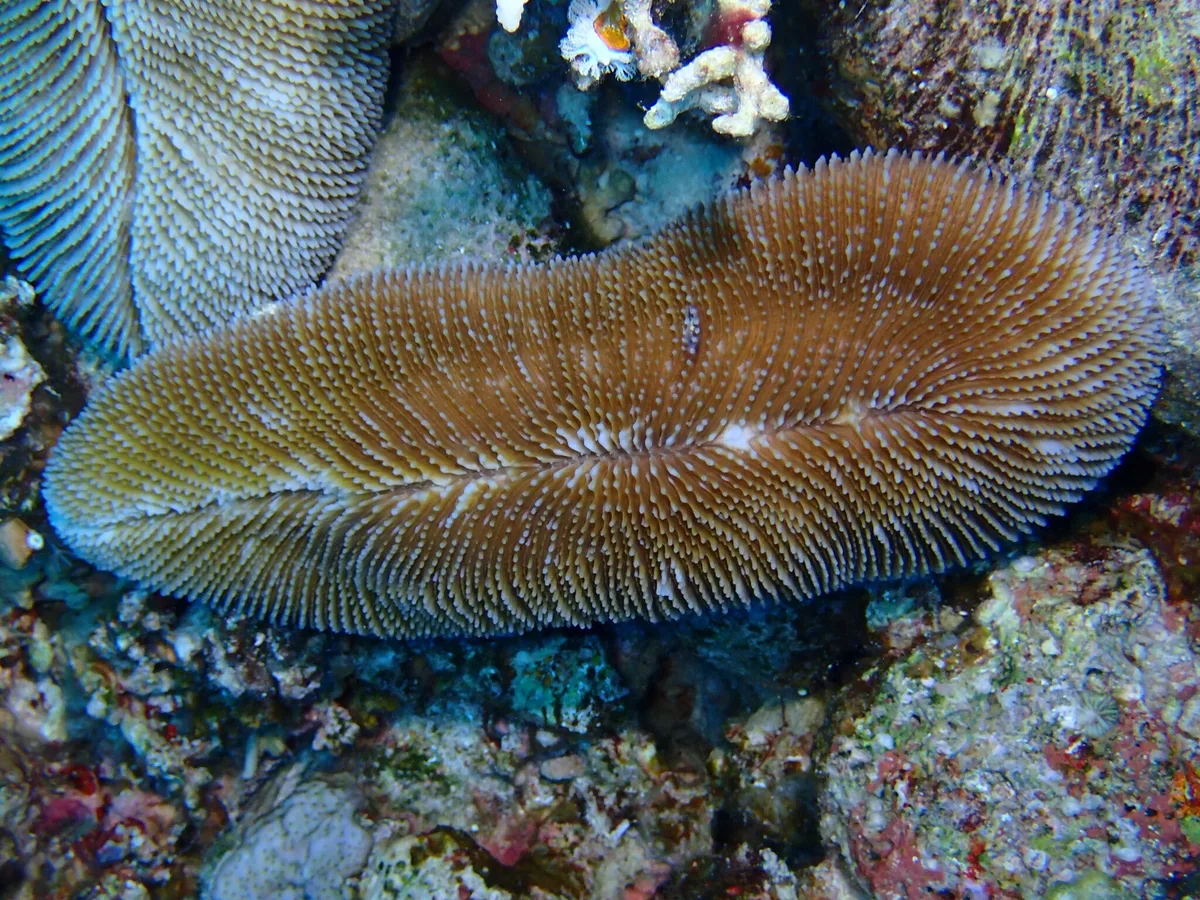
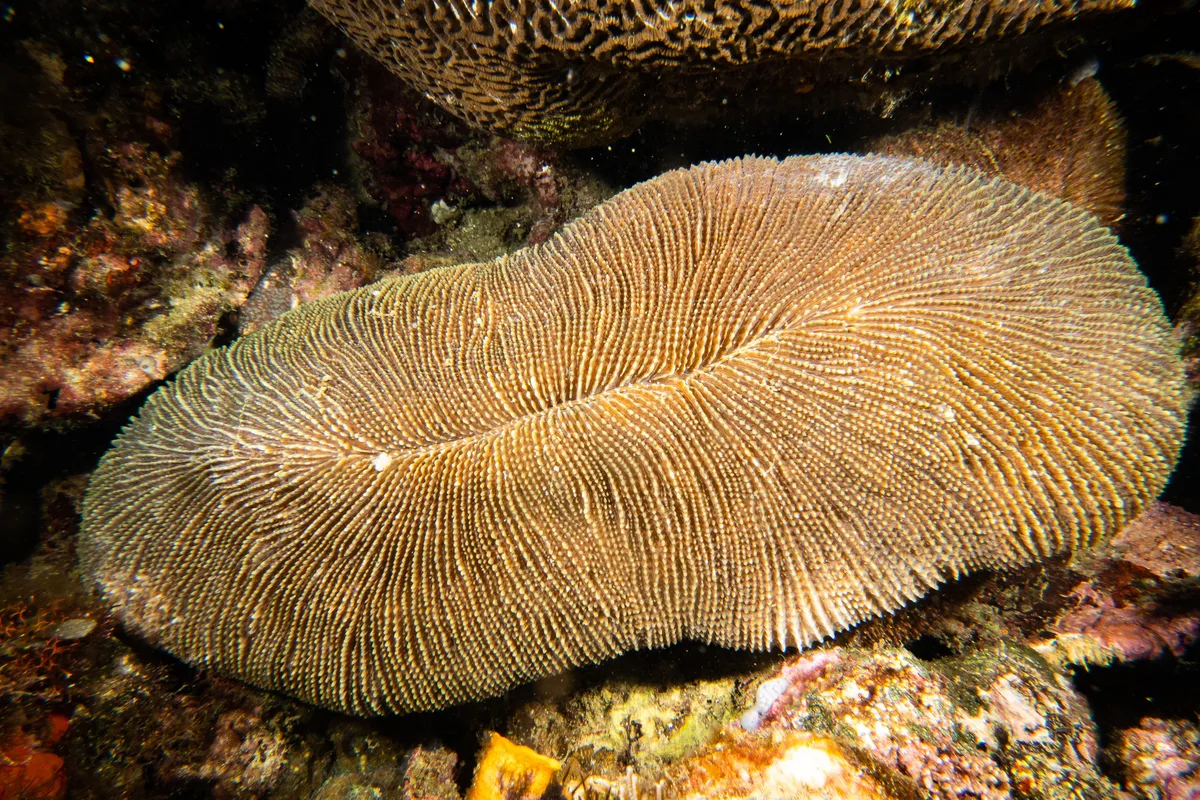
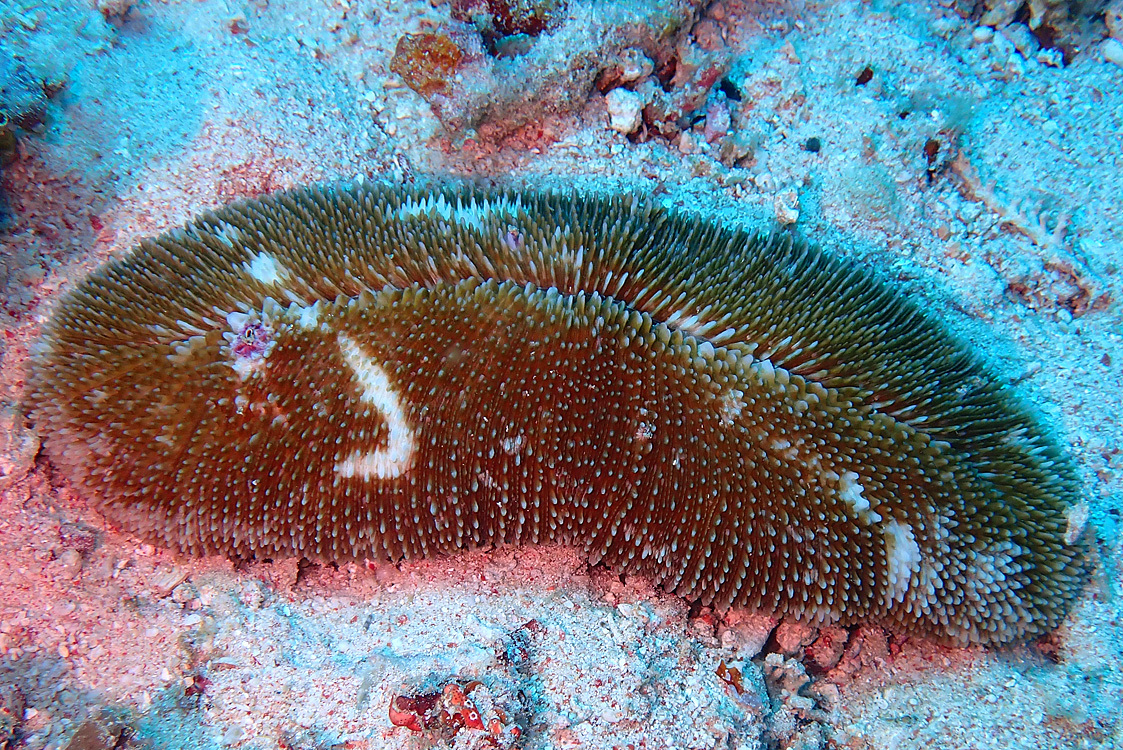
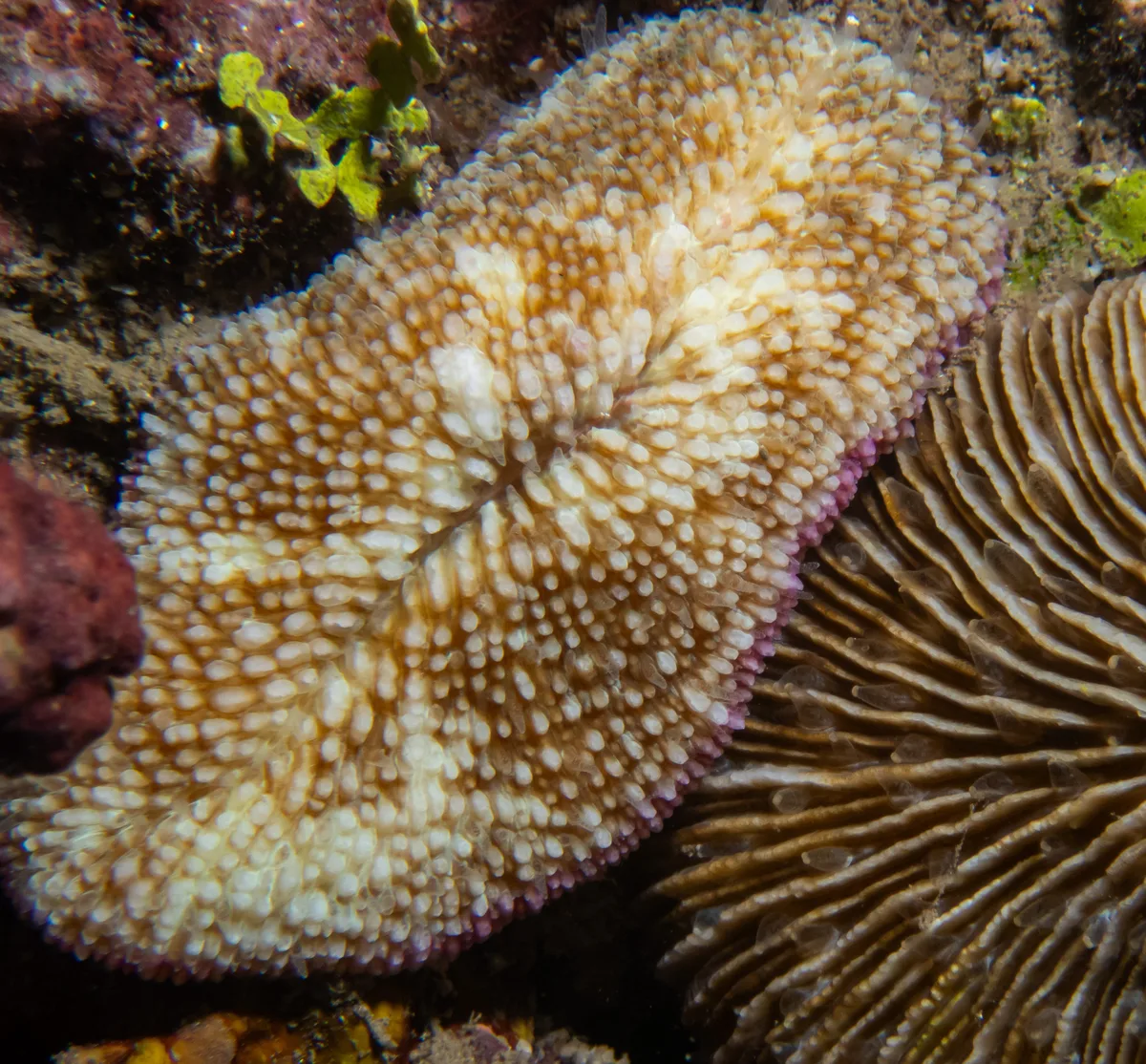
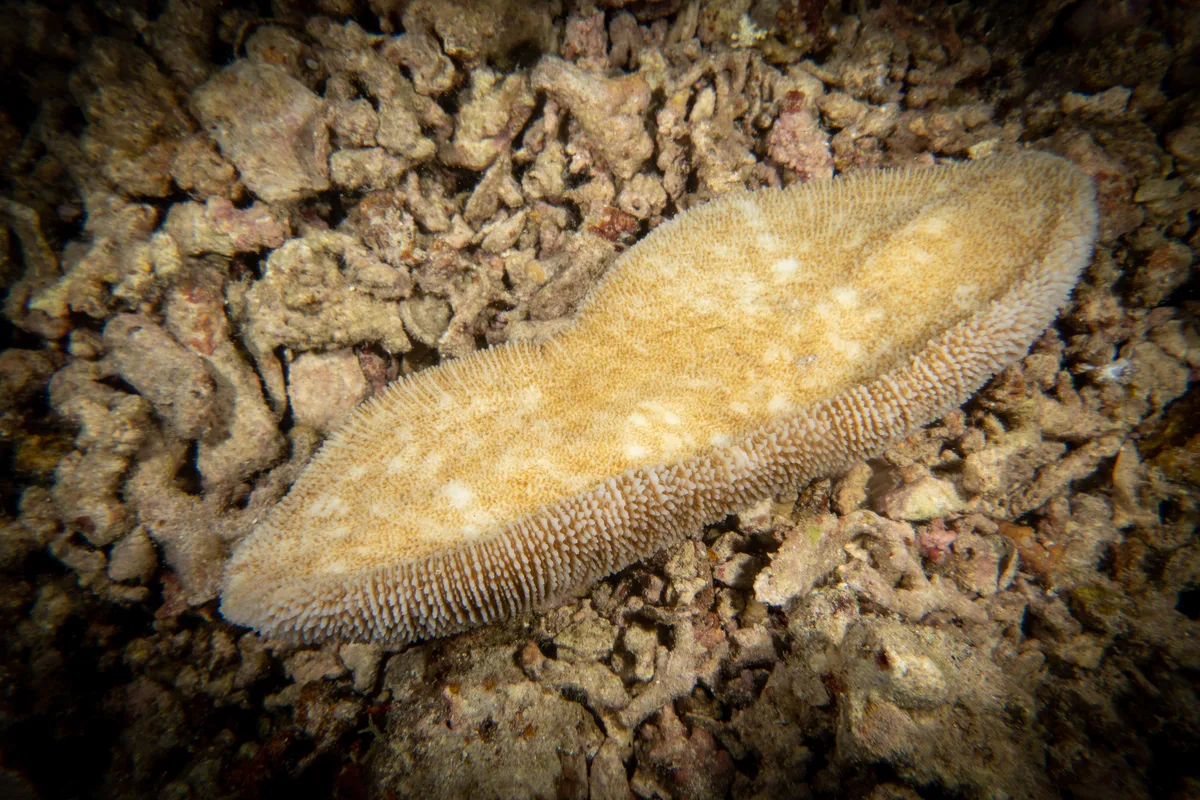
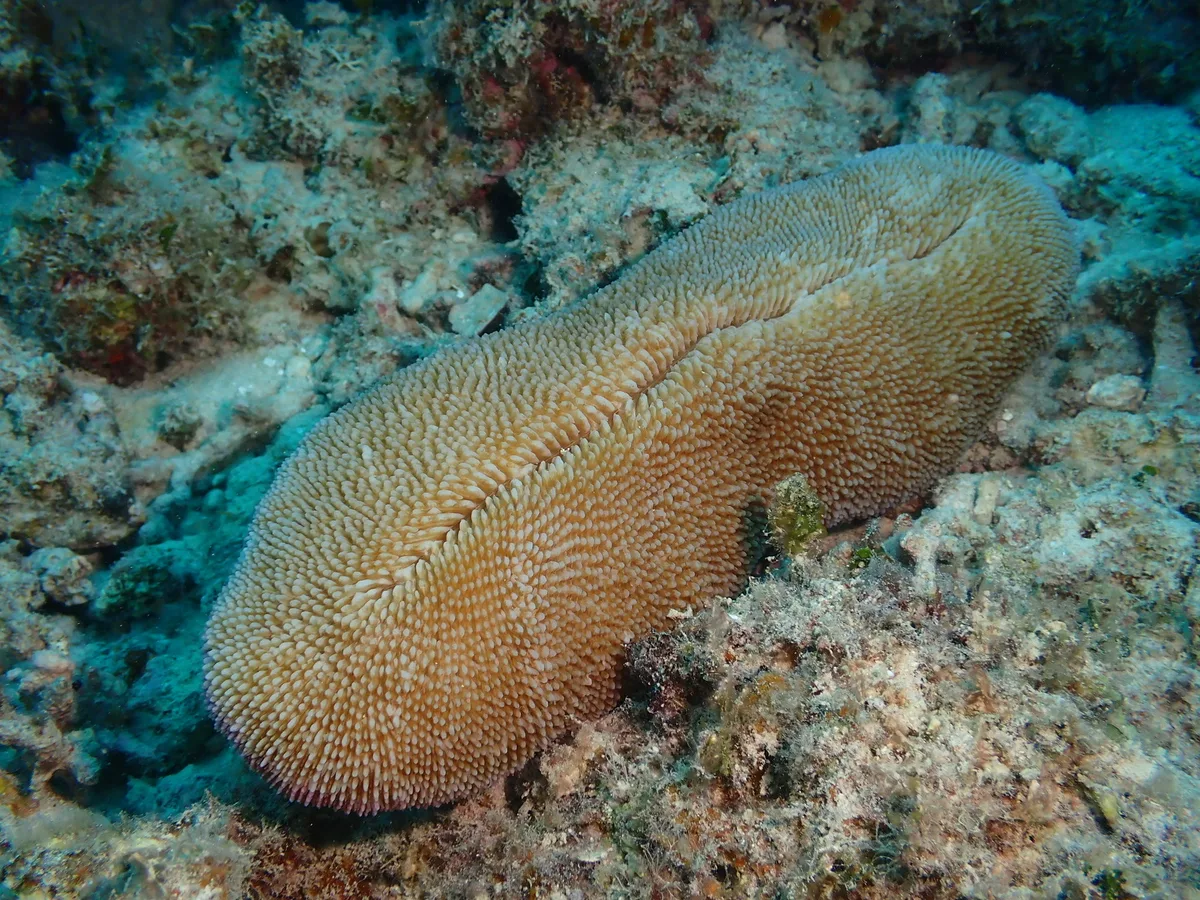
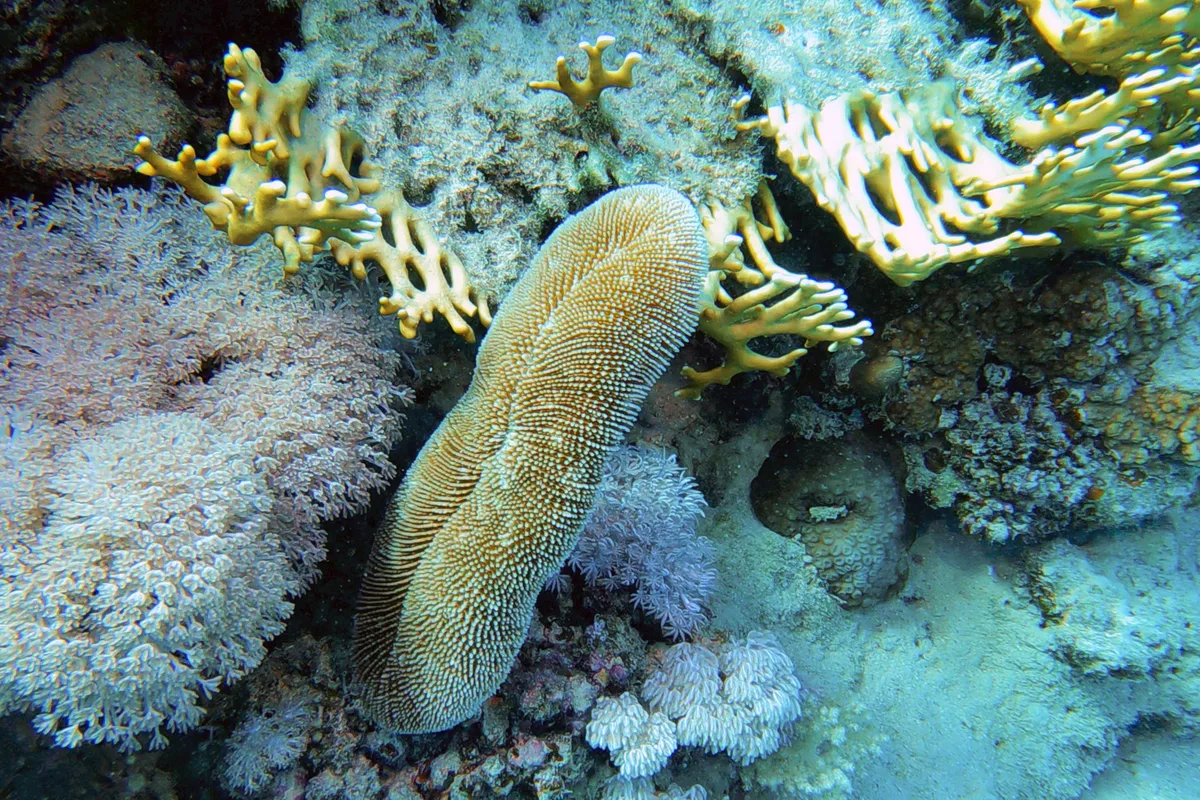
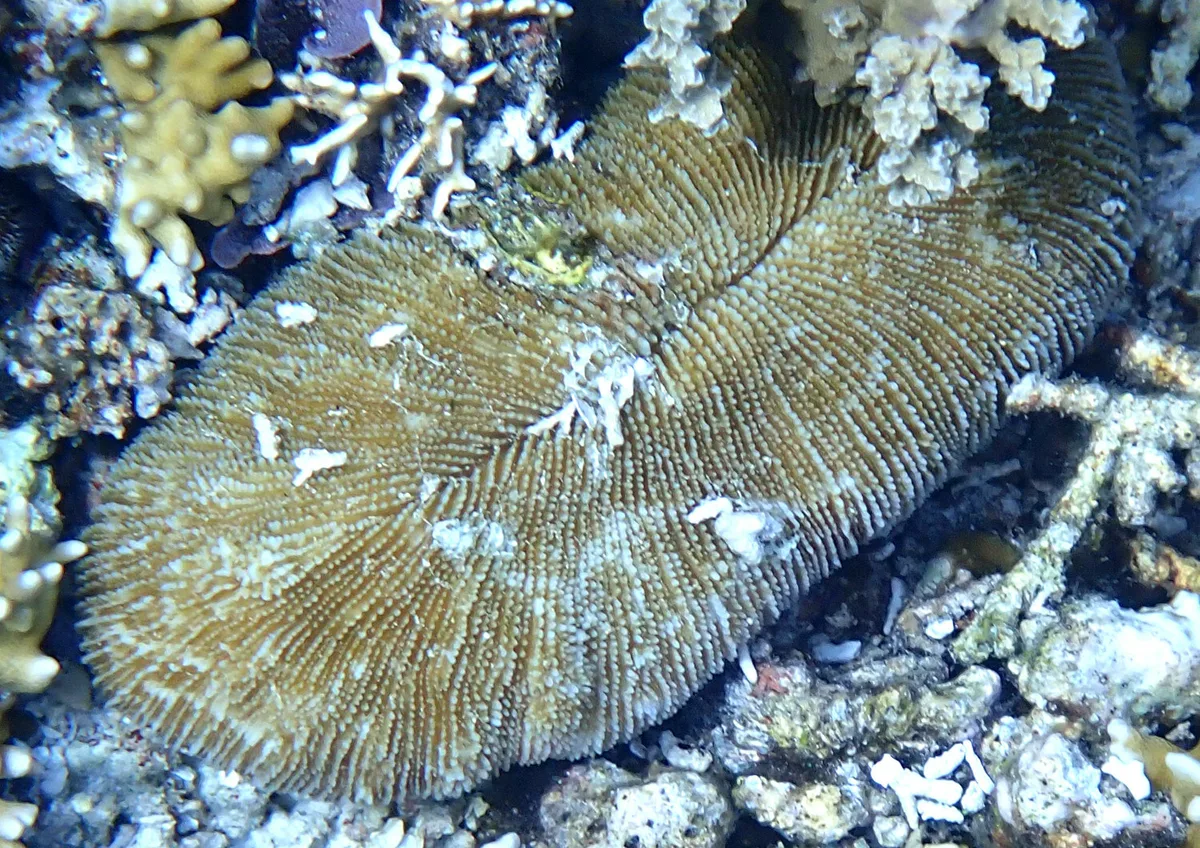
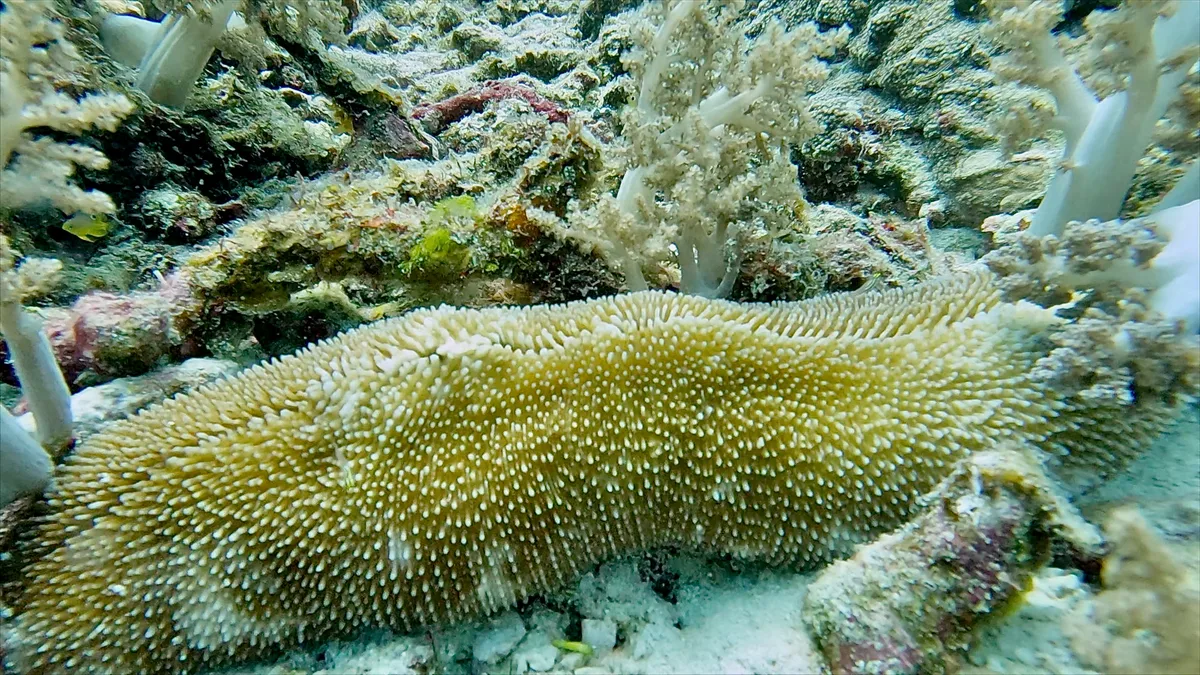
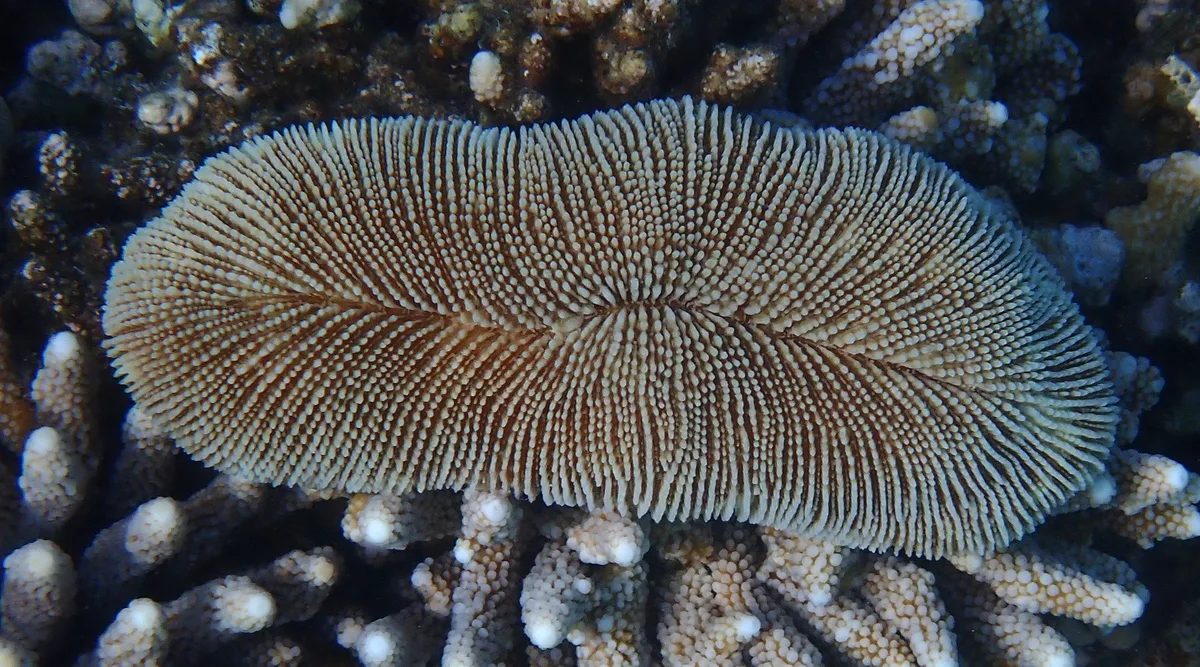
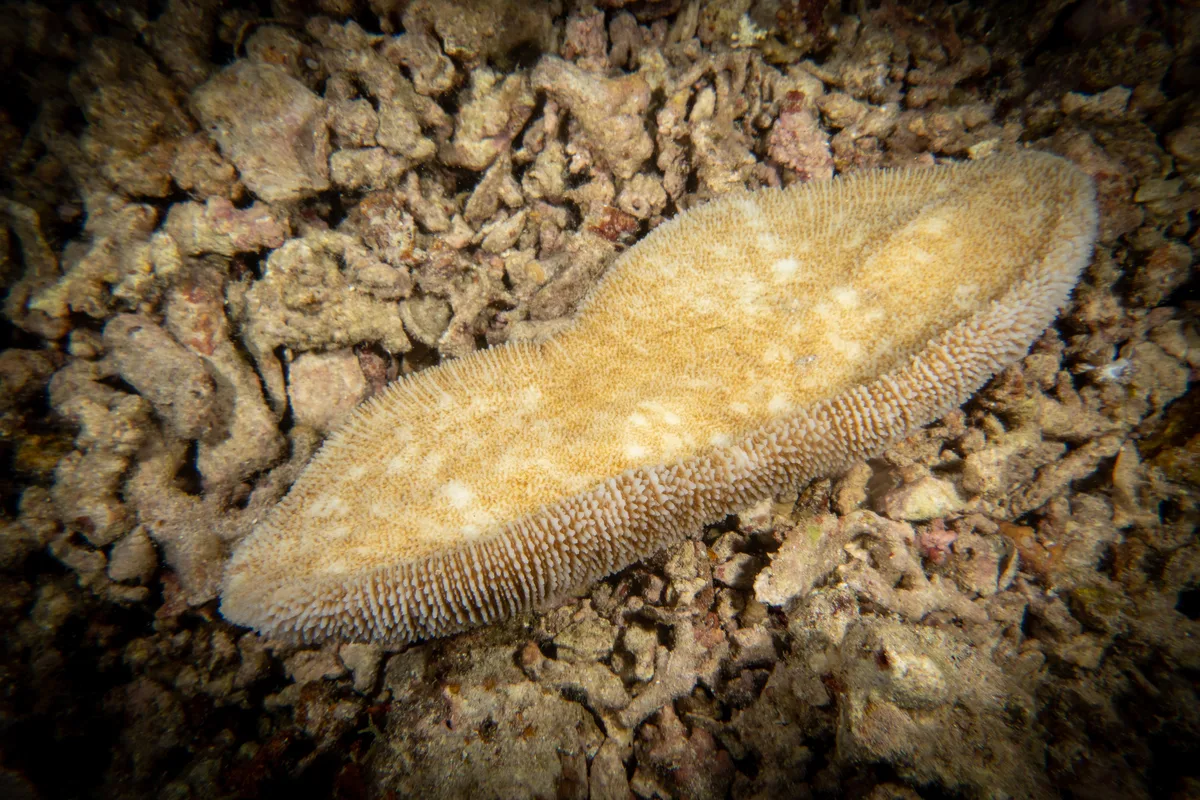
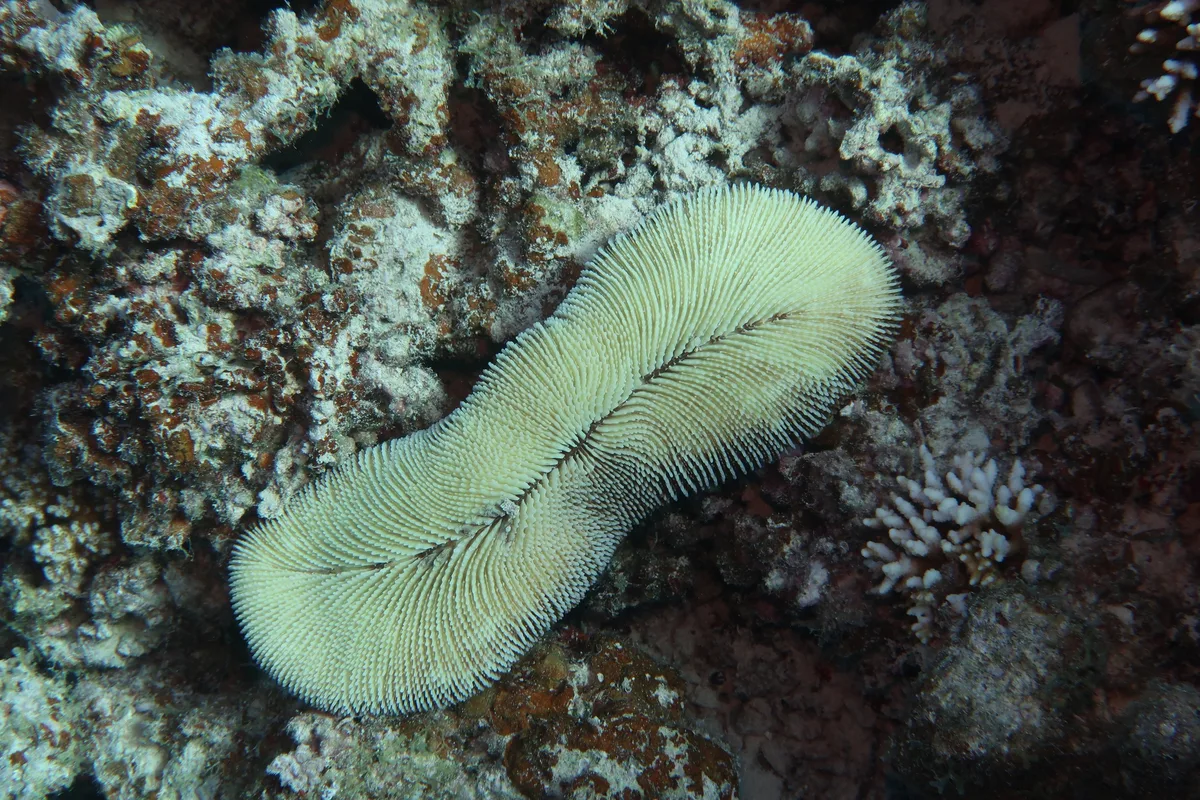
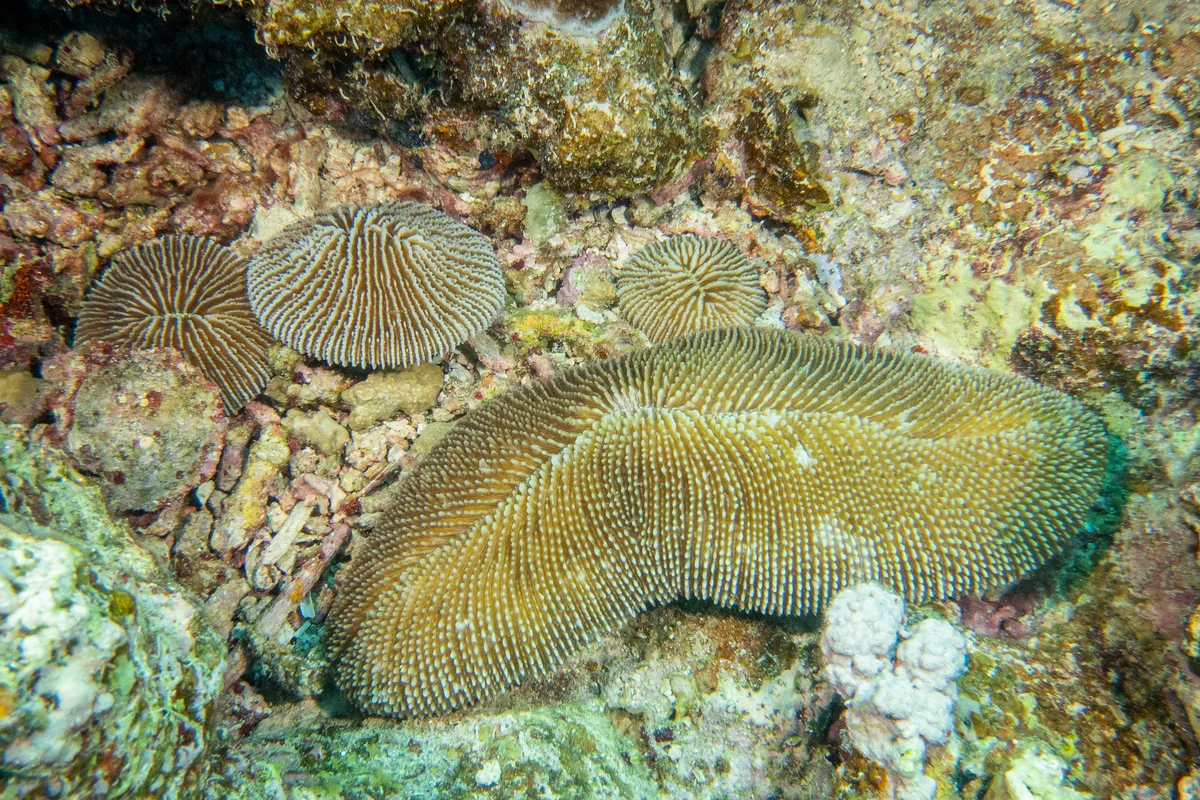
This is one animal. One polyp, up to 48 cm long, lying loose on the sand and cemented to nothing.
Almost every other stony coral on the reef is a colony: thousands of small polyps, all clones, all fixed to the rock. Mushroom corals went the other way. A Ctenactis begins life as a tiny polyp on a stalk, attached to hard bottom. Then it dissolves its own skeleton along a clean plane just below the disc, breaks free, and spends the rest of its life unattached. The stump left behind can bud a replacement, and another after that.
Lying loose has a cost. Sand slides, storms and clumsy fins turn these corals over, and a mushroom coral face down in sediment suffocates. So they move. By pumping water in and out of the tissue in slow rhythmic pulses, a free-living fungiid can shuffle across the bottom and flip itself upright. In the closely related tongue coral, time-lapse recorded a complete righting in about six hours.
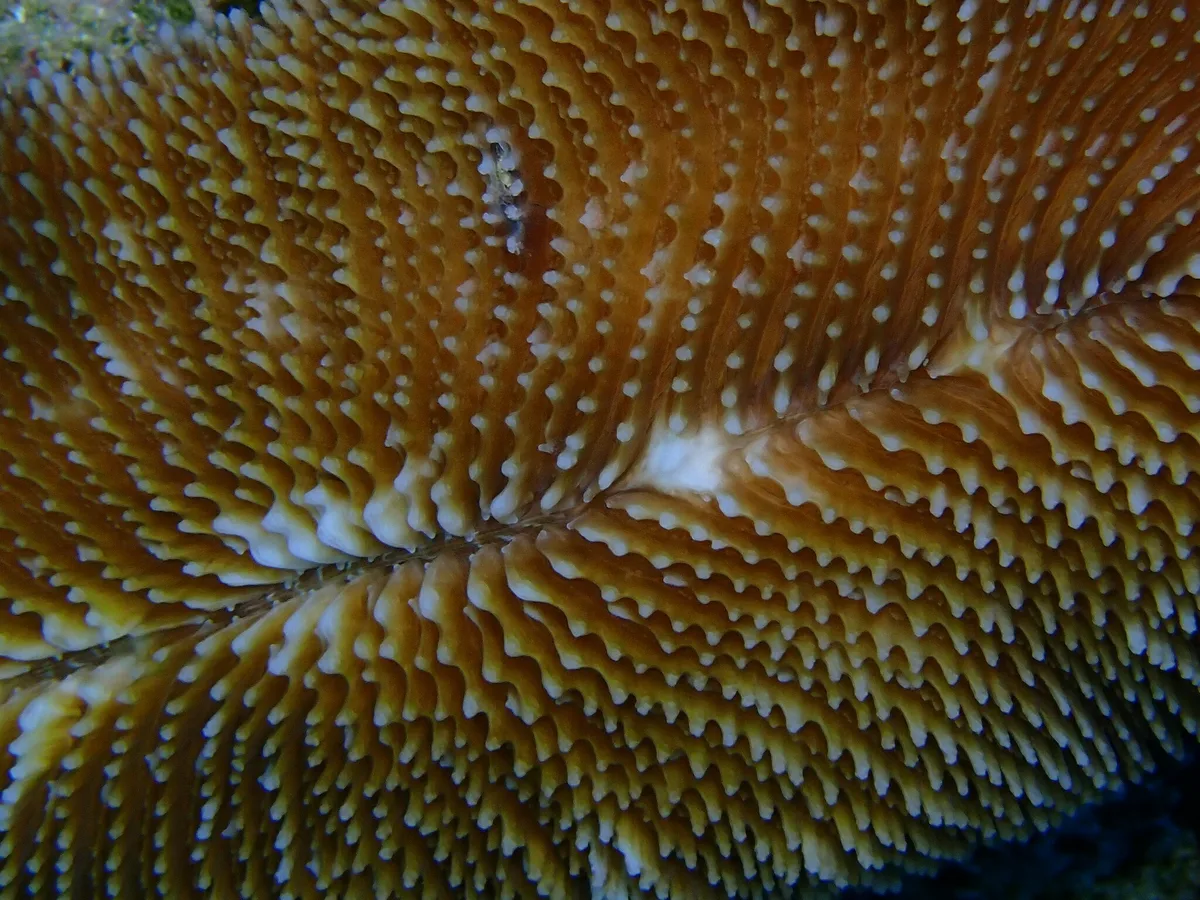
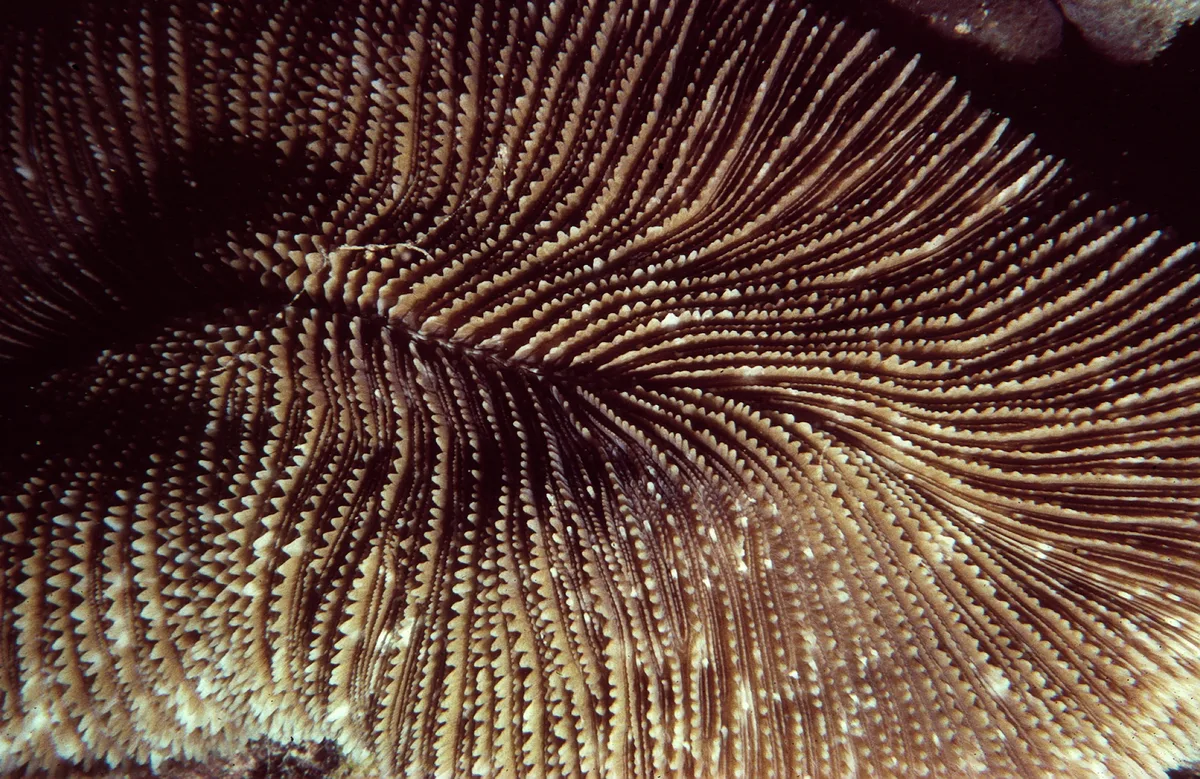
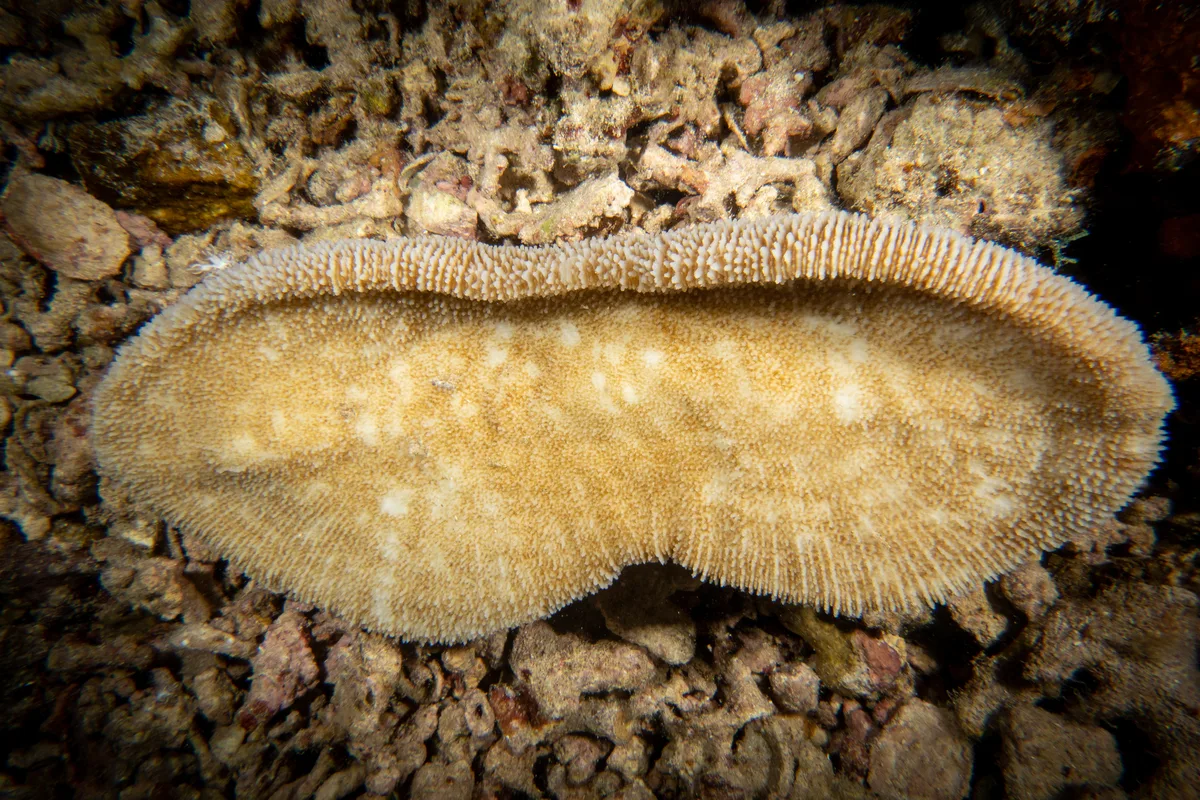
To identify it, look at the mouths. The disc is an elongate oval, pale brown, with an axial furrow running almost its full length, and several mouths are spaced along that furrow with none outside it. Ctenactis echinata, the commoner relative, has a single central mouth instead; the tongue coral Herpolitha limax has mouths scattered over the disc as well as in the furrow. Fungiids are genuinely hard, borderline cases need the dry skeleton in hand, and a photograph of a sand-dusted disc often will not settle the question.
It lies on sandy lagoon floors and on reef slopes sheltered from surge, from about 1 m down to 30 m, often along the line where reef meets sand, and on the Egyptian coast it is a regular sight rather than a find. Like most reef corals it grows algae in its tissue and feeds itself as well, putting out tentacles after dark. One more thing about the genus: individuals of Ctenactis echinata have been recorded changing sex back and forth, male one season and female the next.
- a single elongate oval disc lying loose on the bottom
- an axial furrow running almost the whole length
- several mouths spaced along the furrow and none outside it
- pale brown, with low rows of teeth across the upper surface
- up to 48 cm long
Why it's threatened
Threat classification from the IUCN Red List.