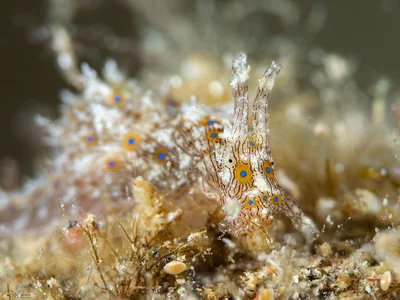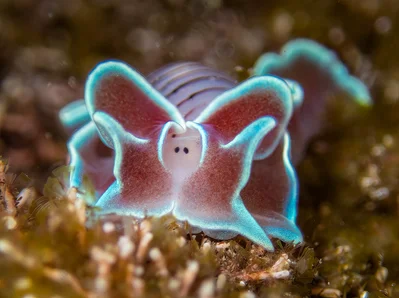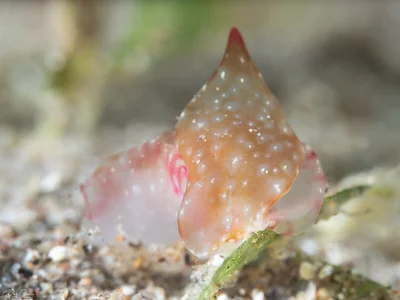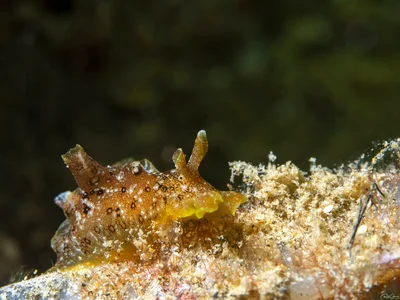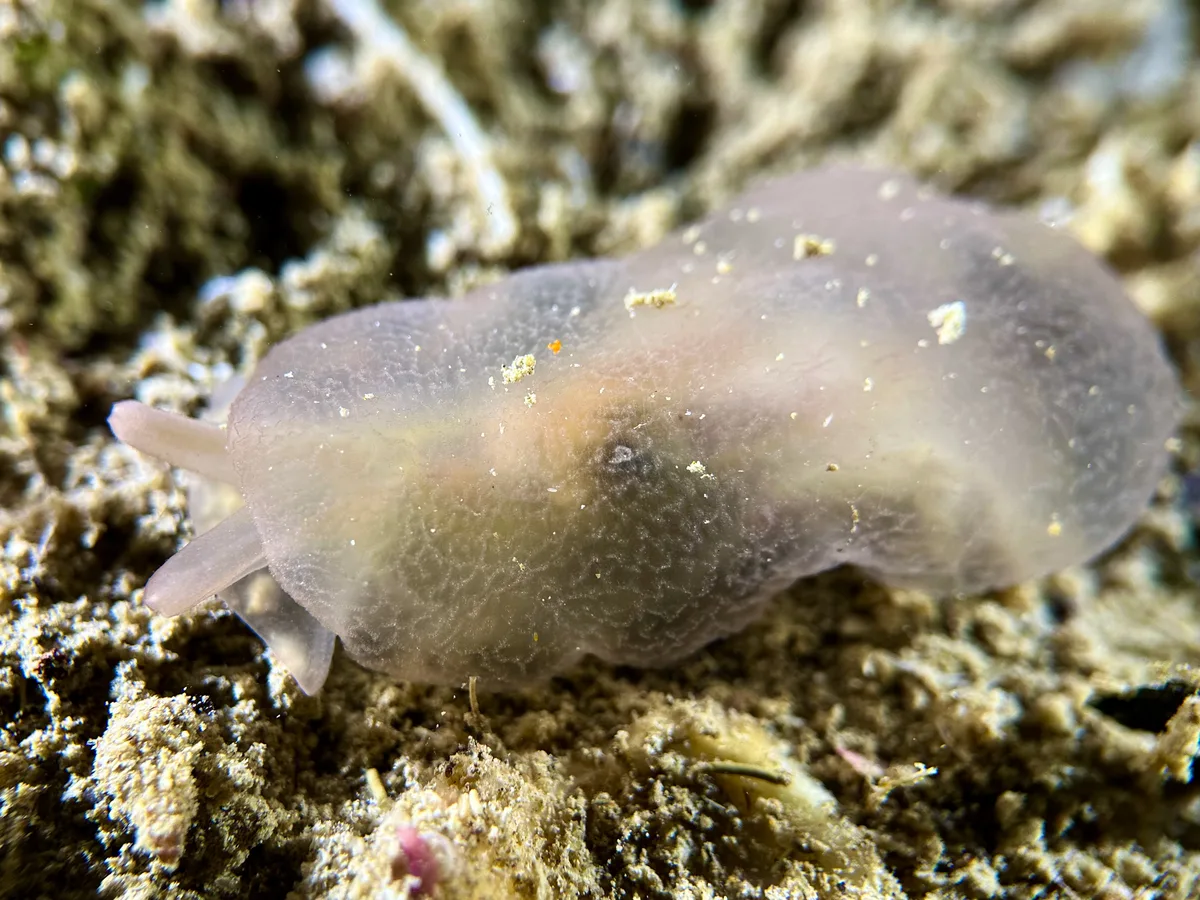
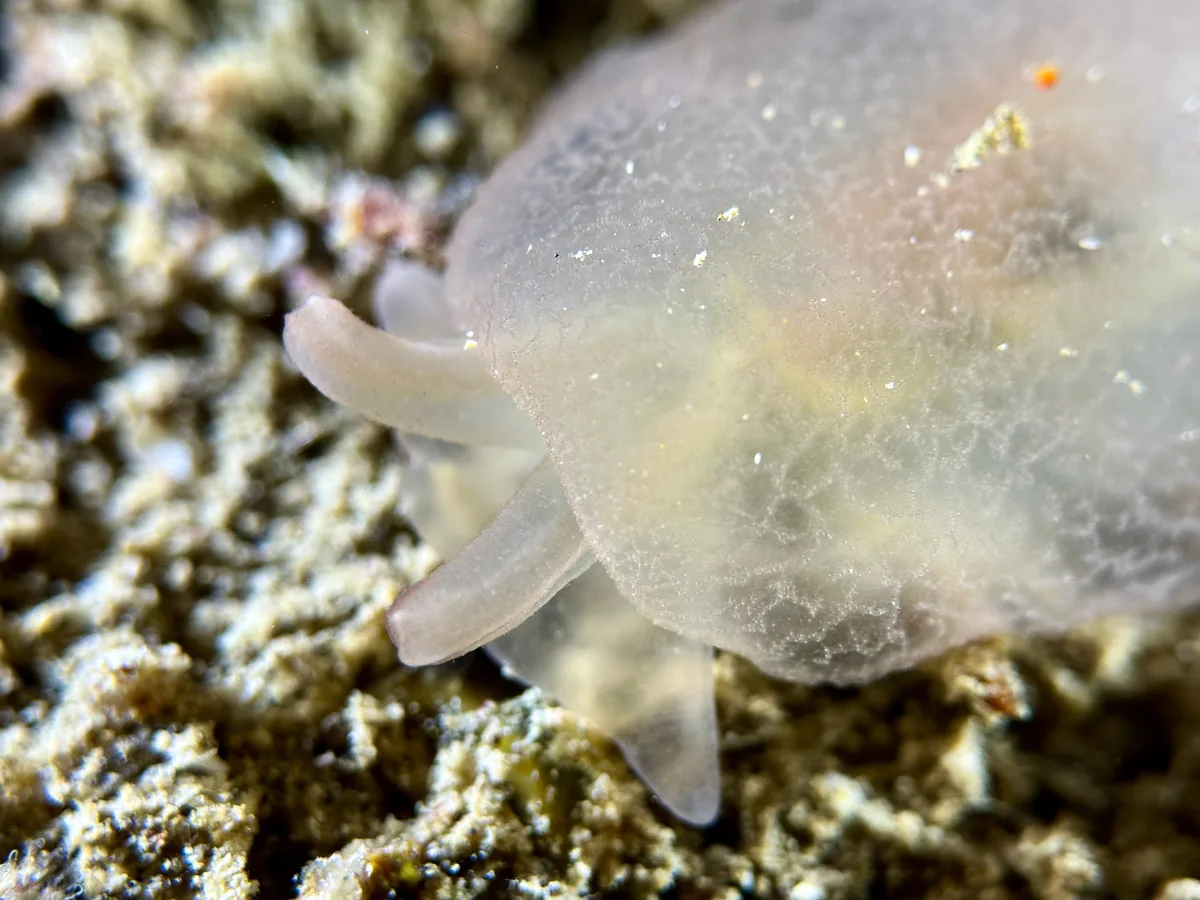
Berthella sp. 1 is a sidegill slug, often mistaken for a nudibranch due to its lack of an obvious external shell. It belongs to the Pleurobranchidae family, distinguished by a single, prominent gill hidden on the right side of its body, tucked beneath the mantle. The species has a translucent, almost jelly-like body, reaching a maximum length of 25 mm (0.98 in). Its dorsal surface is covered in a network of opaque white lines that radiate from a central dark spot, which is the outline of its internal organs visible through the skin. This pattern contributes to its cryptic appearance. The label "sp. 1" is not a name. It is the working tag a catalogue puts on an animal that has been photographed but not pinned to a species, and it stays until somebody examines the internal shell and the radula, which cannot be done from a picture. The animal may already have a name in the literature; this individual has simply not been matched to one.
Berthella sp. 1 is highly light-sensitive and strictly nocturnal. During daylight hours, it conceals itself deep under stones, dead coral formations, and rubble, typically in sandy areas adjacent to reef structures. At night, it emerges to forage. Pleurobranchs of this genus feed on sponges, rasping into encrusting growth on the underside of rubble, and nothing here suggests this one does otherwise. Its small size and effective camouflage make it challenging to locate during dives. Whether it lives anywhere else is unanswerable while it has no name: range is a property of a species, and this animal is still a photograph in search of one.
- translucent lilac-white body, jelly-like and smooth
- internal organs showing through as a soft peach mass in the middle
- fine pale reticulation over the mantle, visible only up close
- a pair of rolled rhinophores in front, and no gills on the back