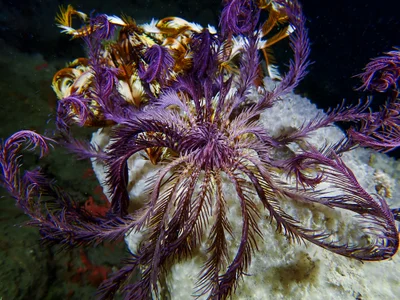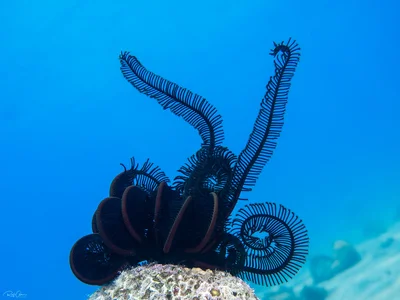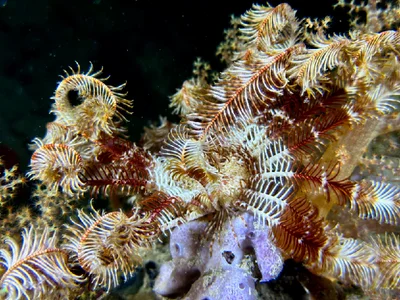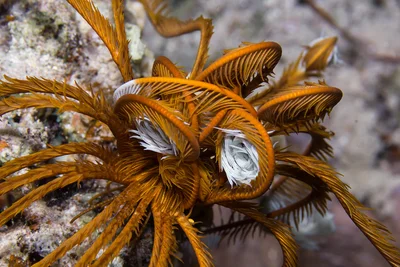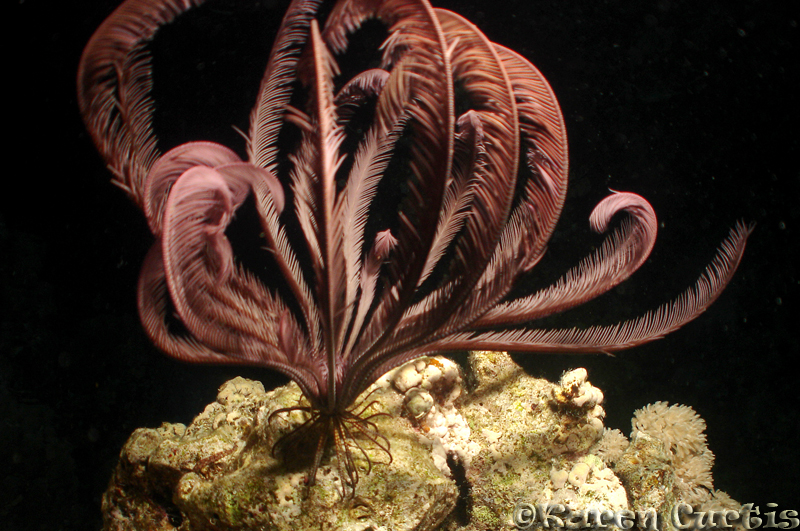
A feather star of about 20 cm (8 in) across, usually a uniform dark brown to black, and far more retiring than the species that perch in the open. Through the day it stays wedged in a crevice or under an overhang with nothing but arm tips protruding, which is how most divers see it - as a few dark feathery points at the edge of a hole.
After dark it works out to the lip and unfolds, filtering plankton from the current. Long stiff cirri underneath hold it in place against surge that would tear a looser grip free. The species was named for Jules-César Savigny, the naturalist of the French expedition to 🇪🇬 Egypt, whose plates of invertebrates from this coast were so precise that they are still consulted - and a good number of the animals in this catalogue carry names traceable to that survey. It is common here, with records concentrated in this sea and the 🌊 Gulf of Aden.
- arms usually uniform dark brown to black
- only arm tips visible from a crevice by day
- arm span about 20 cm
- long stiff cirri gripping deep inside the hole