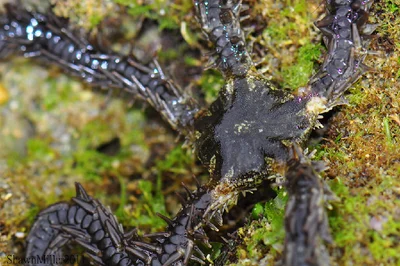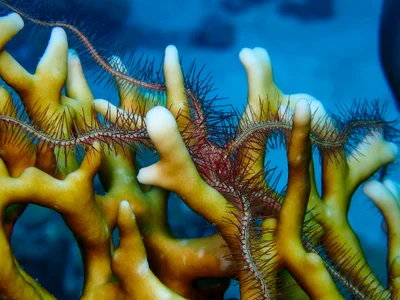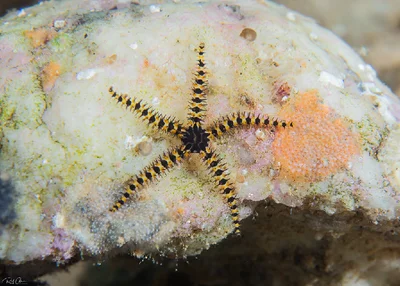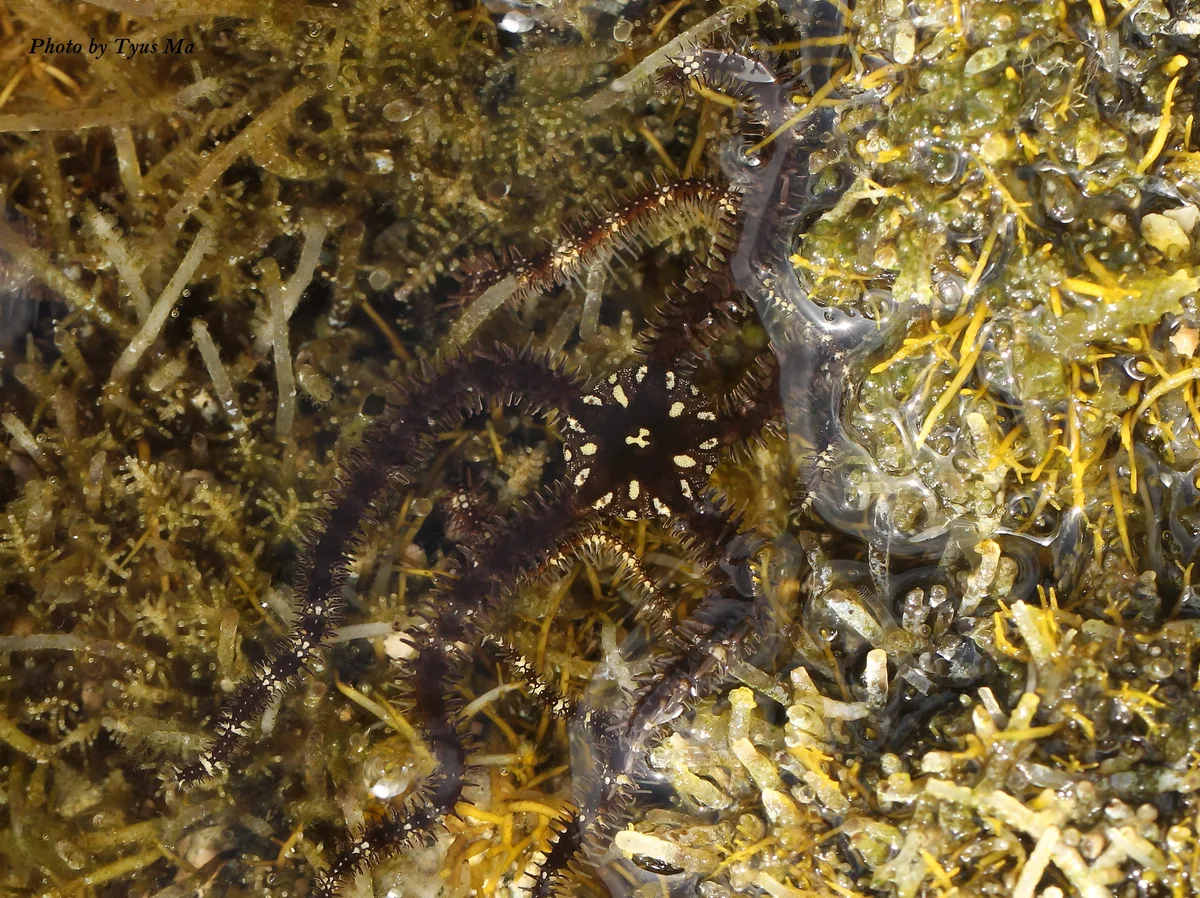
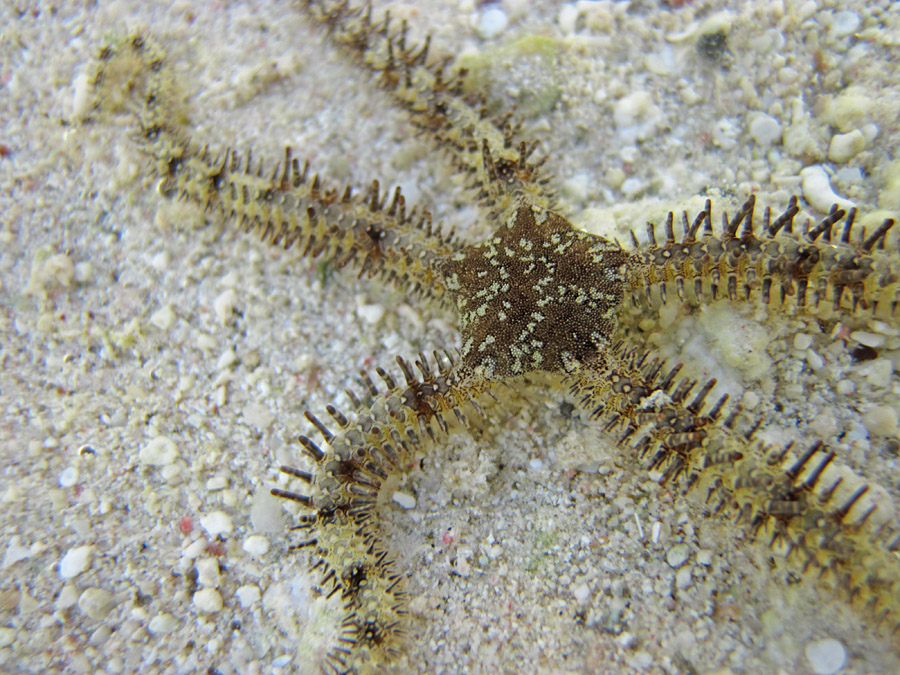
A brittle star of the tide zone with a mottled gray-green disc and five arms that are faintly banded rather than boldly patterned, reaching about 18 cm (7 in) across. The arms carry rows of flattened spines and move in the rippling, many-legged way that gives the species its name - scolopendrina, after the centipede. The body itself stays wedged in a crevice; usually only arms are visible.
The feeding behavior is what sets it apart. Animals anchor in a crack in the intertidal rock and extend two or three arms onto the surface of the water at high tide or in surge, sweeping the surface film sideways to skim off floating organic particles, then curling the arm back to the mouth. It is one of the few echinoderms that feeds at the air-water boundary, and the sweeping is done in daylight, unlike most of its relatives. Depth is effectively zero to 3 m (10 ft): this is a shoreline animal, and a rocky 🌊 Red Sea shore at high water often has dozens working within a few meters of each other.
- mottled gray-green disc, arms faintly banded
- lives wedged in tide-zone crevices
- sweeps the water surface with two or three arms