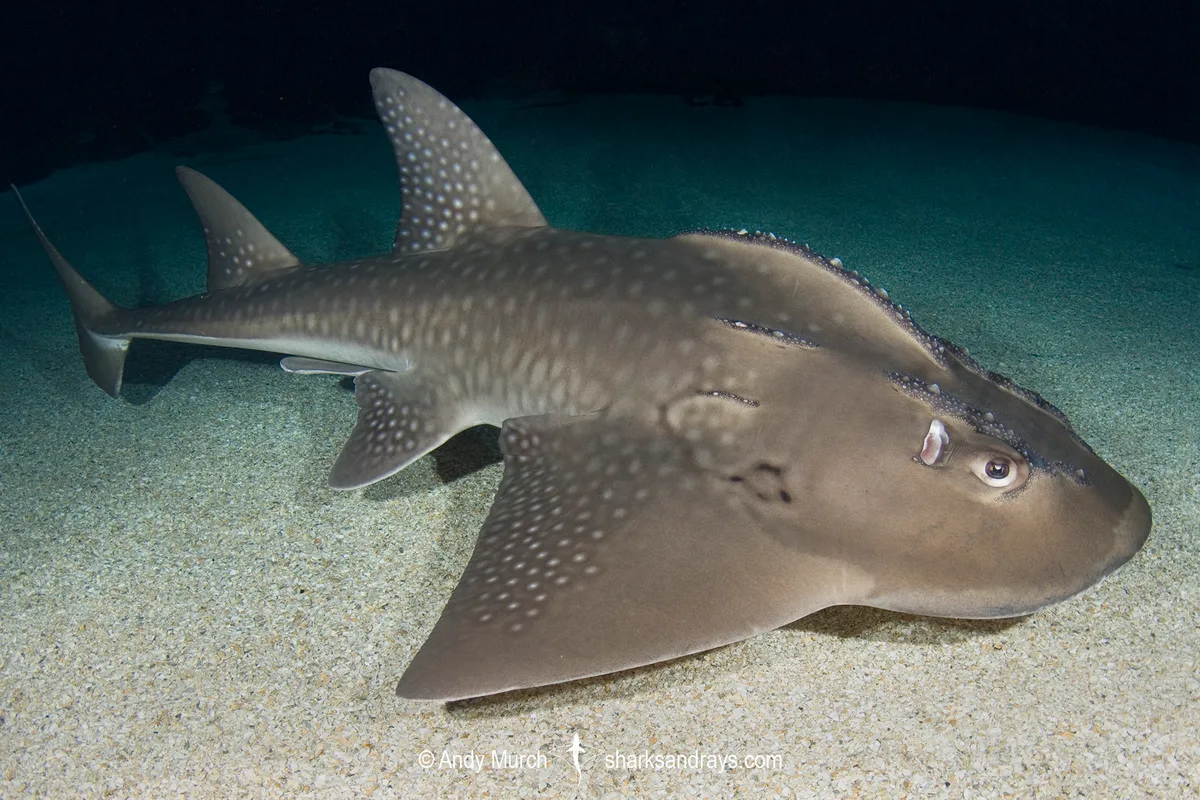
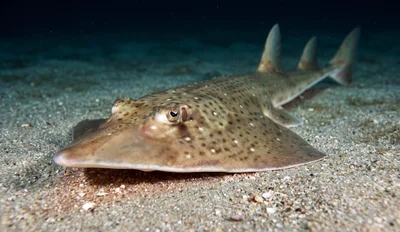
Globally, wedgefishes are subject to intense fishing pressure on their coastal and shelf habitats that is unregulated across the majority of their distributions. Wedgefishes are captured in industrial, artisanal, and subsistence fisheries with multiple fishing gears, including gillnet, trawl, hook and line, trap, and seine net and are generally retained for their meat and fins (Bonfil and Abdallah 2004, White and Sommerville 2010, Moore 2017, Jabado 2018). There is a high level of fisheries resource use and increasing fishing pressure across the range of the Bowmouth Guitarfish, and demersal coastal fisheries resources have been severely depleted in significant areas of the Indo-West Pacific, including India and Southeast Asia (Stobutzki et al. 2006, Mohamed and Veena 2016). Fishing pressure is however considerably lower across northern Australia.
In general, fishing effort and the number of fishers has increased in recent decades across the range of this species, with demand for shark and ray product increasing over the same period due to the shark fin trade (Chen 1996, Jabado et al. 2017). In the Red Sea for example, the number of traditional boats tripled from 3,100 to 10,000 from 1988 to 2006 (Bruckner et al. 2011), and in the Indian state of Gujarat, the number of trawlers increased from about 6,600 in the early 2000s to 11,582 in 2010 (Zynudheen et al. 2004, CMFRI 2010, Jabado et al. 2017). All Indian states have high numbers of trawlers (e.g., as reported in 2010: Maharashtra, 5,613 trawlers; Kerala, 3,678 trawlers, Tamil Nadu, 5,767 trawlers; total trawlers in India: 35,228) and a high number of gillnetters (total of 20,257 as reported in 2010), and most countries have significant fishing fleets operating in coastal waters e.g., Oman (19,000 artisanal boats), Pakistan (2,000 trawlers), Sri Lanka (24,600 gillnet vessels operating in 2004), and Indonesia (~600,000 fishing vessels in marine waters) (Dissanayake 2005, CMFRI 2010, KKP 2016, Jabado et al. 2017).
Sharks and rays, including wedgefishes, are often targeted and now heavily exploited across the region by net and trawl fisheries and increasing fishing effort has put significant pressure on all wedgefish species in the Indo-West Pacific. Furthermore, the high value of fins is driving retention and trade of wedgefishes globally and the targeting of wedgefishes for their fins has also been reported in numerous countries, including Indonesia, Malaysia, Madagascar, Mozambique, and Tanzania (Cripps et al. 2015, Barrowclift et al. 2017, Moore 2017, Jabado 2018). The Bowmouth Guitarfish is landed throughout its range (e.g., White and Dharmadi 2007, Last et al. 2010, Jabado 2018) and several countries within the distribution of this species rank among the top 20 shark fishing nations globally, specifically Indonesia, India, Taiwan, Pakistan, Japan, Malaysia, Thailand, Sri Lanka, and Iran (Lack and Sant 2011). Wedgefishes have been targeted in Indonesia since the 1970s, and these target fisheries have shifted spatially in response to localized depletions (Chen 1996, White and Dharmadi 2007, White and Sommerville 2010, Last et al. 2016, W.T. White, pers. comm. 2015).
Fishing pressure is considerably lower across northern Australia and in Papua New Guinea, which provides some refuge for this species. The degree of connectivity with Indonesia and elsewhere is however unknown, and if animals regularly move into Indonesian waters they would face significantly higher levels of fishing pressure there. There are no target fisheries for this species in Australia, but it is taken as bycatch in numerous non-target fisheries (e.g., Stobutzki et al. 2002). The introduction of Turtle Exclusion Devices in northern and eastern Australian prawn trawl fisheries is likely to have significantly reduced this species' mortality in trawl fishing gear (Brewer et al. 2006).
Illegal, unreported, and unregulated (IUU) fishing is known to occur in some parts of the range, for example by foreign and regional trawlers in Somalia and Yemen, with wedgefish specifically targeted off East Africa (IOTC 2005, Jabado et al. 2017). In northern Australia, wedgefish account for a minor component of the IUU fishing. The IUU activity peaked in the mid-2000s, and although vessel numbers have declined since then, there is still some illegal fishing in the region (Field et al. 2009, Marshall 2011, Harward and Bergin 2016).
The shallow, inshore soft-bottom habitat preferred by the species is threatened by habitat loss and environmental degradation (Stobutzki et al. 2006, White and Sommerville 2010, Moore et al. 2012, Jabado et al. 2017, Moore 2017). In the Arabian Sea and adjacent waters, dredging and coastal land reclamation has increased in recent years and has resulted in almost total loss of mangroves in some areas, such as Bahrain (Sheppard et al. 2010, Jabado et al. 2017), while Southeast Asia has seen an estimated 30% reduction in mangrove area since 1980 (FAO 2007, Polidoro et al. 2010).