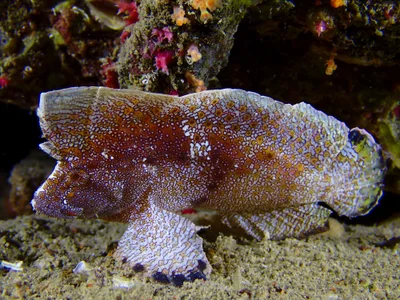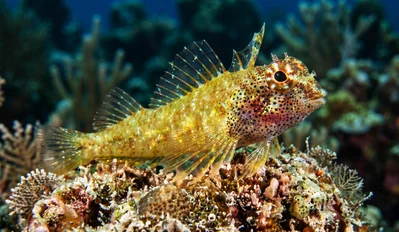
The skin is the whole animal. It has no scales, and the surface is covered in minute papillae that give it the texture of velvet, which is where the family gets its name.
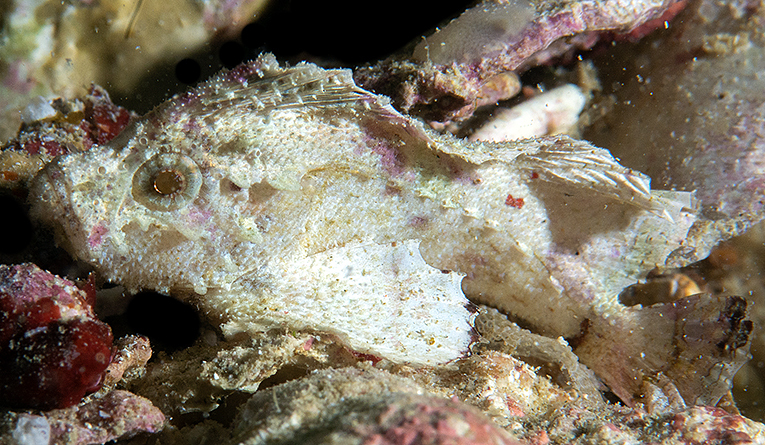
That texture is not decorative. A smooth fish stays clean; a velvet one collects silt, algae, diatoms and fine debris and holds them, so within days of settling on a patch of bottom the fish is wearing it. The camouflage is not painted on, it accumulates, and it updates itself every time the animal moves somewhere new.
The rest of the body agrees with that strategy. Velvetfishes have no swim bladder, so they cannot hover and do not try: they sit on the bottom, walk short distances on their lower fins, and when something approaches they stay exactly where they are, because moving is the only thing that would give them away.
At five centimeters, silt-covered and motionless on rubble, this one is effectively invisible, and almost every record of it comes from someone who was looking for something else. Five distinct spines on the rear edge of the cheek separate it from its relatives, if you get close enough to count them.
The species. Cocotropus steinitzi Eschmeyer & Dor 1978 - Honours Heinz Steinitz. ETYFish
- skin like velvet, scaleless and covered in minute papillae
- five distinct spines on the rear edge of the cheek
- tiny, up to 5 cm, and normally caked in silt and algae
- sits on the bottom and does not swim off when approached