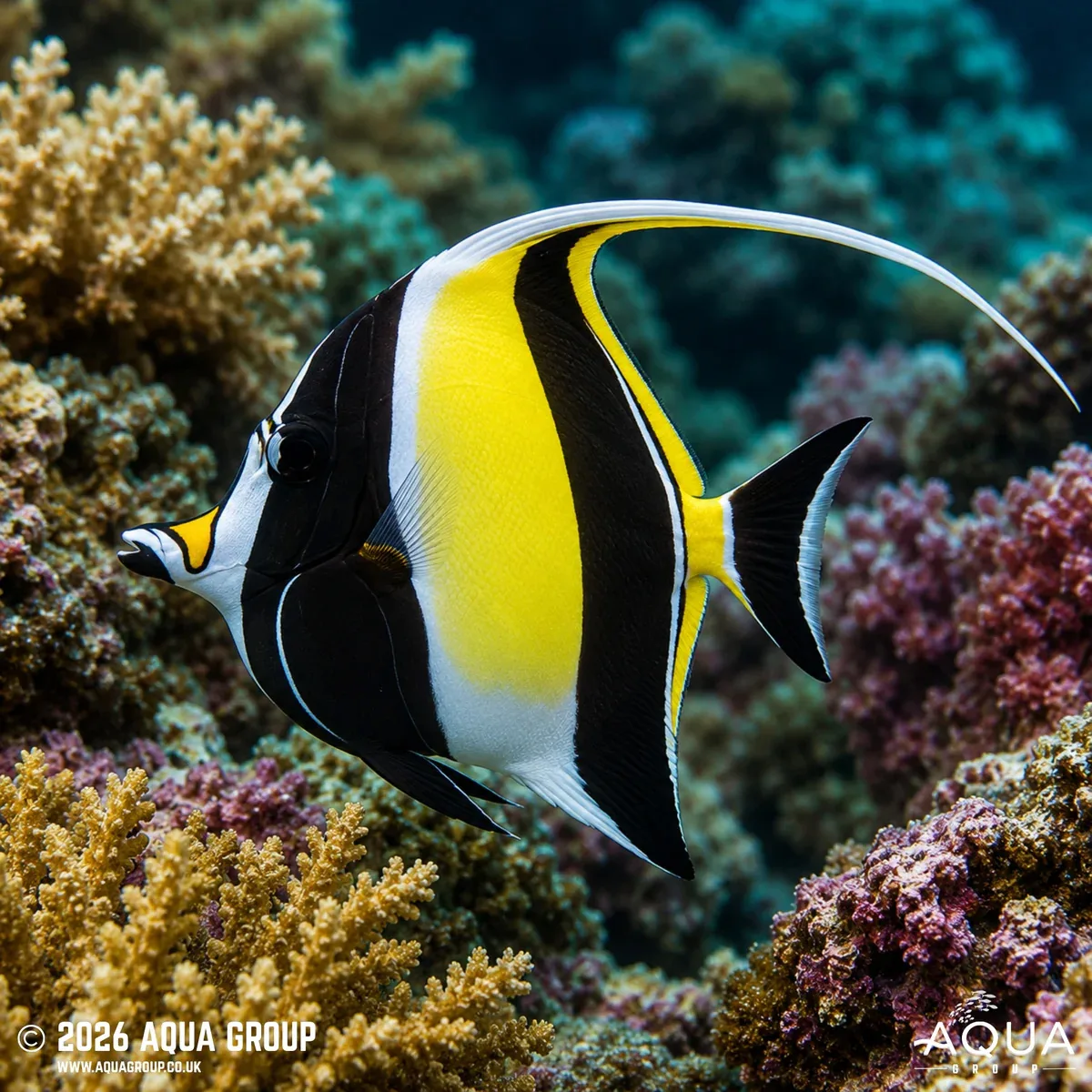
Moorish idolsZanclidae
The same fish is on reefs from here to 🇲🇽 Mexico. One species, from the 🌊 Red Sea and East Africa right across the Pacific to the Gulf of 🇺🇸 California, which is close to the largest range any reef fish has, and it is the same animal at both ends with no local forms worth arguing about.
The explanation is the young. A moorish idol drifts in the open ocean as a larva for months, far longer than most reef fish manage, and settles at a size at which many species have long since had to find bottom. A drift that long means no population is ever really cut off from the next one: larvae from one reef arrive at reefs an ocean away, the whole range stays stirred, and a fish that never gets isolated never splits into new species. The single species with no relatives and the enormous range are the same fact seen from two ends.
The face is a tool. The snout is drawn out into a tube with a small mouth and fine bristled teeth at the end of it, and it exists to reach into places a deep-bodied fish has no business in: cracks, undercuts, the gaps between coral branches. Young ones carry a pair of bony horns above the eyes that they lose as they grow, and those are what the scientific name refers to. The trailing dorsal filament goes the other way and keeps getting longer.
It is famous twice. Once as the aquarium fish that almost nobody keeps alive, because the diet is specialized enough that a tank cannot supply it, and once as a cartoon: the fish leading the escape in Finding Nemo is one of these. Here you meet it in ones and twos over a reef slope, and the fish people mistake for it is a bannerfish wearing the same white body and black bars without the snout.
- long, streaming dorsal fin filament
- broad black, white, and yellow vertical body bands
- prominent black spot below the eye
- small, pointed mouth
1 species in Moorish idols
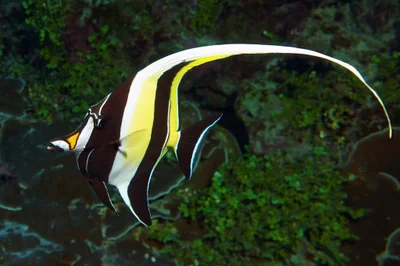
Other disc-shaped groups
Similar silhouette underwater - worth a look if this was not your animal.


Last Update: August 23, 2026