The Language of the Deep

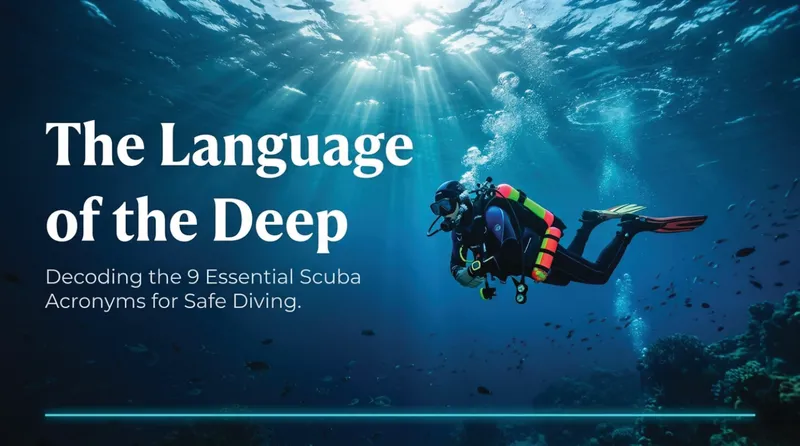
Nine essential scuba acronyms, decoded
Show up for your first boat dive and the surface world turns out to be anything but quiet. The captain starts calling out NDLs, SMBs and buddy checks - an alphabet soup that sounds like a secret code.
It kind of is. Every one of these acronyms is a small safety ritual, packed down into a few letters so it sticks when your heart's pounding and the current's pulling. Here are the nine that matter most, in the order you'll actually use them - from the moment you gear up to the moment you're back on the boat.
Start with the gear: SCUBA, BCD, LPI
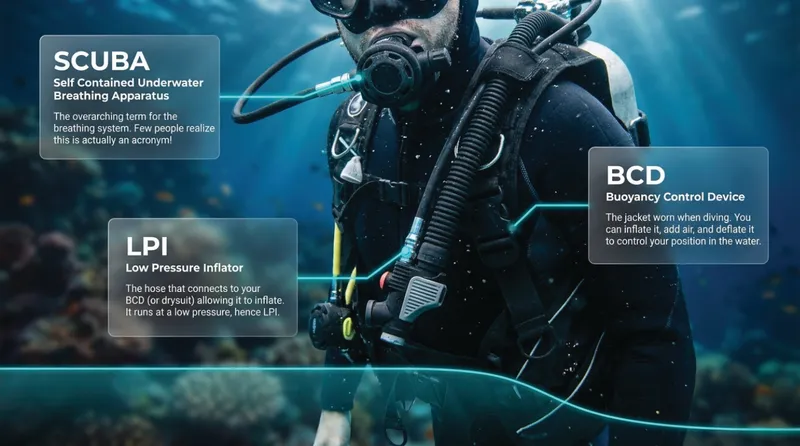
SCUBA gets thrown around as a plain word, but it's an acronym: Self Contained Underwater Breathing Apparatus. Before the 1940s, seeing a reef usually meant being tethered to a hose and a surface pump. SCUBA is the tech that cut the cord - a portable life-support system you carry on your back.
Two pieces of that kit have their own initials. Your BCD (Buoyancy Control Device) is the inflatable jacket that lets you hang weightless: add air to rise, dump it to sink. The hose that feeds it is the LPI (Low Pressure Inflator) - "low pressure" because it runs off gently reduced air, not the high-pressure line.
The buddy check: BWRAF
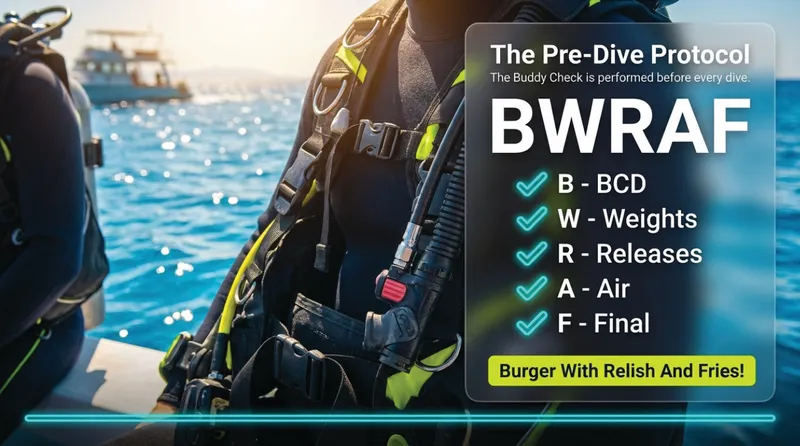
Right before you drop in, you and your buddy check each other's gear. It's the single most important habit in the sport, and it's the easiest one to rush - so it comes with a mnemonic built for hungry divers: Burger With Relish And Fries.
-
B - BCD: inflates, deflates, holds air.
-
W - Weights: secure, and set for a quick right-hand release.
-
R - Releases: every buckle and clip holding the rig together.
-
A - Air: turned on, breathing sweet, and the SPG reads full.
-
F - Final: one last sweep for loose hoses and forgotten fins.
Skip the burger and you're trusting luck. Don't.
Leaving the surface: SORTED
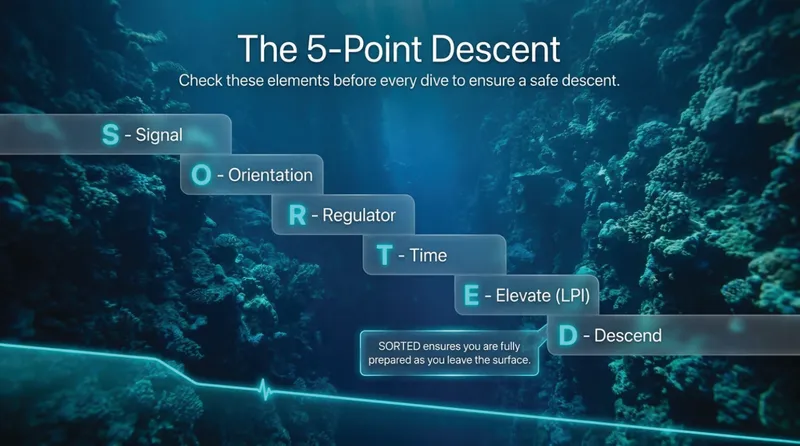
Dropping from air into water is a transition between two worlds, so it gets its own checklist. Before you go under, get SORTED:
-
S - Signal your buddy (thumbs down).
-
O - Orientation: pick a landmark or heading.
-
R - Regulator: swap the snorkel for your reg.
-
T - Time: note it on your computer or watch.
-
E - Elevate: hold the LPI hose up and vent the air.
-
D - Descend, slow and together.
Yes, that's six steps for something the industry insists on calling a "five-point descent." Call it diver math and move on.
Your two clocks: SPG and NDL
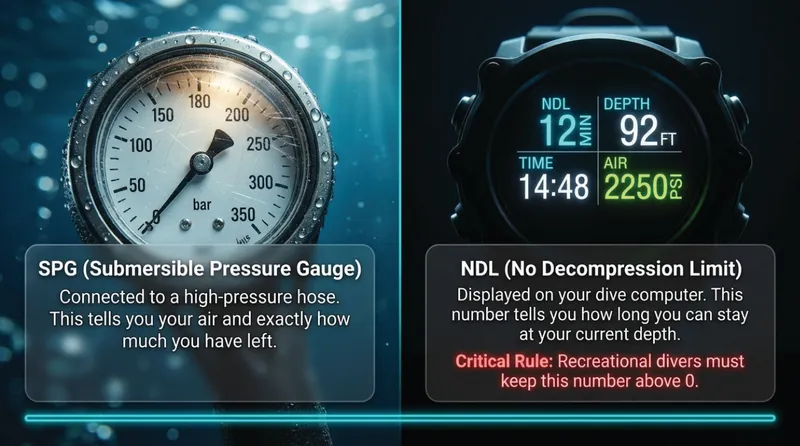
New divers assume the tank is the only limit. There are actually two clocks running the whole dive.
The first is air. Your SPG (Submersible Pressure Gauge) sits on a high-pressure hose and tells you exactly how much you have left. Watch it early, watch it often.
The second is invisible: your NDL (No Decompression Limit), the number on your dive computer. The deeper you go, the more nitrogen your tissues soak up. Stay too long and surface too fast and that nitrogen can bubble out inside you - decompression sickness, "the bends." For recreational diving the rule is simple and non-negotiable: keep the NDL above zero.
Heading back: STELLA and the SMB
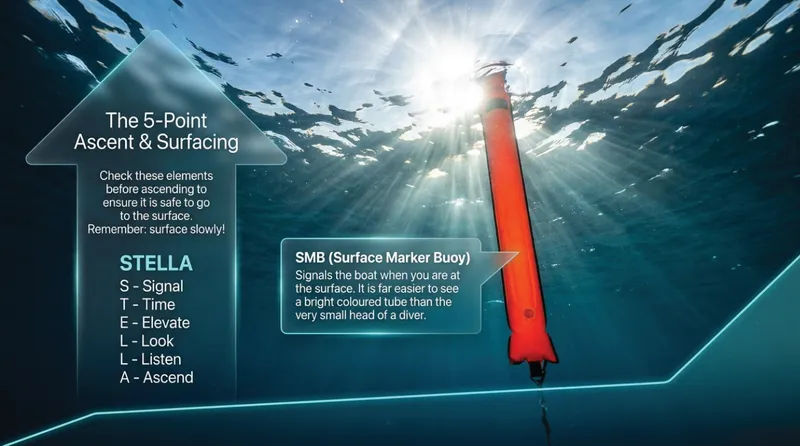
When the dive's done, you run the ritual in reverse. Follow STELLA:
-
S - Signal (thumbs up).
-
T - Time: check it.
-
E - Elevate: LPI hose up again.
-
L - Look up for boats and obstacles.
-
L - Listen for engines.
-
A - Ascend, slowly - no faster than your own smallest bubbles.
Near the surface, send up your SMB (Surface Marker Buoy) - the tall orange tube. A captain scanning a glary, choppy sea will never spot the small head of a diver, but a six-foot neon marker is impossible to miss. It says one thing clearly: I'm here, come get me.
The whole dive, one table
That's the language, start to finish. Learn it once and the letters disappear - what's left is muscle memory, and the quiet.
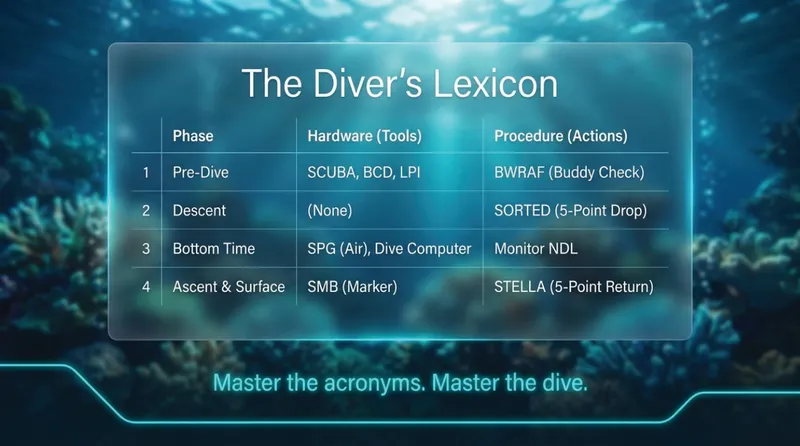
The map is simple: Pre-dive (SCUBA / BCD / LPI, then BWRAF) → Descent (SORTED) → Bottom time (SPG + NDL) → Ascent & surface (SMB, then STELLA).
Master the acronyms. Master the dive.
PADI Divemaster and underwater storyteller with over 7 years of hands-on Red Sea diving experience, documenting marine life, mapping dive sites, and promoting responsible ocean conservation.