Jacques-Yves Cousteau: The Explorer Who Gave the Ocean Its Voice

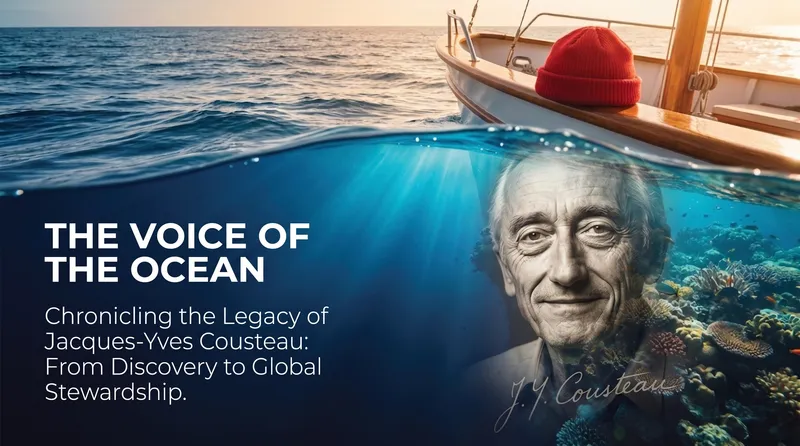
Today, June 11, marks the birthday of one of the most influential figures in the history of ocean exploration. Jacques-Yves Cousteau was born on this day in 1910 in Saint-André-de-Cubzac, France - and over the course of his 87 years, he fundamentally changed the way humanity sees, understands, and relates to the sea.
As the world quietly marks 115 years since his birth, his legacy feels anything but distant. The technologies he pioneered, the films he made, and the warnings he issued decades ago are more relevant today than ever. Cousteau didn't just explore the ocean - he gave it a voice. At a time when the deep sea was little more than a dark mystery to most of the world, this French naval officer turned inventor, filmmaker, and activist brought it alive in living rooms across the globe.
His journey - from a shattered career dream to becoming the most recognized ocean advocate in history - is one of the most remarkable stories of the 20th century. This is that story.
A Shattered Dream Birthed a New Frontier
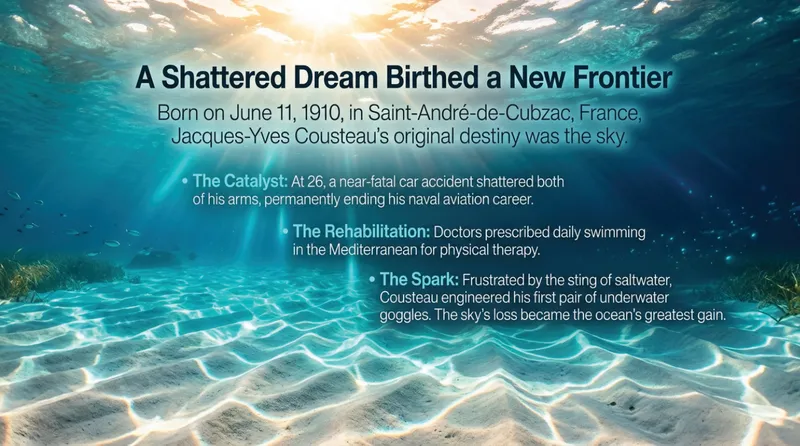
Born on June 11, 1910, in Saint-André-de-Cubzac, France, Cousteau was destined for the skies - not the sea. He trained as a naval aviator and was on track for a career in aviation until fate intervened in the most violent way possible.
At just 26 years old, a near-fatal car accident shattered both of his arms and permanently ended his aviation career. His doctors prescribed daily swimming in the Mediterranean Sea as physical therapy. It was during these long, painful sessions that Cousteau grew frustrated with the sting of saltwater in his eyes - and so he built his first pair of underwater goggles.
That small act of problem-solving changed everything. The sky's loss became the ocean's greatest gain.
Breaking the Tether: The Evolution of Access
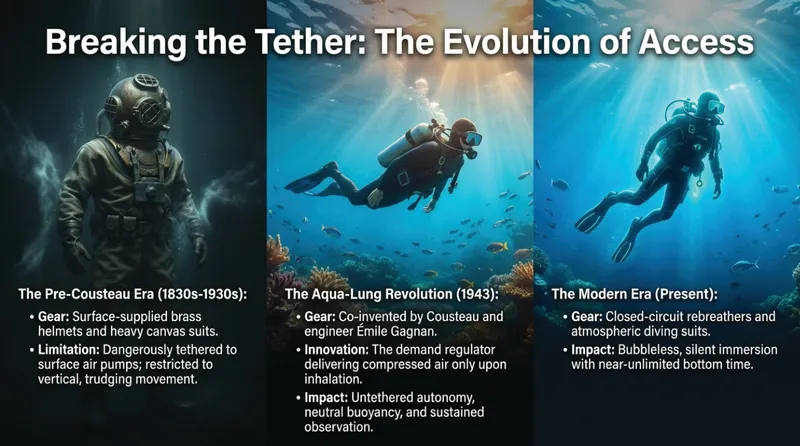
Before Cousteau, getting underwater was an ordeal of brass helmets, heavy canvas suits, and surface air hoses that tethered divers like balloons on strings. Movement was limited, dangerous, and exhausting - exploration was barely possible.
In 1943, everything changed. Cousteau and engineer Émile Gagnan co-invented the Aqua-Lung, a device with a demand regulator that delivered compressed air only when the diver inhaled. The result was extraordinary:
- Untethered autonomy - divers could move freely in three dimensions
- Neutral buoyancy - hovering alongside marine life became possible
- Sustained observation - divers could stay down long enough to actually study what they saw
Today, modern closed-circuit rebreathers and atmospheric diving suits have taken this even further, enabling bubbleless, near-silent immersion with almost unlimited bottom time. But it all started with that first breath underwater in 1943.
Calypso: The Mobile Laboratory
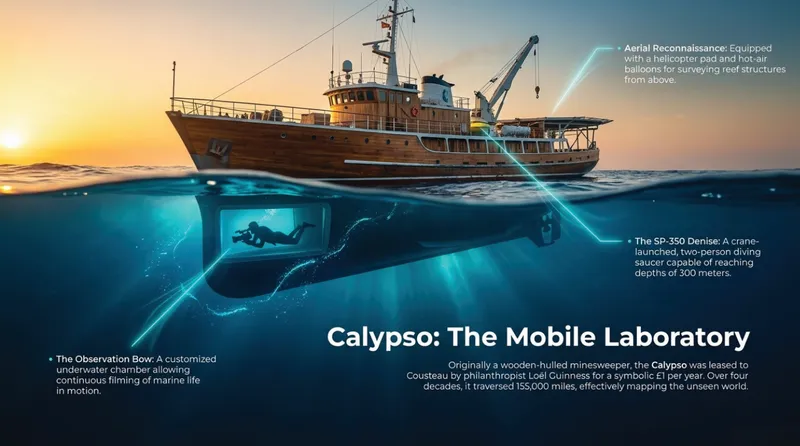
Every great explorer needs a great vessel. For Cousteau, that was the Calypso - a wooden-hulled former minesweeper leased to him by philanthropist Loël Guinness for the symbolic sum of £1 per year.
What Cousteau did with that ship was nothing short of extraordinary. Over four decades, the Calypso traversed 155,000 miles, effectively mapping the unseen world. She was fitted with remarkable innovations for her time:
- The Observation Bow - a customized underwater chamber that allowed continuous filming of marine life in motion
- The SP-350 Denise - a crane-launched two-person diving saucer capable of reaching depths of 300 meters
- Aerial Reconnaissance - a helicopter pad and hot-air balloons for surveying reef structures from above
The Calypso was more than a ship. She was a floating scientific platform, and her voyages produced some of the most important marine research and documentary footage of the 20th century.
Inhabiting the Abyss: The Conshelf Missions
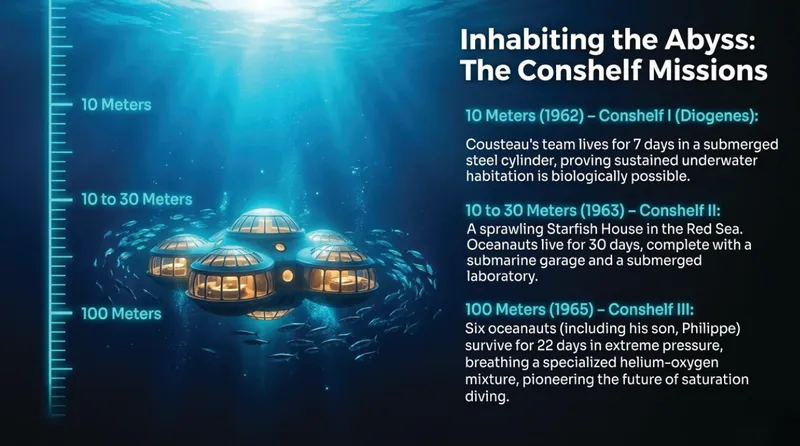
Exploration from a boat wasn't enough for Cousteau. He wanted humans to actually live underwater - and he made it happen through the legendary Conshelf missions.
- Conshelf I (1962, 10 meters) - A team lived for 7 days inside a submerged steel cylinder called Diogenes, proving that sustained underwater habitation was biologically possible.
- Conshelf II (1963, 10-30 meters) - A sprawling Starfish House was deployed in the Red Sea. Oceanauts lived there for a full 30 days, complete with a submarine garage and a working submerged laboratory.
- Conshelf III (1965, 100 meters) - Six oceanauts, including Cousteau's own son Philippe, survived 22 days at extreme pressure while breathing a specialized helium-oxygen mixture, pioneering the future of saturation diving.
These missions weren't just scientific achievements - they were a bold statement that humanity's relationship with the ocean could be far more intimate than anyone had imagined.
The Master Storyteller
Science without an audience changes nothing. Cousteau understood this better than almost anyone of his era.
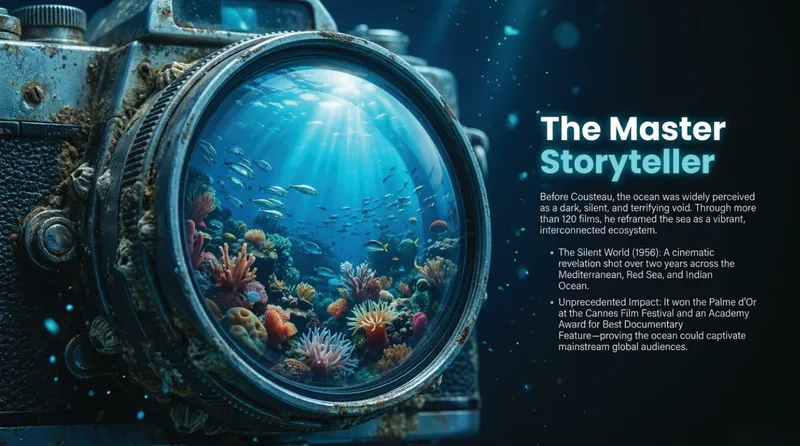
Before him, the ocean was widely perceived as a dark, silent, and terrifying void. Through more than 120 films, he completely reframed it - showing the sea as a vibrant, colorful, deeply interconnected ecosystem full of personality and wonder.
His 1956 film The Silent World, shot over two years across the Mediterranean, Red Sea, and Indian Ocean, became a cultural landmark. It won the Palme d'Or at the Cannes Film Festival and an Academy Award for Best Documentary Feature - proving that the ocean could captivate mainstream global audiences on the grandest possible stage.
Before Cousteau, you couldn't love what you couldn't see. He made the invisible visible.
The 1970 Awakening: Discovery Becomes Loss
For all the wonder Cousteau brought to the world, his decades of continuous observation also forced him to witness something devastating - and invisible to almost everyone else.
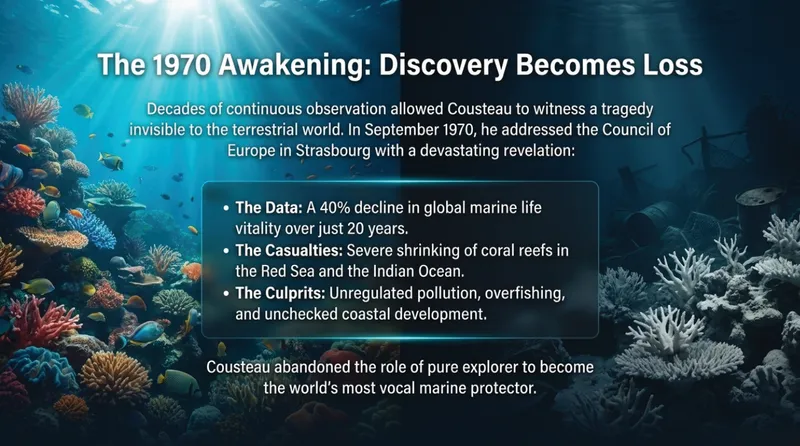
In September 1970, he stood before the Council of Europe in Strasbourg and delivered a revelation that shocked the room:
- The Data: A 40% decline in global marine life vitality over just 20 years
- The Casualties: Severe shrinking of coral reefs in the Red Sea and the Indian Ocean
- The Culprits: Unregulated pollution, overfishing, and unchecked coastal development
It was a turning point. Cousteau abandoned the role of pure explorer and became the world's most vocal marine protector. His films now carried an urgent message alongside their beauty: we are losing this.
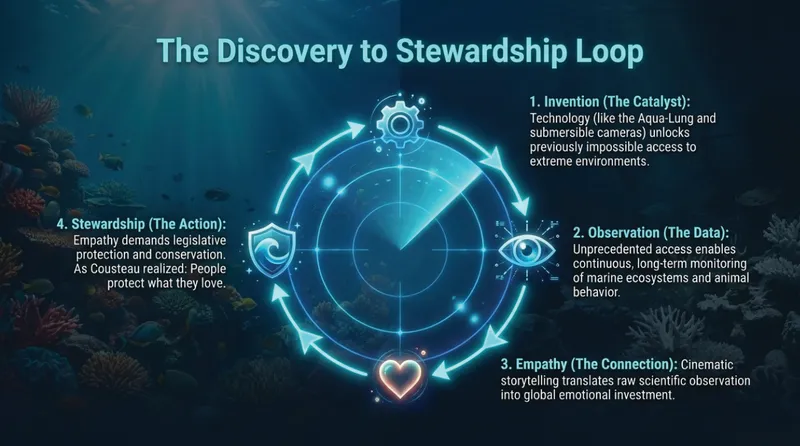
The Discovery to Stewardship Loop
Looking back at Cousteau's life, a clear pattern emerges - one that he himself seemed to consciously follow and eventually articulate:
Invention → Observation → Empathy → Stewardship
- Invention (The Catalyst): Technology like the Aqua-Lung and submersible cameras unlocked access to previously unreachable environments.
- Observation (The Data): That access enabled long-term, continuous monitoring of marine ecosystems and animal behavior.
- Empathy (The Connection): Cinematic storytelling translated raw scientific data into global emotional investment.
- Stewardship (The Action): Empathy demands protection. As Cousteau realized - people protect what they love.
This loop is his greatest intellectual contribution. It's a model that environmental movements, conservation organizations, and ocean advocates still follow today.
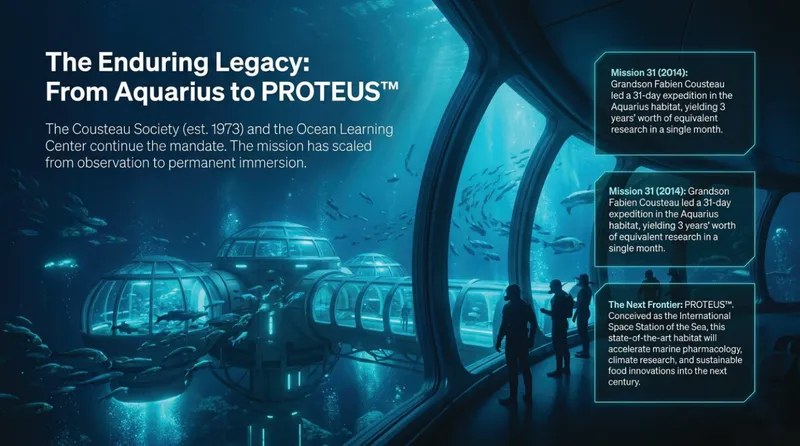
The Enduring Legacy: From Aquarius to PROTEUS™
Cousteau passed away on June 25, 1997 - but the mission he started lives on, bigger than ever.
The Cousteau Society, established in 1973, and the Ocean Learning Center continue his mandate. His grandson Fabien Cousteau carried the torch dramatically in 2014 with Mission 31 - a 31-day expedition living in the underwater Aquarius habitat that yielded the equivalent of three years' worth of scientific research in a single month.
And the next frontier is already being built. PROTEUS™, conceived as the International Space Station of the sea, will accelerate research in marine pharmacology, climate science, and sustainable food innovation into the next century. The mission has scaled from observation to permanent immersion.
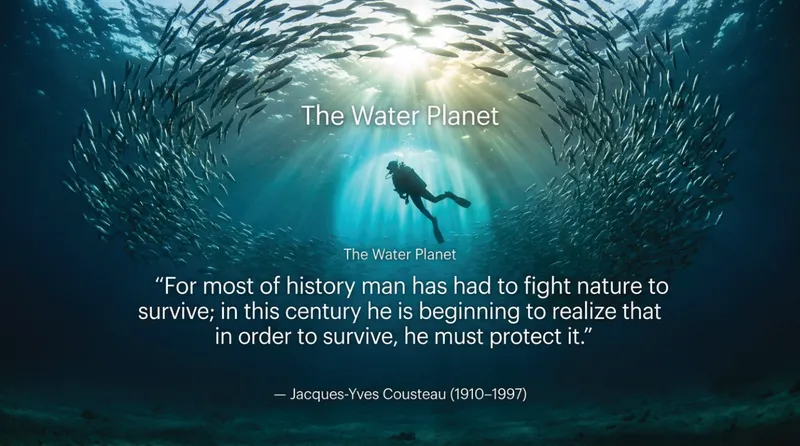
The Water Planet
Jacques-Yves Cousteau lived 87 years, and spent the majority of them fighting for a world most people had never seen. He left us with technology we use every day, images that changed how we see our planet, and data that made the threat to our oceans undeniable.
But perhaps his most enduring gift was simpler than all of that. He gave us the capacity to love something we couldn't reach.
"For most of history man has had to fight nature to survive; in this century he is beginning to realize that in order to survive, he must protect it." - Jacques-Yves Cousteau (1910-1997)
That sentence is as true today as the day he said it. Maybe more so.
PADI Divemaster and underwater storyteller with over 7 years of hands-on Red Sea diving experience, documenting marine life, mapping dive sites, and promoting responsible ocean conservation.