Biofluorescence
Absorbing blue light and re-emitting it as green, orange or red - not the same thing as bioluminescence, and far more common on a reef than anyone realized.
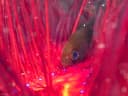
Biofluorescence is the absorption of light at one wavelength and its re-emission at a longer one. An animal lit with blue or ultraviolet light glows green, orange or red, and switches off the instant the light does - it produces nothing of its own, it transforms what falls on it.
That is what separates it from bioluminescence, which is a chemical reaction - luciferin and luciferase - that makes light from scratch, in complete darkness, with no external source at all. Deep-sea fish and the plankton that lights up in a night wake are bioluminescent. The reef corals and fish that light up under a blue torch are fluorescent.
It is unexpectedly widespread. Surveys with blue light have found fluorescence in well over two hundred species of fish, including eels, gobies, scorpionfish, flatfish, rays and sharks, on top of the corals and anemones where it was already familiar. Since seawater filters out everything but blue within a few tens of meters, and many reef fish have eyes tuned to see the difference, the working assumption is that a good deal of it is signaling that we have simply been unable to see.
The same molecules turned out to be worth a great deal in the laboratory. Green fluorescent protein, taken from a jellyfish, became the standard way of tagging a gene so its activity can be watched inside a living cell, and the work behind it won the Nobel Prize in Chemistry in 2008.