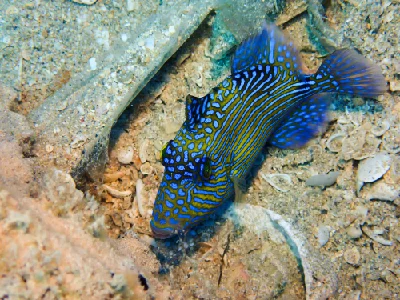
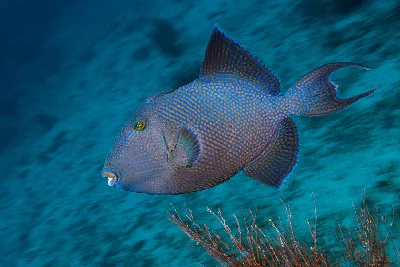
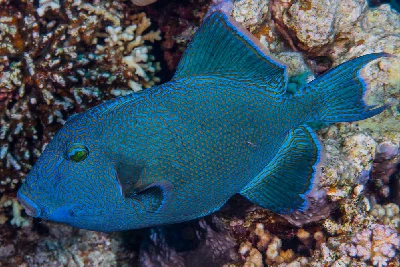
Pseudoundefinedstes fuscus, known variously as the blue triggerfish, yellow-spotted triggerfish, or blue-and-gold triggerfish, is a striking member of the Balistidae family. Males of this species can grow up to 55 centimeters (22 inches) in length. Their bodies are generally dark brown with distinctive yellow-edged fins. Juveniles exhibit a yellowish-brown color that is intricately patterned with vibrant bluish wavy lines, which become more connected as they mature.
These triggerfish inhabit the Tropical Indo-Pacific region, from the 🌊 Red Sea to 🇿🇦 South Africa, including the Society Islands (🇵🇫 French Polynesia), southern 🇯🇵 Japan, 🇦🇺 Australia, and 🇳🇨 New Caledonia (🇫🇷 Overseas France). They thrive in reef-associated environments, preferring coastal waters such as shallow lagoons and seaward reefs, at depths from 1 to 50 meters (3 to 164 feet). While adults are often found in deeper reef areas or around shipwrecks beyond 30 meters, juveniles tend to stay inshore on rubble reefs or around small outcrops in open substrates.
Pseudoundefinedstes fuscus is known for its aggressive behavior, especially during the mating season in the warmer months of spring and summer. This aggression is particularly evident when the fish defends its nesting sites and territory, making it a species to be cautious around for divers and other marine life.
In terms of diet, the blue triggerfish primarily feeds on sea urchins, crustaceans, molluscs, dead fish, tunicates, and corals. It is an oviparous species, laying eggs that are fiercely guarded by the territorial females. These fish exhibit monogamous and polygynous behaviors, with males often having multiple mates. They are also caught for commercial purposes and are marketed both fresh and dried-salted.
The blue triggerfish has three dorsal spines, 24-27 dorsal soft rays, no anal spines, and 19-24 anal soft rays. Juveniles less than 5 centimeters in length are tan with dark saddles and numerous dark wavy lines, which evolve into a complex network of brilliant blue lines as they grow larger.
Why it's threatened
There are no known major threats.
Threat classification from the IUCN Red List.


