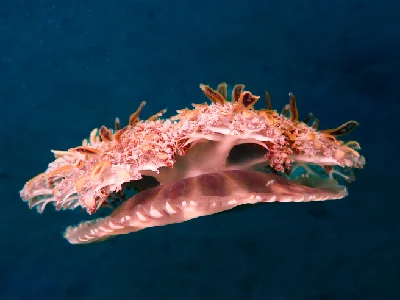
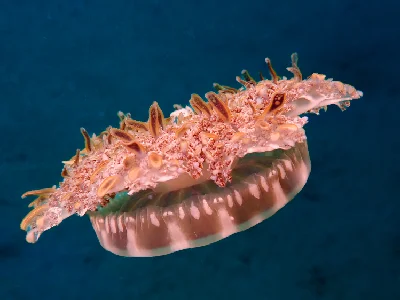
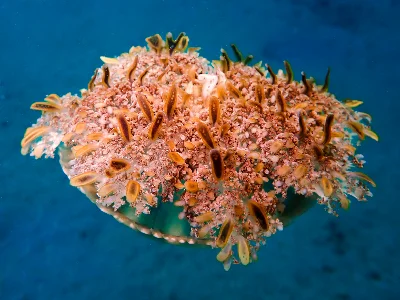
Cassiopea andromeda, commonly known as the upside-down jellyfish, is a fascinating species native to the 🌊 Red Sea. It gets its name from its distinctive habit of floating upside down, with the bell facing downward and its delicate tentacles reaching upwards. This unique orientation allows it to house photosynthetic algae, known as zooxanthellae, within its tissues. These algae convert sunlight, carbon dioxide, and water into oxygen and sugars, providing energy and nourishment for the jellyfish while the jellyfish offers the algae a safe haven and necessary nutrients, forming a mutually advantageous relationship.
This jellyfish prefers shallow, calm waters with sandy or muddy bottoms, such as lagoons, tidal flats, or mangrove forests, where water movement is minimal. Its habitat suits its unique lifestyle, allowing it to anchor its tentacles in the substrate while exposing its bell to ample sunlight for photosynthesis.
Cassiopea andromeda varies in color, displaying shades of white, brown, or green. Its bell is flat and resembles a flower with finger-like projections, whereas the tentacles are long and slender. Although the tentacles contain stinging cells, they have a mild effect relative to those of other jellyfish species and are usually not harmful to humans. Nonetheless, it is advisable to avoid direct contact to prevent potential skin irritation.
As day turns to night, Cassiopea andromeda exhibits an enchanting blue-green bioluminescent glow. This luminescence attracts small fish and plankton, serving as a food source for the jellyfish. Measuring about 5 to 20 centimeters (2 to 8 inches) across, these jellyfish can live up to two years under optimal conditions.
Cassiopea andromeda is indeed a marvel to witness, with its distinctive posture, symbiotic algae relationship, and captivating bioluminescent display making it a standout species in the 🌊 Red Sea.


