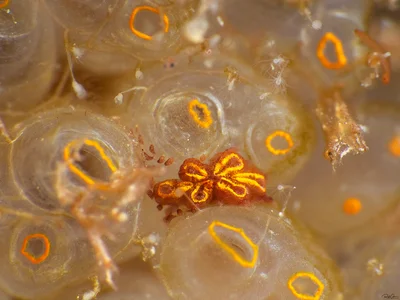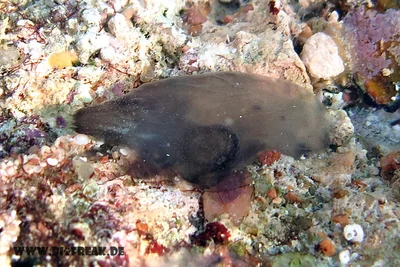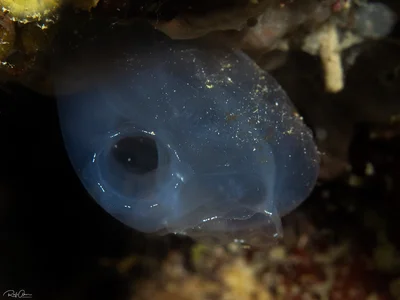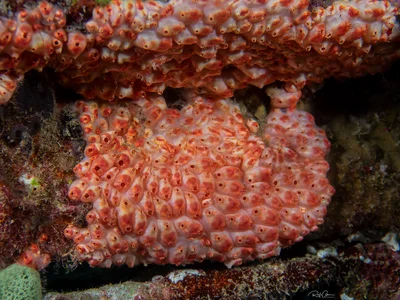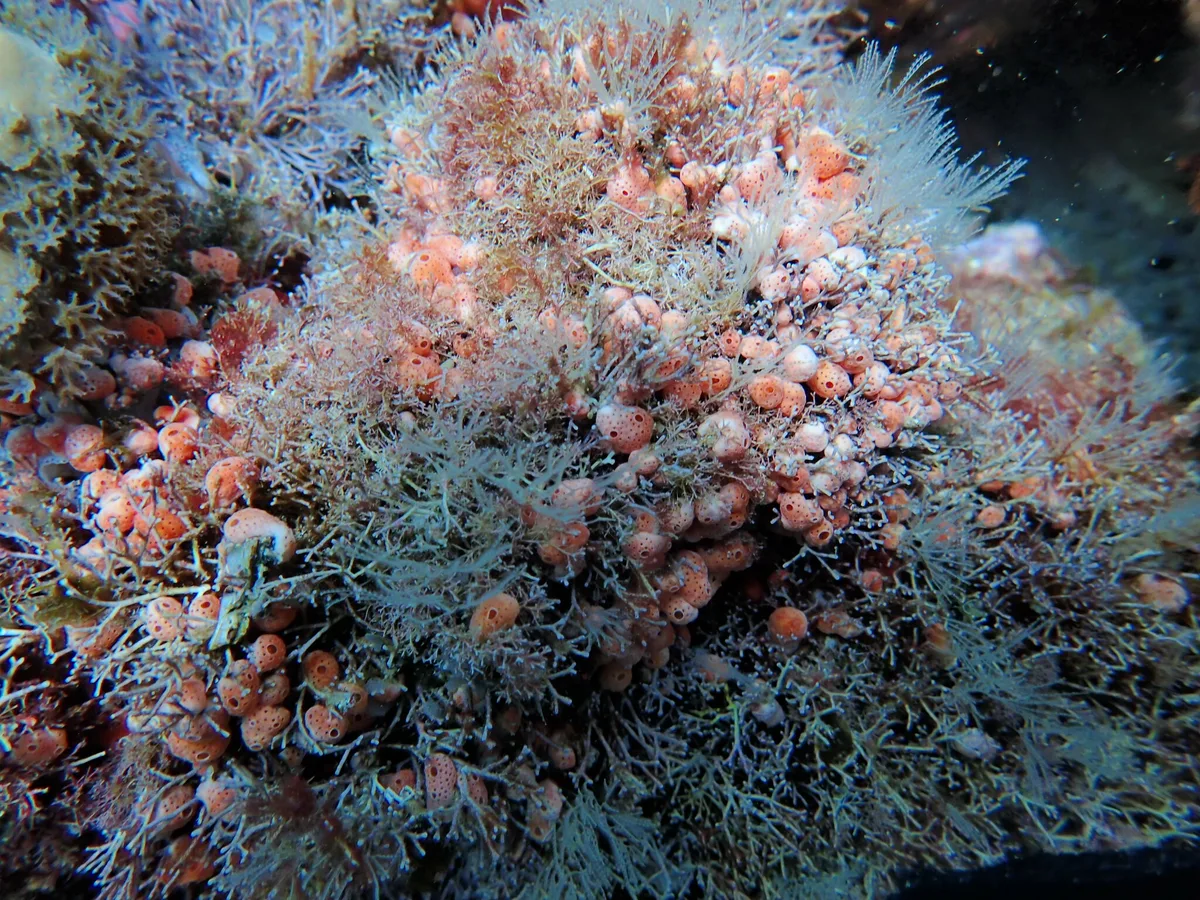
A thin white to cream sheet spreading over dead coral, rock and even living sponges, its surface finely pitted with the inlet holes of hundreds of individual animals and punctuated by larger shared outlets. Colonies reach about 20 cm (8 in) and follow every contour of what they cover.
The tunic is stiffened with microscopic calcareous spicules, which is why the sheet feels gritty and why almost nothing grazes it. Didemnid ascidians are among the fastest-spreading encrusters on a reef, and some species elsewhere have smothered entire seabeds after being introduced. They also host symbiotic algae in some cases, and are a rich source of compounds now studied as anti-cancer drugs - one class taken from a relative of this genus reached clinical use. All of it comes from an animal that looks like spilled paint.
- thin white to cream sheet overgrowing whatever it sits on
- surface finely pitted with many small inlet holes
- larger outlet openings scattered across the sheet
- colonies up to 20 cm across