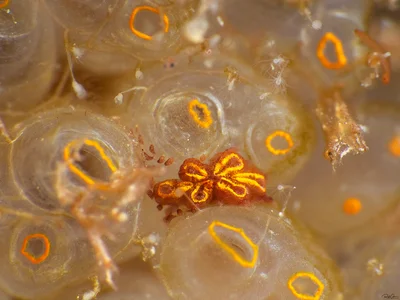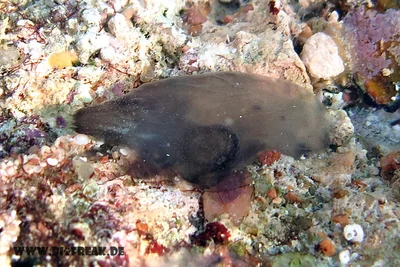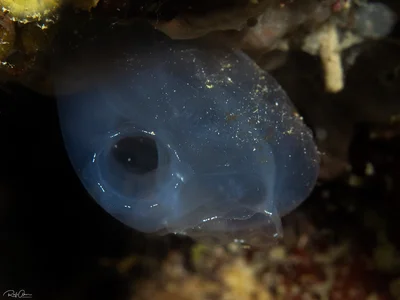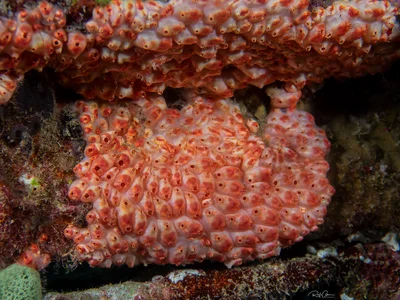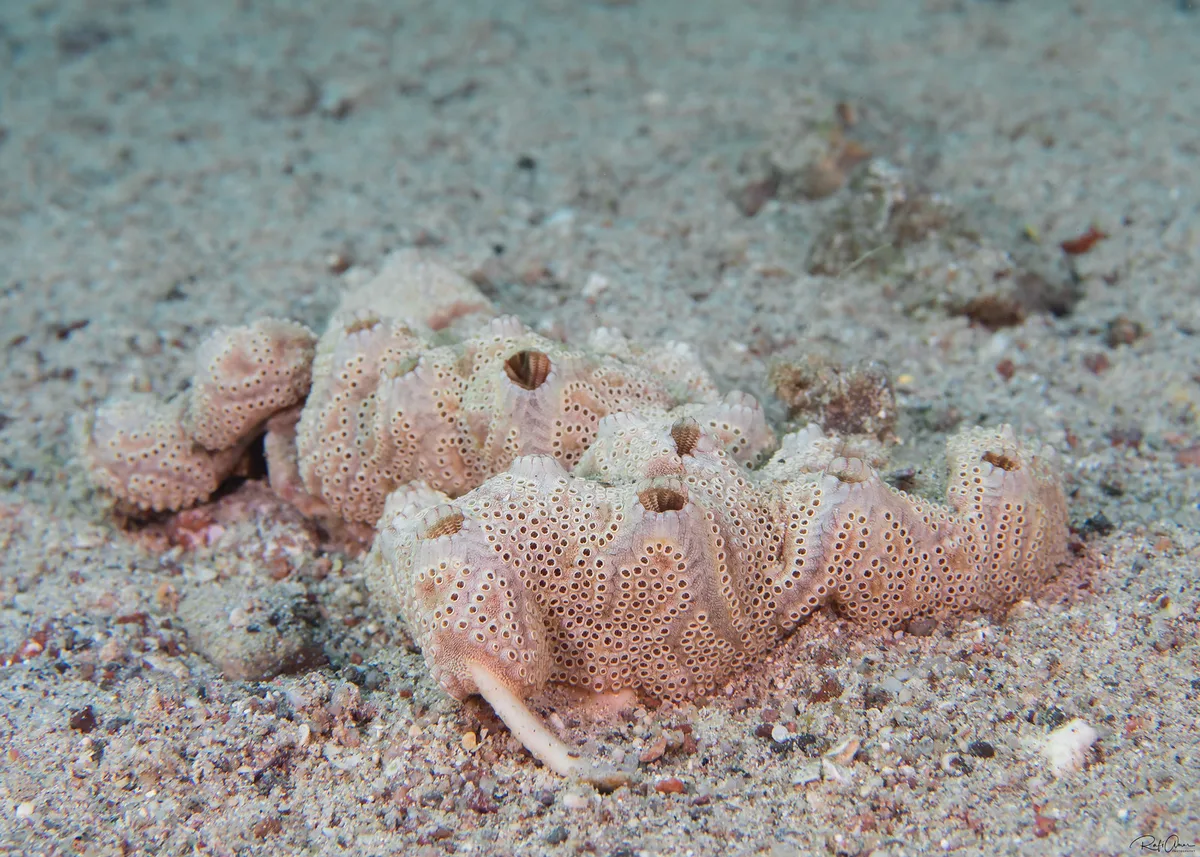
A colonial sea squirt that encrusts shaded rock as a flat sheet, its individual animals arranged in star-shaped clusters of six to a dozen, each cluster sharing one central outlet while every animal keeps its own inlet. The pattern is unmistakable once seen, and colonies reach about 15 cm (6 in).
The colony grows by budding, so every animal in it is a clone, and it can regenerate an entire colony from a fragment. That makes the genus a laboratory favorite for work on regeneration and on immune recognition: when two colonies meet, they either fuse into one or reject each other along a visible line, using a system that resembles vertebrate tissue matching. This species was described from the northern end of this sea, and the star pattern makes it one of the few colonial ascidians a diver can name underwater.
- flat encrusting sheet with animals arranged in star-shaped clusters
- each star shares one central opening
- color varies - orange, purple, gray with paler stars
- colonies up to 15 cm across