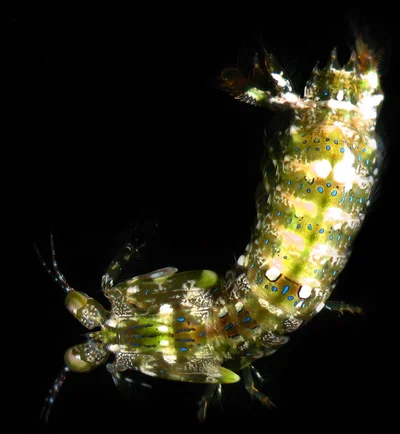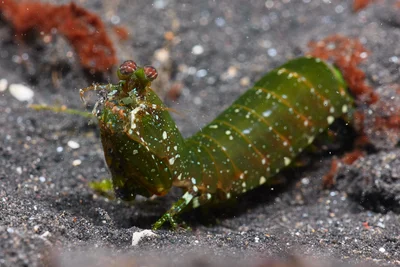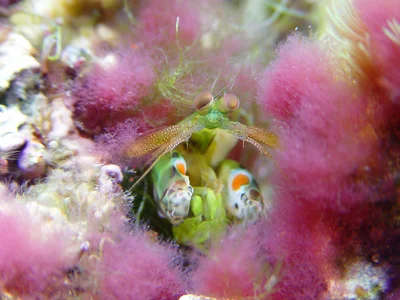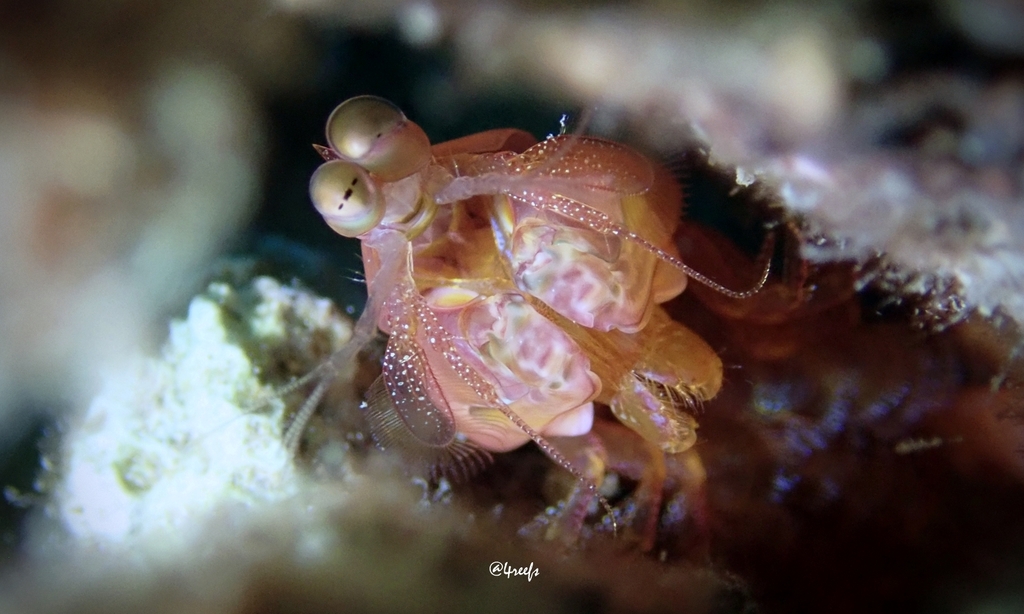
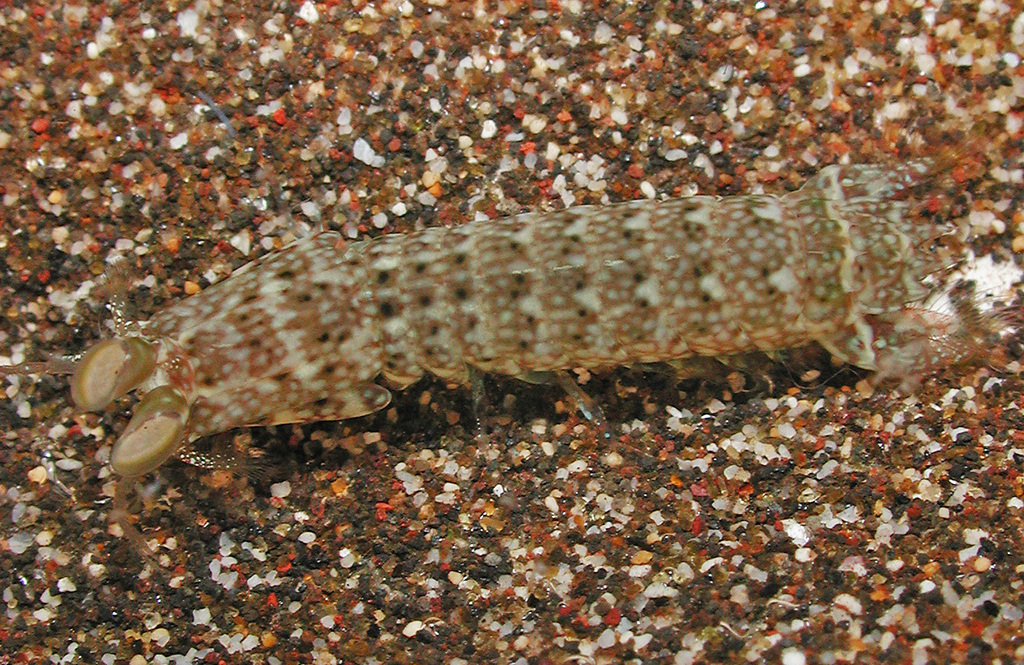
A stocky green to olive mantis shrimp of about 10 cm (4 in), one of the smashers: the second pair of legs ends in heavy calcified clubs rather than the spined blades of the spearing species. The strike is among the fastest movements in the animal kingdom, quick enough that the water behind the club briefly boils into a cavitation bubble whose collapse delivers a second blow of its own. Snails, hermit crabs and small bivalves are broken open this way.
It occupies cavities in dead coral and rubble from the shallows to about 15 m (50 ft), holding a hole against all comers and looking out with independently swivelling stalked eyes. Forsskål described it in 1775 from material collected on this coast, so it has carried its name since the earliest scientific work in the region. It has since traveled: carried to Hawaii (🇺🇸 United States) with imported oysters in the 1940s, it spread across those reefs and displaced the native mantis shrimp, one of the better documented invasions by a crustacean. Fingers pushed into holes are how people get hurt by this animal, and the wound is a deep bruise or split rather than a nip.
- mottled green to olive body
- club-shaped smashing claws, not spined blades
- peers out of a hole in dead coral by day
- length up to 10 cm