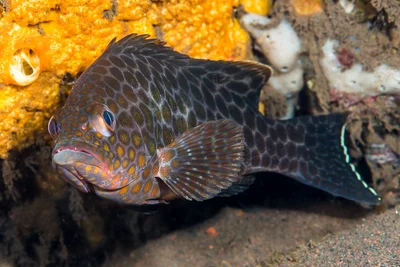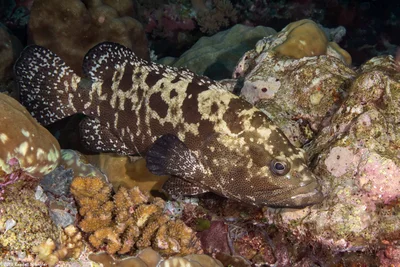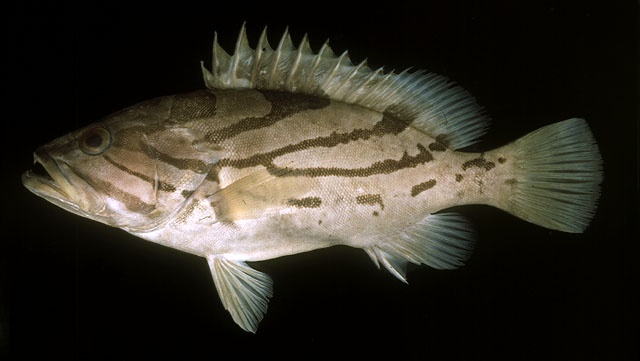
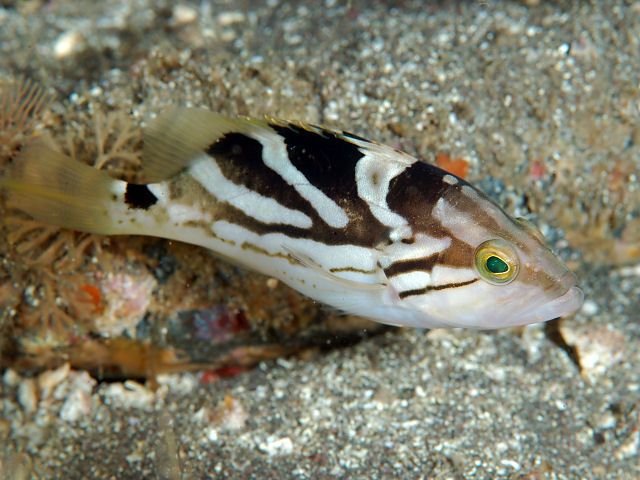
A large, slender-bodied grouper marked by a dark band that runs back from the eye along the upper flank, breaking into blotches towards the tail. The ground color is pale gray to brown, overlaid with irregular dark saddles and pale patches, and the pattern changes with mood and depth - fish photographed at the surface after capture often look nothing like the same animal on the reef. Length reaches about 90 cm (35 in). Juveniles are more strongly patterned than adults.
This is a deep-water species: it occupies rocky slopes, drop-offs and ledges from about 15 m down to 370 m (50 to 1,200 ft), and is only occasionally seen within recreational limits, usually on deep walls with cold water pushing up. It hunts fish and large crustaceans, taking prey with a fast lunge and the suction of a rapidly opened mouth. Sightings on 🌊 Red Sea reefs are rare enough to be worth logging, and most records from the region come from deep drop-offs in the north. Like other groupers it begins adult life as a female and changes sex later, so the largest animals on a site are males - and removing them costs a population more than the numbers suggest. Some guides list the species under Mycteroperca, a genus of Atlantic and eastern Pacific groupers it does not belong to.
The genus. Epinephelus Bloch 1793 - epinéphelos (ancient Greek for clouded over). ETYFish
The species. Epinephelus morrhua (Valenciennes 1833) - latinization of morue. ETYFish
- dark band running from the eye back along the flank
- pale body broken into blotches and dark saddles
- deep water - rarely above 30 m