Overview
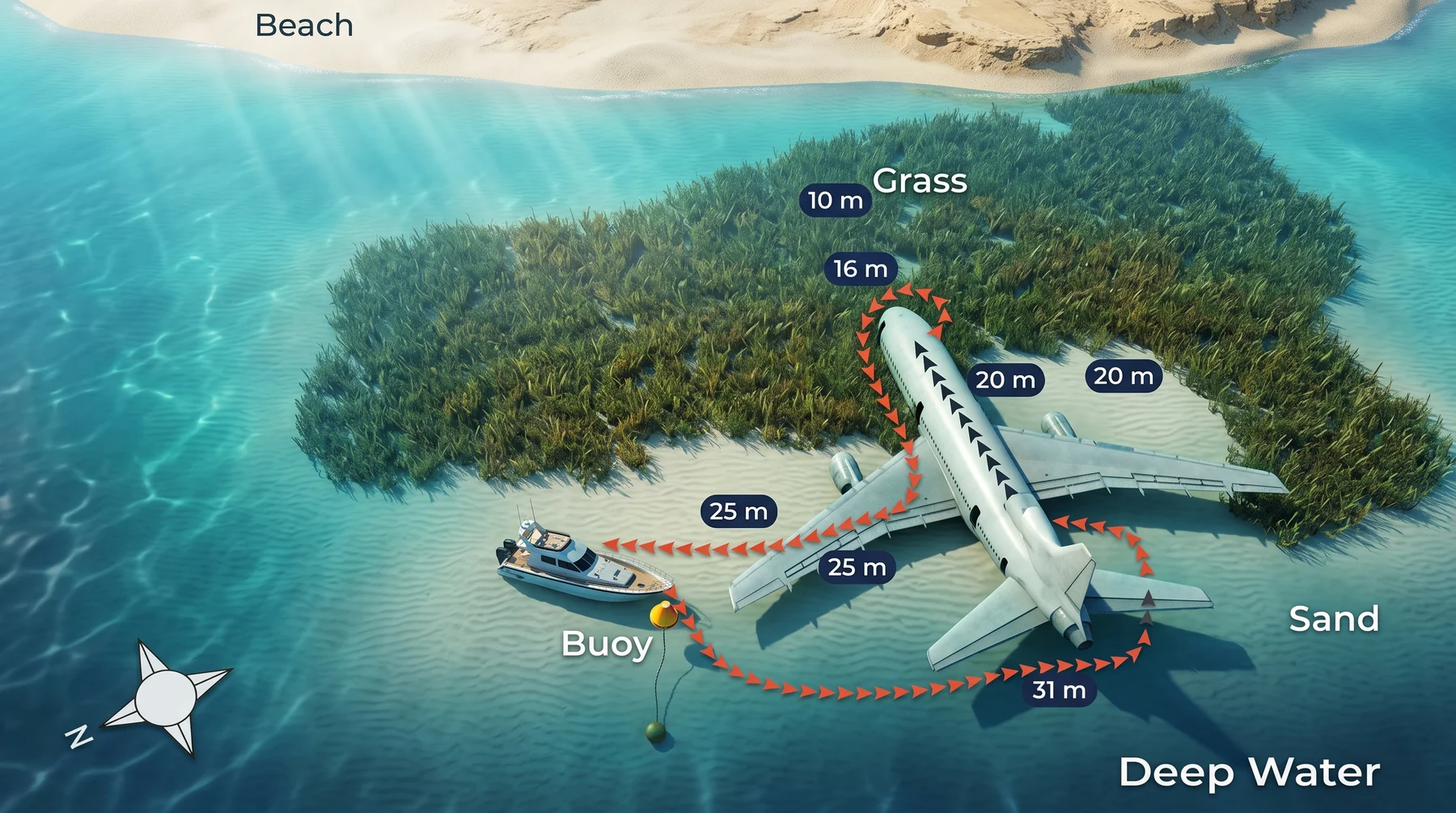
The TriStar is a trijet, and its third engine sits in the tail, fed by an S-shaped duct that curves down through the fin to turn the airflow into the intake. Underwater that duct is a swim-through, and divers use it as the way out of the wreck. The aircraft is a Lockheed L-1011-500, 50 m long with a 50 m wingspan, resting upright on sand with the cockpit at 15 m and the tail at 28 m. It was delivered to Royal Jordanian in 1985, passed through five other airlines over the next twenty years, ended up parked at Aqaba's airport, and was bought by the Aqaba Special Economic Zone Authority and sunk on August 26, 2019, a few kilometers from where it had been standing.
Dive plan
The aircraft was stripped before it went down. Fuel, oils, lubricants and toxic material were removed, the main doors were taken off and the middle row of seats pulled out, so the cabin is open, lit and wide enough to swim without silting it out. The usual route works the outside first, along the fuselage and past the wings and their engines, then enters through a doorway and follows the aisle. Two rows of three seats were left in place in both cabins, the overhead bins and the roof-mounted video projectors are still fitted, and the cockpit forward still carries its instruments, controls and switches. The exit is the S-duct through the tail engine intake, the tightest part of the dive and the one that decides how the dive is planned.
What to see
The plane was put down on bare sand with thin seagrass around it and no natural reef within reach, which was the point: it pulls divers onto a structure that has no coral to damage. Colonization has been quick, since it is the only hard ground for some distance. Lionfish hold station along the fuselage, moray eels have taken the gaps in the airframe, and glassfish fill the lit sections of the cabin. Octopus, shrimps and nudibranchs work the skin of the aircraft, and larger predatory fish patrol the outside of it.



Dive sites nearby
Reviews & comments
Please, sign in to leave a review
Continue with a social account - yours will be created automatically.
No reviews yet — be the first.