Ostracitoxin (pahutoxin)
The boxfish defense: a soap released from the skin that destroys the gills of every other fish in a confined volume, itself included.
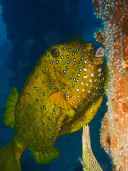
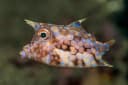
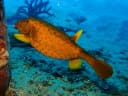
Ostracitoxin is the chemical defense of the boxfishes and cowfishes, family Ostraciidae. A boxfish that is cornered, handled or dying releases it from glands in the skin, and the water around it becomes poisonous to other fish within seconds. It is also known as pahutoxin, after pahu, the Hawaiian word for boxfish, and it was isolated in the 1960s from a boxfish caught off Hawaii - the first poison ever obtained in pure form from a fish's own skin.
What makes it unusual is what it is not. Most animal toxins on the reef are proteins or nerve poisons that pick out one specific target - a sodium channel, a receptor, a pump. Ostracitoxin is a choline ester of a fatty acid: a small, stable molecule with a water-loving head and a greasy tail. That is the structure of a detergent, and it behaves like one. Water carrying it foams when it is shaken.
Being a soap is the entire mechanism. It does not interfere with a cell, it dismantles it, prying apart the fatty membrane that holds one together. Red blood cells burst. The gill epithelium - a single layer of cells across an enormous surface, the thinnest tissue a fish owns - comes apart on contact, and the fish suffocates in clean, fully oxygenated water. Nothing about the poison has to be aimed, which is why it works on almost anything with gills.
Volume is what decides the outcome. On the reef the toxin is diluted to irrelevance almost at once, and a boxfish releasing it inconveniences nobody. In a bucket, a live well, a collecting bag or an aquarium there is nowhere for it to go: a single stressed boxfish can kill everything in the tank, itself included. It is one of the classic ways to lose an aquarium overnight, and the reason boxfish should never share a container with other fish.
For a diver it is a non-event. Intact skin is a good barrier, the dose in open water is nothing, and a boxfish hanging motionless an arm's length away is one of the easiest subjects on the reef - it can afford to be approachable, which is rather the point of carrying the stuff. The caution applies out of the water: do not carry one, and do not eat one. Cases of poisoning from boxfish flesh are on record, and the toxin survives cooking.
First aid
Not a first-aid subject for a diver: intact skin is a good barrier and the open sea dilutes it instantly. Wash your hands after handling a boxfish and keep them away from your eyes.
The casualties are other fish. A boxfish carried in a bucket, a bag or a tank with anything else can kill everything in it, including itself. If a boxfish has been stressed in a closed volume, get the other animals into clean water immediately.
Do not eat one - poisoning from boxfish flesh is on record, and cooking does not help.