
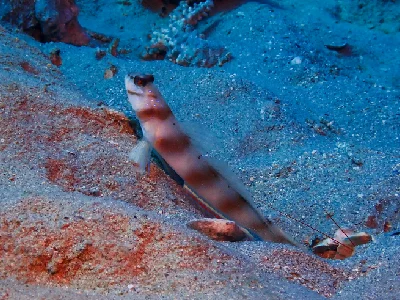
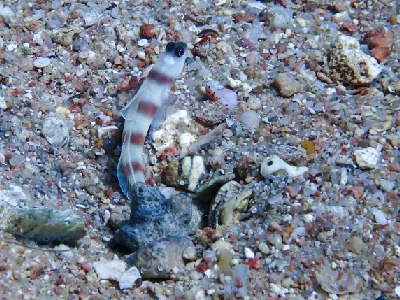
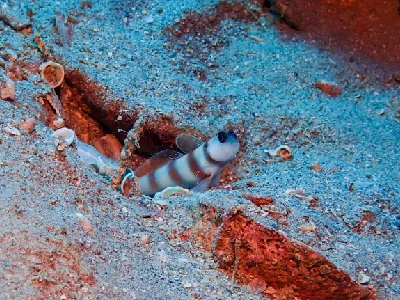
Amblyeleotris steinitzi, commonly referred to as Steinitz' prawn goby or simply Steinitz' goby, is a small fish species belonging to the Gobiidae family. These fish are found in a wide geographical range, spanning from the 🌊 Red Sea to the 🌊 Indian Ocean and continuing to the western 🌊 Pacific Ocean. They inhabit shallow waters, typically in sandy areas of reef flats, outer lagoons, estuaries, and bays, reaching depths of up to 43 meters (141 feet). Their habitat includes regions like the Chagos (🇮🇴 British Indian Ocean Territory) Archipelago, 🇲🇺 Mauritius, 🇲🇭 Marshall Islands, 🇸🇨 Seychelles, southern 🇯🇵 Japan, and the Great Barrier Reef.
Steinitz' goby can grow up to 13 centimeters (5.1 inches) in length and is recognized for its protruding eyes and elongated, slender body. Its appearance is marked by a primarily white body with about five wide, reddish-brown bands and fine pale yellow lines. The dorsal fin, decorated with small orange spots, contains seven spines and twelve soft rays, while the anal fin has one spine and twelve soft rays.
An interesting aspect of Steinitz' goby's life is its symbiotic relationship with alpheid shrimp, including species like Alpheus purpurilenticularis. Although the goby does not participate in building the burrow, the shrimp is adept at creating intricate burrow systems in the sandy or silty seabed. The burrow, typically with one or more openings that may shift position daily, serves as a shared shelter for both. The goby might create a new entrance by pushing through the substrate, with entrance locations potentially moving by up to 80 centimeters (31 inches) per day. At night, both retreat into the burrow, which may be reinforced with shell and coral fragments.
During the day, the goby often rests near the entrance of the burrow, occasionally venturing out to forage. Its diet consists of small invertebrates dislodged by the shrimp, or the goby may ingest sediment to extract nutritional bits. The shrimp, primarily feeding on detritus, constantly stirs the substrate. It relies on the goby's tail flick as a warning of approaching predators, swiftly withdrawing into the burrow when alerted. The goby, adept at identifying threats, responds accordingly to potential dangers.
Notably territorial, Steinitz' goby might alter its burrow entrance location if neighboring gobies become aggressive. During breeding, it might move its burrow closer to those of a goby of the opposite sex. The shrimp also forms a lasting pair bond with another shrimp in a nearby burrow.
The species name and common name honor Heinz Steinitz (1909-1971), an esteemed 🇮🇱 Israeli marine biologist and herpetologist. He established the marine laboratory in Eilat, 🇮🇱 Israel, on the Gulf of Aqaba, a location where Steinitz' goby can also be found.
Why it's threatened
Threat classification from the IUCN Red List.


