
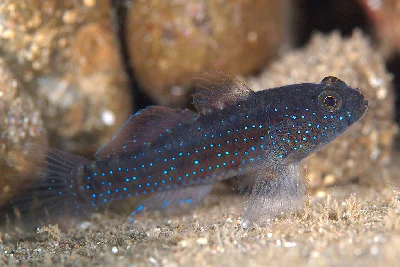
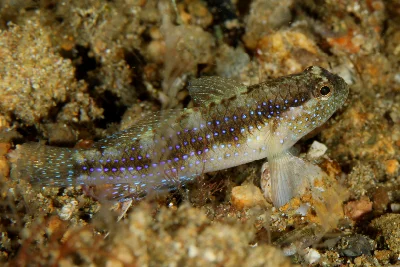
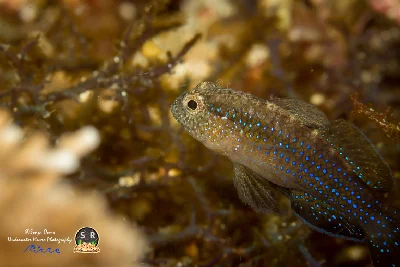
The starry goby, scientifically known as Asterropteryx semipunctata, is a small fish belonging to the Gobiidae family. Found throughout the Indo-Pacific region, its range extends from the 🌊 Red Sea and 🌊 Persian Gulf to the Hawaiian and Tuamoto Islands (🇵🇫 French Polynesia). It further stretches north to 🇯🇵 Japan and south to Lord Howe Island and Rapa, including areas of Western Australia and New South Wales.
These fish are typically found in protected environments like bays and lagoons, often among algae-covered reef rocks, rubble, and the inner flats of turbid lagoons. Starry gobies are known to occupy depths ranging from 1 to 20 meters (3 to 65 feet), where they take refuge in burrows and holes within reefs.
The starry goby exhibits a body length of up to 6.5 centimeters (approximately 2.6 inches). It displays a tan to black coloration adorned with light spots, and features distinctive dark elongated spots along its sides and short vertical bars or saddles on its back. A notable characteristic is the prolonged third dorsal spine, forming a long filament in adults. The fish's body is covered with ctenoid scales, excluding parts of the head such as the snout and space between the eyes.
Its fin configuration includes seven dorsal spines and 9 to 11 dorsal soft rays, alongside a single anal spine and 8 to 9 anal soft rays. The caudal fin is rounded, and its body depth is roughly one-third to slightly more than one-third of its standard length.
Starry gobies primarily feed on small benthic invertebrates, and their lifestyle varies between solitary living or forming small groups. Known as benthic spawners, they play an essential role in their aquatic ecosystems. The name Asterropteryx originates from Greek, combining words for "consistent" and "fin."
Why it's threatened
Threat classification from the IUCN Red List.


