
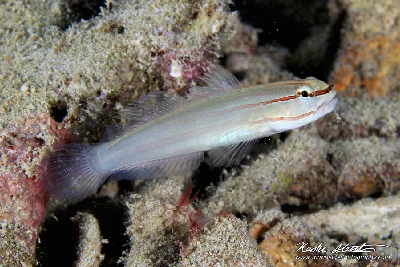
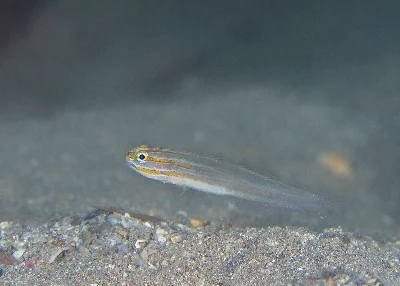
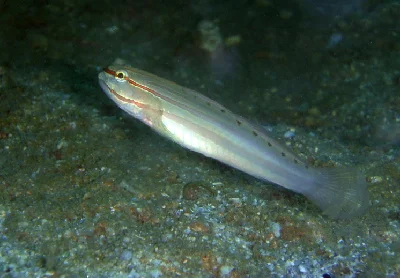
The Nocturn Goby, scientifically known as Amblygobius nocturnus, is a small tropical marine fish that is often found in reef environments. This species typically inhabits depths ranging from 1 to 30 meters (3 to 98 feet). It can grow to a maximum length of approximately 10 centimeters (about 4 inches).
The Nocturn Goby has a pale grey body adorned with pink stripes, especially prominent on its head. A row of 8 to 9 dark spots can be found at the base of its dorsal fin. Its dorsal fins are notable for having 7 spines and 13 to 15 soft rays, while the anal fin features 1 spine and 13 to 15 soft rays. The fish's tail fin, or caudal fin, is slightly pointed, and it has a long, slender body covered in cycloid scales, except on its head, which is scaleless. The body depth typically measures between 4.7 and 6.4 times the standard length of the fish.
These gobies are usually seen alone or in pairs and often inhabit areas with fine sand or muddy bottoms at the bases of inner lagoons and coastal reefs. They are monogamous, often forming both social and obligate pair bonds, and their diet consists of small invertebrates and organic material.
The Nocturn Goby is distributed across the 🌊 Western Indian Ocean, including the 🇲🇻 Maldives, the 🌊 Red Sea, and the Arabian Gulf, extending to the 🌊 Pacific Ocean from the 🇵🇭 Philippines to the Tuamoto Islands (🇵🇫 French Polynesia). You can also find them as far north as the Yaeyama Islands and south to the Rowley Shoals, southern Great Barrier Reef, and Rapa, with populations present in places like 🇬🇺 Guam and Kapingamarangi in 🇫🇲 Micronesia.
The genus name "Amblygobius" derives from the Greek word "amblys," meaning darkness, and the Latin word "gobius," meaning gudgeon, reflecting the species' nocturnal and benthic nature.
Why it's threatened
Threat classification from the IUCN Red List.


