
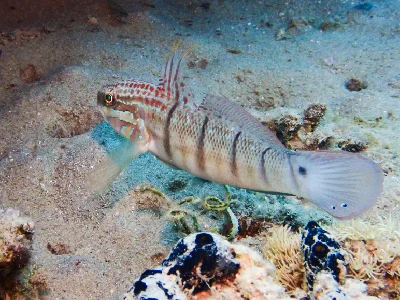
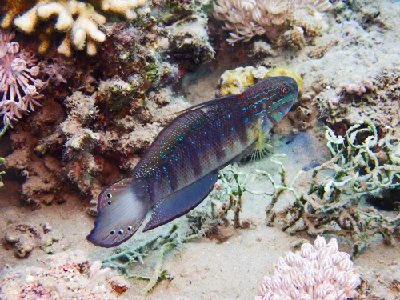
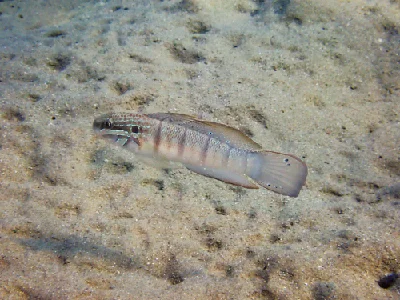
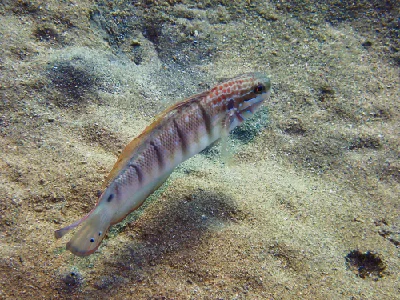
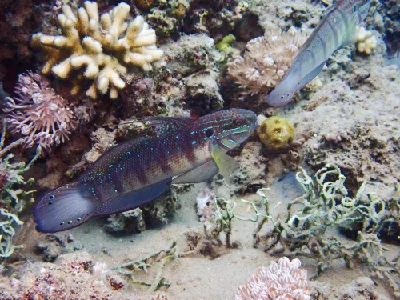
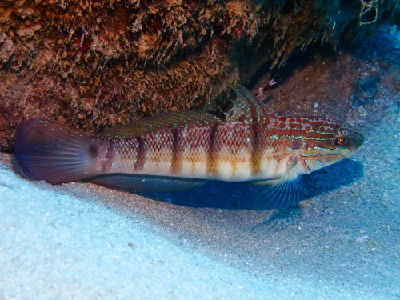
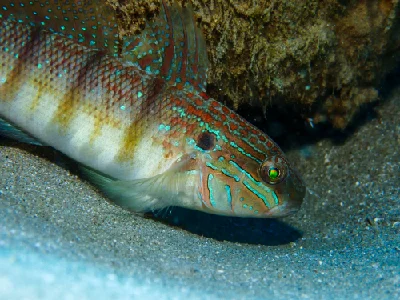
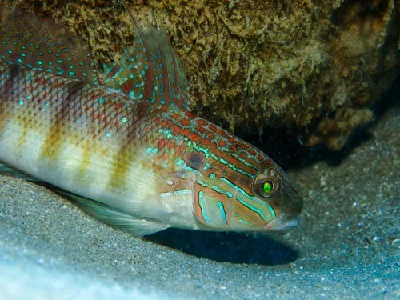
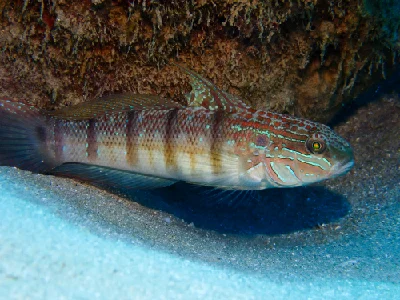
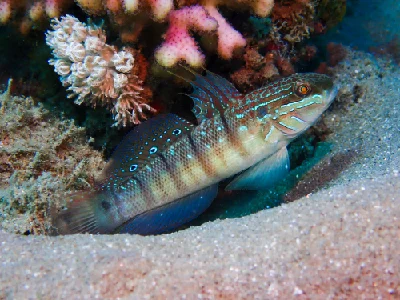
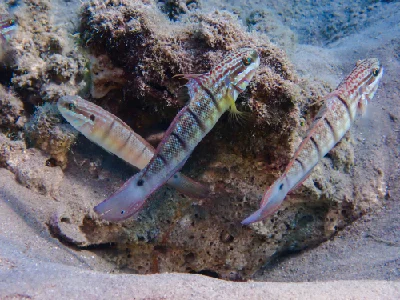
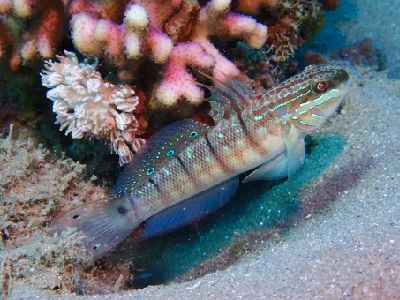
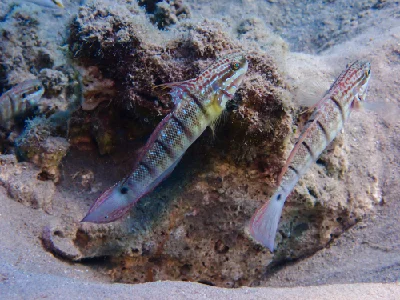
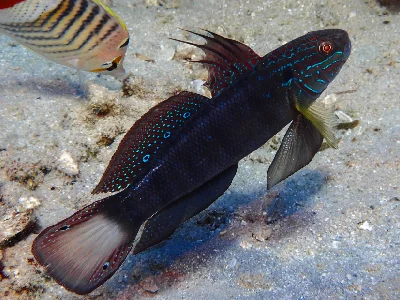
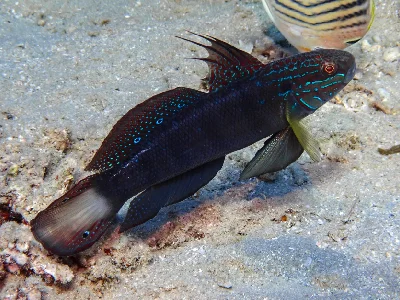
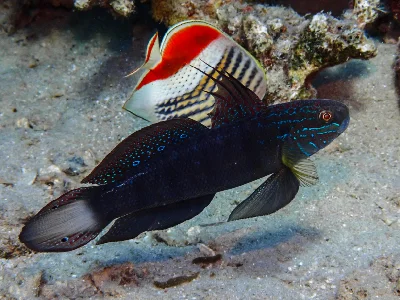
The Butterfly Goby, scientifically referred to as Amblygobius albimaculatus, is a fascinating marine fish species found in tropical waters. Preferring shallow environments, it commonly inhabits sandy and grassy areas at depths ranging from 1 to 20 meters (3 to 65 feet). This small fish can grow up to a maximum length of 18 centimeters (about 7 inches). It is typically encountered in pairs, demonstrating a monogamous social structure, and its body coloration varies to blend with its surroundings.
The Butterfly Goby feeds by filtering sand through its mouth to extract small invertebrates, a behavior that both nourishes it and contributes to the ecology of its habitat. This fish has a dorsal fin with 7 spines and 13 to 15 soft rays, and an anal fin with 1 spine and 12 to 14 soft rays. Male Butterfly Gobies can be distinguished by three distinctive black spots near the base of their second dorsal fin and round spots on their cheeks. In contrast, females have a characteristic brown-edged band extending from their upper lip to the upper part of their gill cover.
They are epibenthic and littoral, meaning they are often found in coastal and relatively shallow waters, including estuaries and lagoons. Butterfly Gobies are known to hover just above the substratum, displaying a unique behavior as they construct burrows in sandy or silty environments by moving mouthfuls of sediment.
Geographically, this species is distributed across the Indo-West Pacific region, extending from the 🌊 Red Sea and East Africa southwards to Durban in 🇿🇦 South Africa, encompassing numerous islands in the undefined, as well as locations such as 🇮🇩 Indonesia, 🇦🇺 Australia, the South Pacific islands, 🇯🇵 Japan, the 🇵🇭 Philippines, and the 🌊 Persian Gulf.
The name Amblygobius comes from the Greek word "amblys," meaning darkness, and Latin "gobius," referring to gudgeon, a type of small freshwater fish.
Why it's threatened
Threat classification from the IUCN Red List.


