Yellow-spoted puffer
Yellowspoted Puffer
Yellowspoted Puffer
Yellowspoted Puffer
Poisonous© Holger Pollmann
Bony fishes · Puffers

Yellowspoted Puffer

Torquigener flavimaculosus Hardy & Randall, 1983
syn. Torquigener flavimaculatus
16 cm3-57 mPoisonousLeast Concern
957

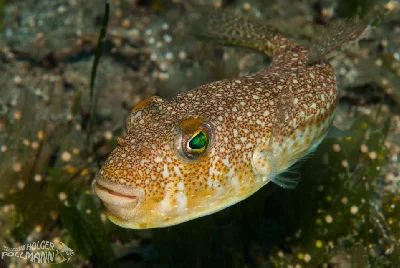
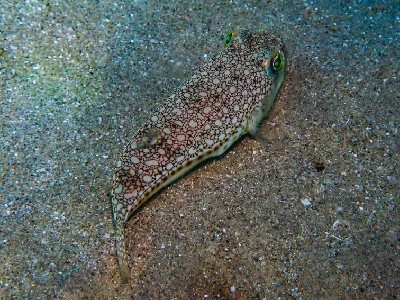
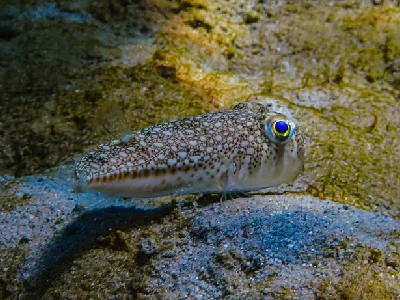
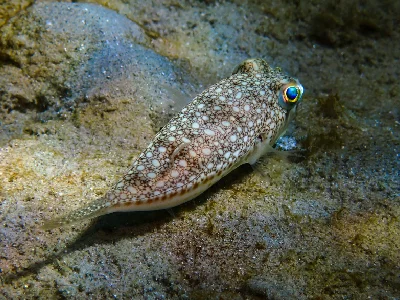
The Yellowspotted Puffer, scientifically known as Torquigener flavimaculosus, is a unique species of pufferfish recognized for its ability to rapidly inflate as a defense mechanism. This fascinating marine creature is typically found in tropical, reef-associated environments, inhabiting waters ranging from 3 to 57 meters (approximately 10 to 187 feet) in depth. It can grow up to a length of 16 centimeters (about 6.3 inches).

Geographically, the Yellowspotted Puffer is native to the 🌊 Western Indian Ocean, including areas such as the northern 🌊 Red Sea and the coast of 🇰🇪 Kenya. Notably, it has expanded its habitat to the Mediterranean Sea through migration via the Suez Canal (🇪🇬 Egypt), and it has also been observed in the 🌊 Persian Gulf and the 🇸🇨 Seychelles.

The scientific name "Torquigener" is derived from Latin, combining "torquere," meaning to twist, and "generare," meaning birth or race, highlighting the distinctive characteristics of this species.

Why it's threatened

Residential & commercial development
Housing & urban areas · Commercial & industrial areas · Tourism & recreation areas
Agriculture & aquaculture
Scale Unknown/Unrecorded · Subsistence/artisinal aquaculture · Industrial aquaculture
Pollution
Sewage · Run-off · Type Unknown/Unrecorded · Oil spills · Seepage from mining · Nutrient loads · Soil erosion, sedimentation · Herbicides and pesticides · Garbage & solid waste
Climate change & severe weather
Habitat shifting & alteration · Temperature extremes

There are no major threats known to this species. However, due to its affinity with seagrass beds and coral reefs, it may be experiencing population declines. As of 2008, fifteen percent of the world’s coral reefs were considered under imminent threat of being “Effectively Lost” (with 90% of the corals lost and unlikely to recover soon), with regions in East Africa, south and southeast Asia, and the wider Caribbean being the most highly threatened (Wilkinson et al. 2008).

Of 704 zooxanthellate reef-building coral species which were assessed by using the International Union for Conservation of Nature Red List Criteria, 32.8% are in categories with elevated risk of extinction (Carpenter et al. 2008).

One-third of global seagrass species are currently experiencing population declines, and 21% of globally assessed seagrass species are in threatened or Near Threatened categories primarily due to coastal development and pollution (Short et al. 2011).

In the Persian Gulf, T. flavimaculosus is caught as bycatch in trawls and traps (Carpenter et al. 1997).

Threat classification from the IUCN Red List.

Comments

Please, sign in to leave a comment

Continue with a social account — yours will be created automatically.

No comments yet — be the first.

Last Update: June 28, 2026