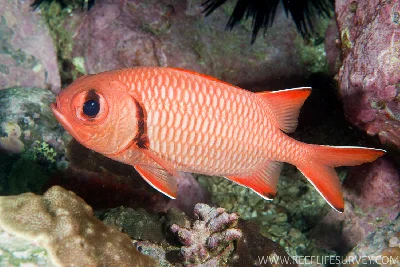
Sargocentron spiniferum, commonly known as the sabre squirrelfish, giant squirrelfish, or spiny squirrelfish, represents a prominent species within the Indo-Pacific region and is classified under the family Holocentridae.
Notably, Sargocentron spiniferum is the largest among the squirrelfish in its geographical area, achieving lengths of up to 51 cm (20 in) and weights of approximately 2.6 kg (5.7 lb). While the Atlantic species Holocentrus adscensionis may exceed this length, it is characteristically slimmer. Typically, S. spiniferum reaches a length of around 35 cm (14 in). Its body is oval and laterally compressed, featuring a head with a pointed snout and large eyes, an adaptation attributed to its predominantly nocturnal lifestyle. The species is distinguished by its bright red body with silver scale margins, a spinous dorsal fin, and a prominent deep red patch located just behind the eyes. Additionally, the lower jaw extends beyond the upper jaw, and the fish is equipped with an elongated preopercle spine near the gill opening. The anal and ventral fins display a yellowish hue, complemented by a distinctly bifid caudal fin.
Sargocentron spiniferum is widely distributed throughout the tropical Indo-Pacific, ranging from the 🌊 Red Sea and 🌊 Indian Ocean to Hawaii (🇺🇸 United States), 🇯🇵 Japan, and southern 🇦🇺 Australia. It inhabits coral reef environments in tropical waters, from shallow areas down to depths of approximately 120 meters (390 feet).
Why it's threatened
There are no known major threats to this species.
Threat classification from the IUCN Red List.