
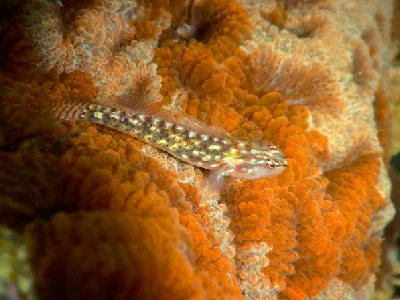
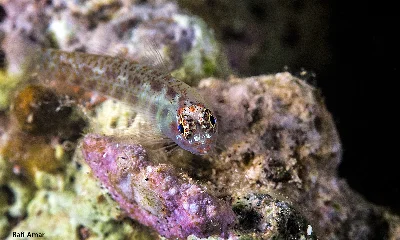
The Spotted Dwarfgoby, scientifically known as Eviota guttata, is a small tropical marine fish commonly found in shallow reef environments. It lives in depths ranging from 1 to 15 meters (approximately 3 to 49 feet), primarily in areas rich with mixed algae and coral growth. This species can reach a maximum length of 3.2 centimeters (about 1.26 inches).
Eviota guttata can be identified by its dark spot located on the underside of the head, along the isthmus, and occasionally exhibits scattered dark pigments, known as melanophores, on the lower jaw near the tip. This unique marking differentiates it from closely related species, such as Eviota albolineata, which lacks these distinct color traits.
The fish is characterized by having 6 to 7 dorsal spines, 8 to 9 dorsal soft rays, 1 anal spine, and 8 to 9 anal soft rays. The formula for its fin-rays is 9/8, which is a common trait among similar species.
Geographically, the Spotted Dwarfgoby is found in the 🌊 Indian Ocean, particularly in regions such as the 🌊 Red Sea, Gulf of Aqaba, 🌊 Gulf of Oman, 🇸🇨 Seychelles, and the 🇲🇻 Maldives. It also inhabits coastal and island areas, though records from the 🌊 Pacific Ocean are likely to be of a different but related species, Eviota cf. teresae, except for populations in 🇫🇯 Fiji, which are true E. teresae.
Why it's threatened
Threat classification from the IUCN Red List.


