
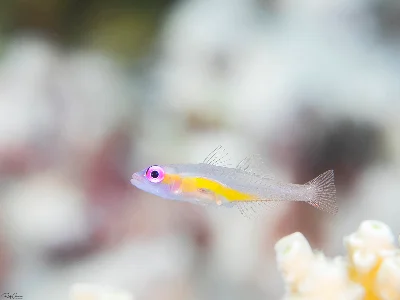
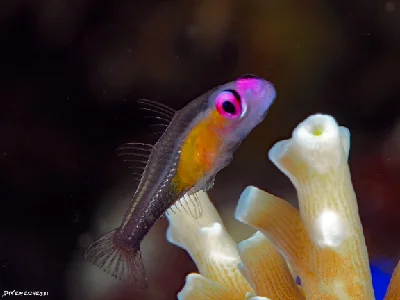
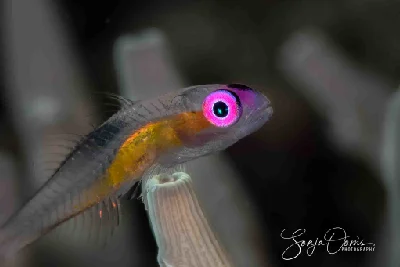
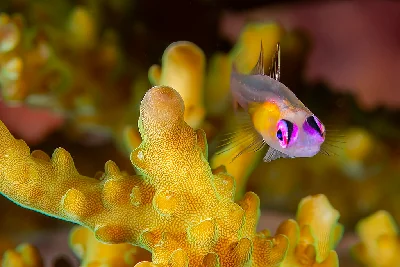
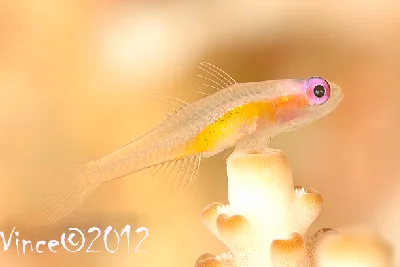
The Redeye Goby, scientifically known as Bryaninops natans, is a small marine fish found in the tropical waters of the Indo-Pacific region, including the 🌊 Red Sea. This species is part of the Gobiidae family and typically reaches a maximum length of about 2.5 cm (1 inch). It resides in reef environments at depths ranging from 7 to 27 meters (23 to 89 feet).
The Redeye Goby is characterized by a distinctive body structure and fin configuration: it has 5 to 9 dorsal spines, 7 to 9 dorsal soft rays, and a single anal spine with 8 to 9 anal soft rays. Its dorsal fins are typically structured as VI + I,7-1,9 (often I,8), while the anal fins usually feature I,8 or I,9 rays (most commonly I,9). The pectoral fins generally have 14 to 16 rays, and the body scales extend forward to just below the gap between the dorsal fins. Notably, a canine tooth is present on the side of the lower jaw. The body of the goby is compressed, with body depth at the origin of the anal fin being about 16 to 25% of the standard length, a term used in fish biology to indicate the length from the snout to the base of the tail.
The Redeye Goby is generally transparent, with yellow coloring over the abdomen, and features bright pink interorbital areas and irises. The largest known specimen measures 19.5 mm in standard length. Social in nature, these fish form groups that hover above branches of certain Acropora corals found in shallow lagoon reefs. As benthic spawners, they lay their eggs on the seafloor.
Geographically, the Redeye Goby ranges from the 🌊 Red Sea to the 🇨🇰 Cook Islands, extending north to the Ryukyu Islands (🇯🇵 Japan) and south to the northern Great Barrier Reef. They are also found in places like 🇬🇺 Guam and Kapingamarangi in 🇫🇲 Micronesia.
Why it's threatened
Threat classification from the IUCN Red List.


