
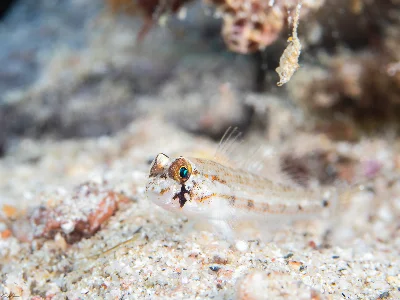
The 🌊 Red Sea Eyebar Goby, scientifically known as Gnatholepis caudimaculata, is a small fish species that inhabits tropical marine environments, typically associated with coral reefs. It can be found at depths ranging from 1 to 17 meters (approximately 3 to 56 feet). The fish reaches a maximum length of 4.3 centimeters (about 1.7 inches).
One of the goby's most striking features is its coloration. The body is predominantly whitish with a finely speckled back. It features distinctive rows of orange dots and two broad, ladder-like stripes ranging from orange to reddish that run along its body. A vertical oval blotch, which ranges from blackish to dark grey, is present across the base of the tail fin. Atop its eye is a unique curved or comma-shaped black mark. Interestingly, the fish's eye also exhibits red fluorescence, thought to function as a private communication system among its kind.
The goby is identified by its fin structure: it possesses 7 dorsal spines and 10 to 11 dorsal soft rays, a single anal spine, and 10 to 12 anal soft rays. Its side fins typically have 15 to 17 rays, with 25 to 28 scales along its lateral line and 7 to 10 predorsal scales. The scales on the head and base of the ventral fins are cycloid, and a distinct flap is present at the end of the lower lip.
This species is primarily found in the 🌊 Western Indian Ocean, specifically restricted to the 🌊 Red Sea, including areas around Ethiopia, 🇮🇱 Israel, the Gulf of Aqaba, the 🌊 Persian Gulf, and parts of 🇴🇲 Oman and 🇪🇬 Egypt. Not much is known about this species, but it has been photographed on sands ranging from white to blackish in color.
Why it's threatened
Threat classification from the IUCN Red List.


