
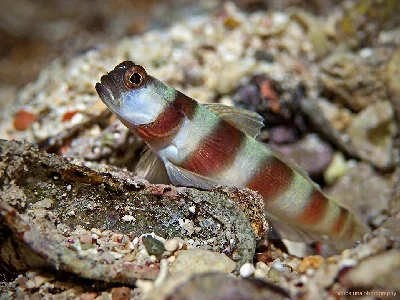
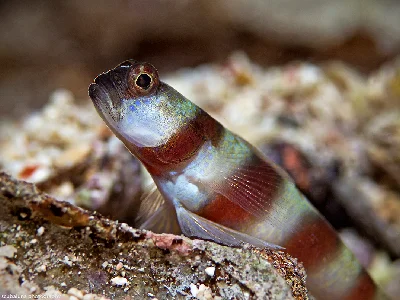
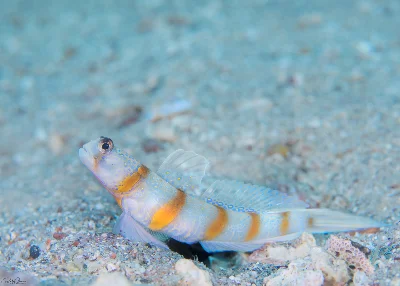
Magnus' Shrimpgoby, scientifically known as Amblyeleotris sungami, is a small tropical fish that thrives in marine reef environments. Typically reaching a maximum length of 10 cm (about 4 inches), this fish is notable for its vibrant coloration. Its body features a pattern of numerous small pale-blue spots and occasional small orange-yellow spots, all set against white spaces between distinctive orange-red bars.
The Shrimpgoby has 13 anal soft rays and a caudal fin length that measures approximately 2.25 to 2.7 times in standard length. It is often found dwelling on open sand bottoms of clear water reefs. An interesting aspect of its behavior is its symbiotic relationship with alphaeid shrimps, with which it shares burrows.
This species occupies a range within the 🌊 Western Indian Ocean, spanning from the 🌊 Red Sea to the 🇸🇨 Seychelles. It is likely that the fish has a broader distribution within the Indo-West Pacific region.
The name Amblyeleotris is derived from Greek, where "amblys" means darkness, and "eleotris" refers to a type of Nile fish. The species name "sungami" is a tribute to Professor Magnus, formed by spelling his name backwards.
Why it's threatened
Threats to this species are unknown.
Threat classification from the IUCN Red List.


